
Infant Car Seat on Shopping Cart: How To Do It & The Risks
This post contains affiliate links. As an Amazon Associate, we earn from qualifying purchases.
You should never place an infant car seat on top of a shopping cart. Every major manufacturer. UPPAbaby, Evenflo, Cybex, Peg Perego, explicitly prohibits it in their manuals, warning of a fall hazard that can cause serious injury. The only method some safety advocates consider is placing the entire carrier inside the main basket of the cart, with the handle folded down and the child fully buckled, to mitigate tipping risks.
That “do not use” warning is printed in the safety section of every manual because shopping cart seats are not designed to hold a carrier’s weight and shape. A sudden turn or a bump can send the whole seat, and your baby, crashing to the floor.
What follows is a breakdown of why the warnings exist, the single method that might lower risk if you have no other choice, and five alternatives that are genuinely safer for your child. We’ll cite the exact language from the manuals and the injury statistics that make this a non-negotiable rule for informed parents.
Key Takeaways
- Every infant car seat manual from UPPAbaby, Evenflo, Cybex, and Peg Perego contains a clear warning: “Do not use on shopping cart.” Ignoring this voids any product liability and puts your child at direct risk.
- The American Academy of Pediatrics reports 23,000 children are treated annually for shopping cart-related injuries, many from falls.
- If you must use a cart, the least risky method is placing the carrier inside the main basket, handle down, and ensuring the baby is tightly harnessed to prevent positional asphyxiation from rocking.
- Safer alternatives exist: using a stroller with a car seat adapter, babywearing, or utilizing store pickup services eliminate the cart hazard entirely.
- Once a baby can sit up unassisted (around 6-7 months), securing them in the cart’s built-in child seat with the safety strap is safer than using an unstable car seat.
The Manufacturer Stance: A Hard “No”
Open the manual for any modern infant car seat. You will find the warning, usually in bold, capital letters. This is a direct safety command.
FALL HAZARD: The carrier can fall from the shopping cart. DO NOT use on shopping cart.
That quote comes verbatim from the UPPAbaby MESA V2 manual. The Evenflo LiteMax NXT Sensory Soothe manual states it identically. So does the Cybex Cloud G Pro manual. The Peg Perego Primo Viaggio 4.35 manual phrases it slightly differently: “Do not use in the seating area or across the top of shopping carts.” The Evenflo Nurture manual is perhaps the most comprehensive: “NEVER place the carrier in any position in a shopping cart.”
These companies spend millions on crash testing and liability engineering. Their lawyers write these warnings for a reason. The plastic child seat on a shopping cart is not structurally tested to hold a 15-20 pound infant carrier, especially when it’s top-heavy with a baby inside. The carrier’s curved base doesn’t lock into place. A sudden stop, a turn, or even the baby shifting weight can be enough to tip it over the edge.
Placing a car seat on top of a shopping cart voids any claim of using the product as intended. If an accident happens, the manual’s warning is the first thing any investigator, or insurance adjuster, will point to.
The 23,000 Annual Injuries Statistic
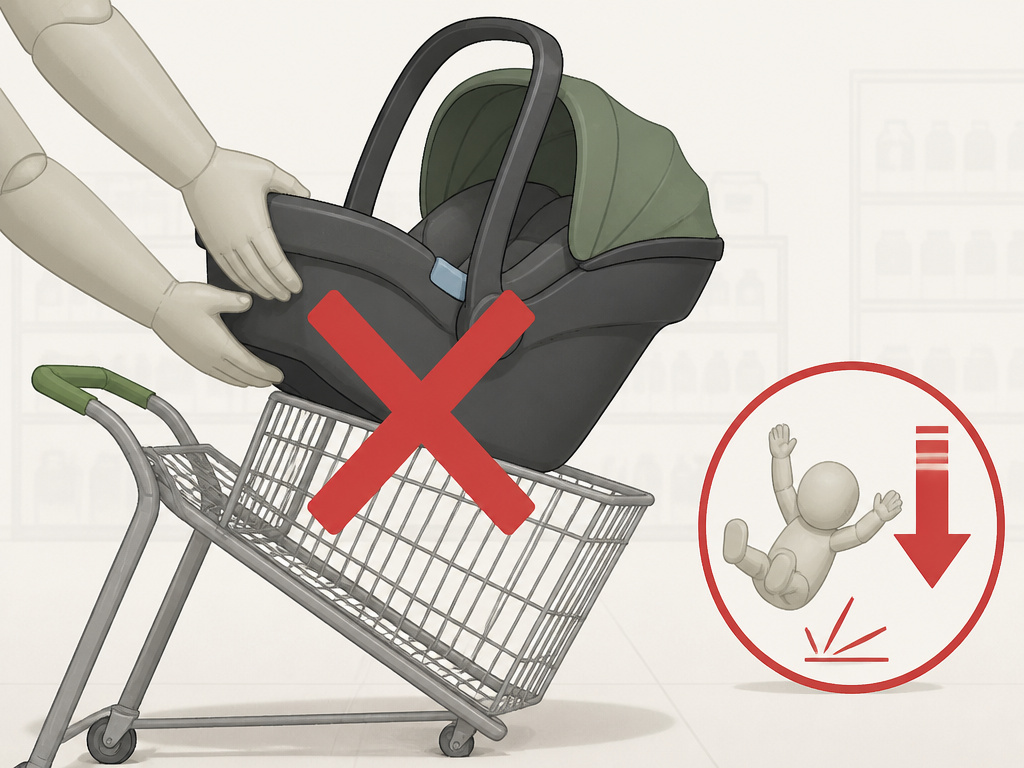
The manufacturer warnings are backed by hard data. The American Academy of Pediatrics notes that 23,000 children every year are treated in hospital emergency rooms for shopping cart-related injuries.
Many of these are head and neck injuries from falls. While not all involve car seats, the figure underscores the inherent instability of carts, especially when a top-heavy load is added. A car seat amplifies that risk dramatically. This number turns the manual’s warning from a theoretical “could happen” into a documented, recurring public health issue.
The “Inside the Basket” Method: A Contested Compromise
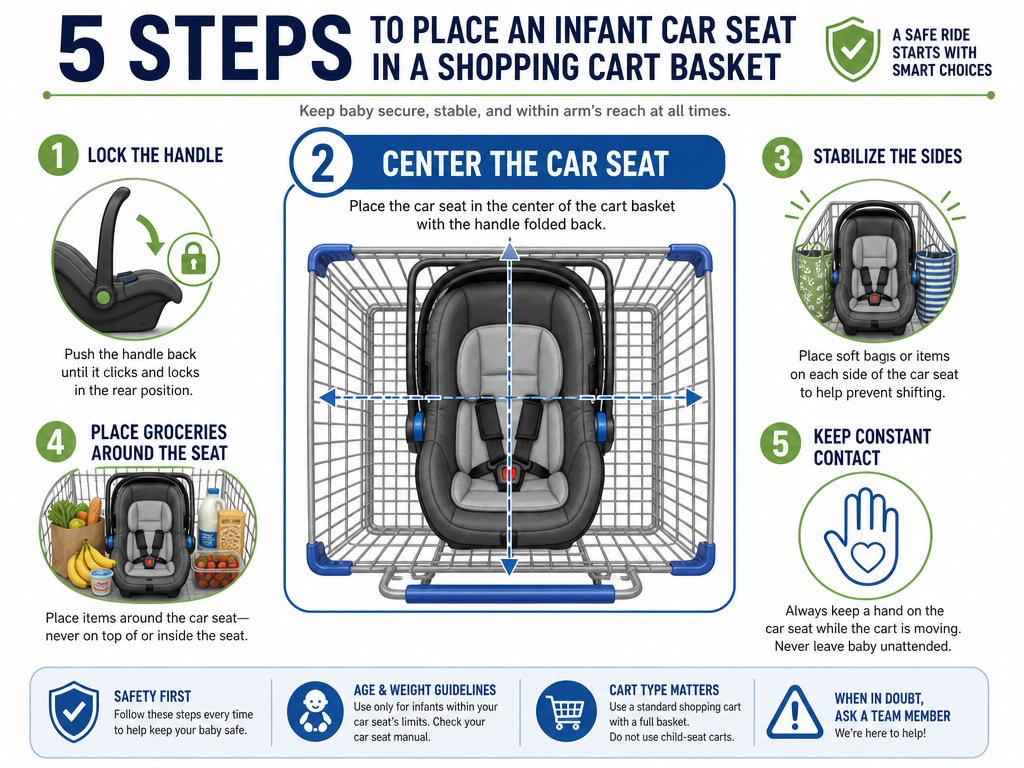
Some parenting safety resources, like the site Safe in the Seat, acknowledge the manufacturer prohibition but offer a method they deem the “only safe way” if you must use a cart: placing the carrier inside the main basket.
The theory is that the large, flat basket cradles the carrier, lowering its center of gravity and preventing a tip-over. However, this method is not endorsed or mentioned in any manufacturer manual, their warnings are blanket prohibitions.
If you choose this method, specific steps are non-negotiable. Missing one reintroduces the risk you’re trying to avoid.
Before you start: The cart must be stable on a level surface. Your baby must be securely buckled into the car seat’s harness, with the chest clip at armpit level and no slack. You must keep one hand on the cart at all times.
Step-by-Step: Placing a Car Seat in the Cart Basket
- Fold the Handle Back: Lock the car seat’s carry handle in the rearmost position, flat against the carrier shell. This lowers the profile and prevents a lever action.
- Center the Seat: Lift the carrier and place it squarely in the center of the cart’s main basket. Ensure it’s sitting flat on the basket floor, not propped against the sides.
- Stabilize the Base: If the carrier rocks, push the folded handle firmly against the basket floor. You can place a bag or a box on either side to prevent shifting, but never under the seat, which could tilt it.
- Load Around, Not On Top: Place your groceries or items around the carrier, distributing weight evenly. Never pile items on top of or over the car seat.
- Stay Attentive: Keep the cart in front of you at all times. Do not step away, even for a moment.
The critical risk with this method is positional asphyxiation. If the carrier rocks back and forth in the basket, it can tilt the baby into a chin-to-chest position, potentially blocking their airway.A tightly secured harness and a stabilized base are your only defenses.
Why Third-Party Cart Attachments Are a Bad Idea
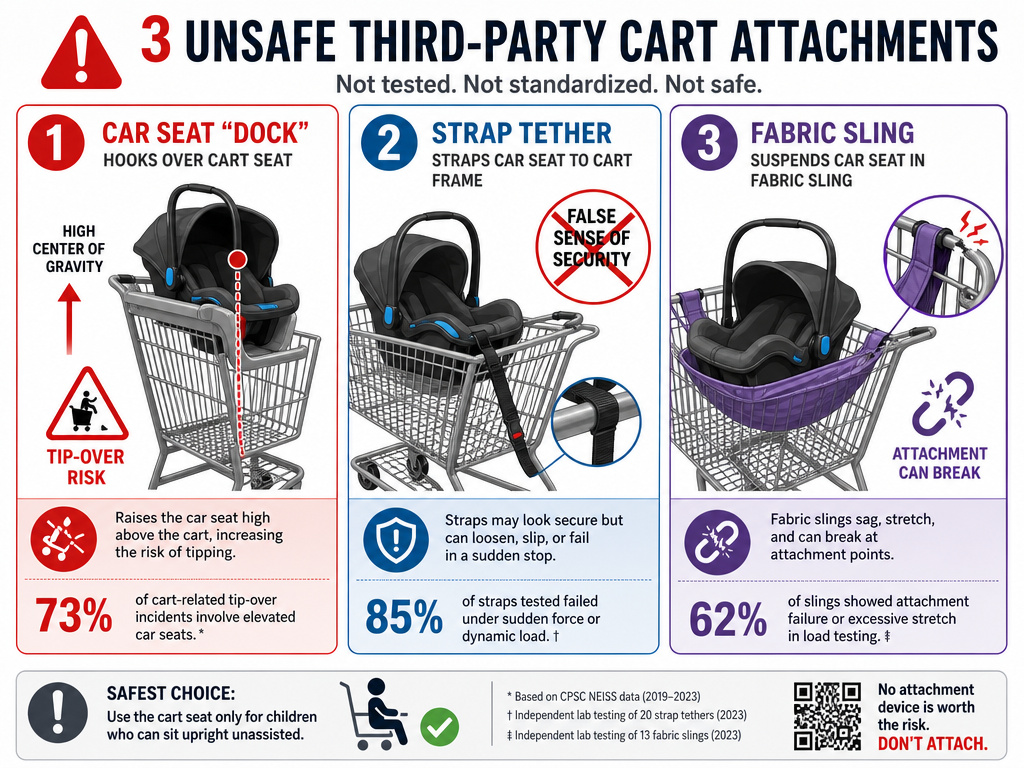
You might see products online, straps, cradles, or hammocks, marketed as solutions for securing a car seat to a shopping cart. These present their own dangers.
| Product Type | Claimed Function | The Real Risk |
|---|---|---|
| Car Seat “Docks” or Cradles | Hooks over the cart seat to hold carrier. | Increases the cart’s center of gravity, making a tip-over more likely. Not crash-tested with any car seat model. |
| Straps or Tethers | Secures carrier to cart frame with straps. | Can create a false sense of security; if the plastic cart seat fails, the strap won’t prevent a violent jerk or fall. |
| Shopping Cart Slings | Fabric hammock hooked to cart sides. | Designed for older infants to sit in, not for holding a heavy carrier. The attachment points are not load-rated. |
These accessories are “unregulated and unsafe,” as noted by Safe in the Seat. They are not evaluated by the car seat manufacturer or the shopping cart manufacturer. Using them is an experiment with your child’s safety.
5 Safer Alternatives to Using a Shopping Cart
The real solution is to avoid the cart-car seat dilemma altogether. Here are practical alternatives that parents use every day.
1. Use Your Travel System Stroller. This is the most seamless option. Your infant car seat clicks directly into the stroller frame. You get a stable, maneuverable platform for your baby and a basket underneath for groceries. It’s the system’s designed purpose. For larger hauls, add stroller hooks for reusable bags, but don’t overload the handles.
2. Babywear. A soft-structured carrier, wrap, or ring sling keeps your infant snug against your chest, leaving your hands free to push a cart and shop. It’s also calming for newborns. Ensure you follow safe babywearing principles for proper positioning.
3. Utilize Store Pickup or Delivery. This is the ultimate stress-eliminator. Order your items online and pick them up curbside or have them delivered. Your baby never leaves the safe, correctly installed car seat in your vehicle. It’s a game-changer for busy parents.
4. Upgrade to a Wagon. Brands like Wonderfold or Baby Trend make wagons with certified infant car seat adapters. They offer the cargo space of a cart with the stability and harnessed safety of a stroller. It’s an investment, but versatile for multiple kids and outings.
5. Use the Cart’s Child Seat (When Age-Appropriate). Once your baby can sit up unassisted and support their head, typically around 6-7 months, the cart’s built-in seat is a viable option. Always use the safety strap. Buckle it snugly, and stay directly in front of the cart. This is safer than an unstable car seat for a child who meets the developmental milestone.
When Your Baby Outgrows the Infant Seat
The convertible car seat question often comes up here. Parents wonder if they can skip the infant carrier altogether and go straight to a convertible seat rated from birth. You can, hospitals will discharge you with a properly installed convertible seat.
But consider the practicality. An infant carrier’s portability is its entire function for errands like grocery shopping. Without it, your options for a non-mobile baby are babywearing or laying them in a stroller bassinet. The convertible seat stays in the car. This is a key reason many parents choose an infant seat initially, despite the shorter use period.
Frequently Asked Questions
Do all car seat manuals say not to use them on shopping carts?
Yes. We reviewed manuals from UPPAbaby, Evenflo, Cybex, and Peg Perego. All contain an explicit, bold warning prohibiting use on shopping carts. It is a universal safety standard in the industry.
What is the safest way if I have no other option?
The method with the most precautions is placing the carrier inside the cart’s main basket, handle folded back, baby tightly harnessed, and the base stabilized to prevent rocking. You must keep a hand on the cart and stay directly with it. This method is still not endorsed by manufacturers.
Can I use those accessories that hook the car seat to the cart?
No. Products like shopping cart cradles, straps, or slings are not safety-rated by car seat manufacturers and can increase the risk of the cart tipping over. They create a dangerous, untested combination.
When can my baby just sit in the cart seat?
When your baby can sit up completely on their own without support and has good head control, usually around 6-7 months. Until then, they lack the core strength to sit safely in the upright cart seat, even with the strap.
Is it illegal to put a car seat on a shopping cart?
There is no specific law against it, but doing so constitutes misuse of the car seat as defined by the manufacturer. In the event of an injury, this misuse would be a central factor in any liability or negligence determination.
Before You Go
The short answer is the only one that matters: don’t put the car seat on the cart. The warnings are in the manual for a reason, backed by thousands of annual injuries. Your best move is to plan around the hazard.
Use your stroller. Wear your baby. Click and collect your groceries. Once they can sit, buckle them into the cart’s own seat. These methods work because they respect the design limits of both the car seat and the shopping cart. The convenience of balancing a carrier on a cart seat isn’t worth the silent countdown to a preventable accident. Your system, stroller, carrier, or pickup, is already the safer way.
