When Can Babies Face Forward in Car Seat? Key Requirements
This post contains affiliate links. As an Amazon Associate, we earn from qualifying purchases.
A baby can face forward in a car seat only after outgrowing the rear-facing height or weight limits set by the seat’s manufacturer, which is typically not before age 2. The decision is driven by physical fit: shoulders must be at or above the harness straps, the top of the head must be below the seat shell, and the child must meet the minimum forward-facing weight, often 22 lb (10 kg).
The “1 inch” and “22 pound” numbers are printed in your manual, but they’re just the start. The real pivot is the child’s body against the seat’s plastic shell. A forward-facing seat holds a child differently, and getting that geometry wrong is how harnesses fail to contain the torso in a side-impact.
What follows: the three specific markers that override any birthday, the regional laws that change the math, and the installation step that most parents skip even when they get the direction right.
Key Takeaways
- Size, not age, is the rule. Your car seat’s shoulder height markers and maximum rear-facing weight limit are the only valid signals.
- The harness changes jobs. In rear-facing mode, straps should be at or below the shoulders. In forward-facing, they must be at or above. This flip is non-negotiable.
- The top tether is mandatory. A forward-facing seat without its top tether strap properly anchored can allow dangerous forward head movement.
- Leg position is irrelevant. A child’s legs touching the vehicle seat back is not a safety concern and not a reason to turn them forward.
- Local law can contradict best practice. Some regions, like New South Wales, Australia, permit forward-facing earlier than major safety bodies recommend.
The Three Official Markers for Forward-Facing
Forget “around age two.” That’s a population average, not a rule for your child in your specific seat. The binding limits are printed on your car seat’s labels and in its manual. If you don’t have the manual, download it from the manufacturer’s website using your model number. Three things must be true simultaneously.
A forward-facing car seat secures a child with an internal 5-point harness and a top tether strap. The harness straps must be threaded at or just above the child’s shoulders. Proper installation requires less than 1 inch (2.5 cm) of movement at the belt path when tested side-to-side and front-to-back.
First, the child must exceed the minimum forward-facing weight. For most convertible seats, like the Graco models referenced in the manual, that’s 22 pounds (10 kg). Crucially, a child under 1 year must remain rear-facing regardless of weight. The American Academy of Pediatrics and the NHTSA car seat safety guidelines are unambiguous on this point.
Second, check the shoulder height markers. These are the little lines or slots on the seat’s shell. In rear-facing mode, the child’s shoulders must be at or below the harness strap slots you’re using. To switch to forward-facing, the shoulders must be at or above the designated forward-facing slots. If the shoulders are below that line, the harness cannot properly restrain the torso; it will ride up and potentially allow the child to submarine downward in a crash.
Third, verify the head clearance. In a rear-facing seat, the top of the child’s head must be at least 1 inch (2.5 cm) below the top of the hard seat shell. This shell contains the head in a rear-impact. When forward-facing, this rule changes to the top of the ears being below the top of the headrest. If the child has outgrown the rear-facing shell height, they have outgrown rear-facing mode in that seat.
| Marker | Rear-Facing Requirement | Forward-Facing Requirement | Risk If Ignored |
|---|---|---|---|
| Shoulder Height | At or BELOW harness slots. | At or ABOVE harness slots. | Harness fails to contain torso; increased risk of spinal injury. |
| Head Position | Top of head ≥1″ below seat shell. | Top of ears below seat headrest. | Lack of containment in rear-impact (rear-facing) or whiplash (forward-facing). |
| Weight Minimum | Meet seat’s rear-facing min/max. | Meet seat’s forward-facing minimum (often 22 lb/10 kg). | Seat’s structure not tested for crash forces at lower weights. |
The bottom line: If all three markers say “go,” you can proceed. If one says “no,” wait. A child’s birthday cake is not a manual.
Why This Timing Isn’t Arbitrary: The Crash Physics
Turning a seat forward isn’t about a better view. It’s a fundamental shift in how crash forces are managed. A rear-facing seat cradles the child, allowing the back of the seat to absorb the massive forces of a frontal crash (the most common and severe type) and distribute them across the child’s back, neck, and head.
A forward-facing seat restrains the child. The 5-point harness holds the torso, but the head and limbs are thrown forward. This places immense strain on the still-developing cervical spine. A young child’s head is proportionally larger and heavier than an adult’s, and their vertebrae are still held together by cartilage.
Where this goes sideways: Moving a child forward-facing too early, before their skeletal structure is more developed, dramatically increases the risk of internal decapitation (atlanto-occipital dislocation) in a frontal crash. This isn’t scare talk. It’s the documented mechanism in crash forensic studies.
This is the core physics behind the “rear-facing as long as possible” mantra from every safety body. A convertible car seat like the Britax One4Life, which allows rear-facing up to 50 pounds, leverages this principle to its maximum. The longer you can keep a child in the protective cocoon of rear-facing, the better. Their legs touching the back seat is irrelevant to safety.
Navigating the Gray Area: Laws, Labels, and Your Pediatrician

You’ll encounter three sources of guidance that may conflict: the law, the car seat manual, and your doctor. Here’s how to reconcile them.
Local Laws Set the Bare Minimum.
Legal minimums are just that—the lowest allowable standard. They are not optimal safety guidance. For example, NSW child car seat rules in Australia permit a child to use a forward-facing seat with a harness from 6 months old. This is legal, but it contradicts the best-practice recommendations from the NHTSA and the Royal Children’s Hospital Melbourne, which advocate for rear-facing until at least age 2. Always follow the stricter standard: your car seat’s manual overrides permissive local law.
The Pediatrician’s “Okay” Isn’t Technical Approval.
Many pediatricians give the green light at the 2-year checkup. They are assessing developmental milestones, not your specific seat’s engineering limits. It is your job as the parent to cross-reference that with the physical markers on your actual seat. A doctor cannot certify that your child fits the forward-facing shoulder height requirement.
The Manual is the Final Word.
The manufacturer’s instructions are a legal document. Failing to follow them can void warranties and, more importantly, compromise the seat’s safety certification. If the manual says your child can be 22 pounds and forward-facing, but their shoulders are still below the line, the answer is no. The manual’s limits are based on crash testing with dummies that fit those specific dimensions.
How to Install a Forward-Facing Seat Correctly (The First Time)
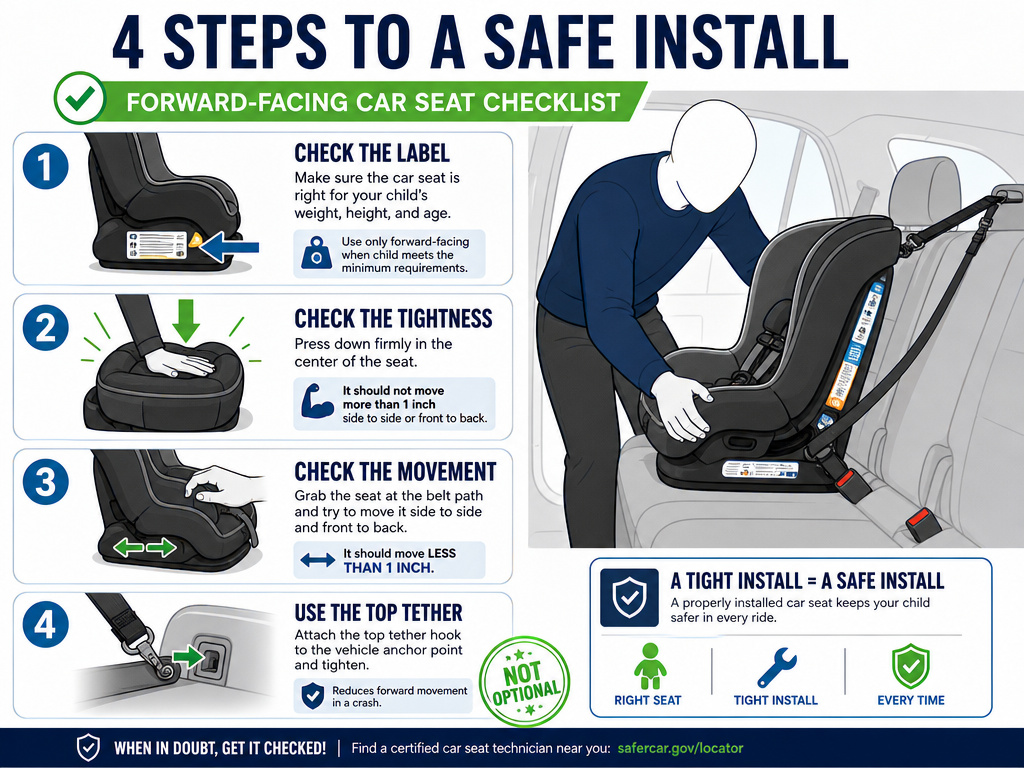
Getting the direction right is only half the battle. A poorly installed forward-facing seat is dangerous. The procedure is different from rear-facing.
- Use the Correct Belt Path. Convertible seats have two distinct belt paths: one for rear-facing, one for forward-facing. Threading the vehicle seat belt or lower anchors through the wrong one is a critical error. Check the label on the seat’s side.
- Install with Force. Use your body weight. Kneel in the seat, pressing down firmly in the center, while you tighten the vehicle belt or lower anchor strap. Remove all slack.
- Perform the 1-Inch Test. Grab the seat at the belt path (where the belt goes through it). Try to move it side-to-side and front-to-back. It should not move more than 1 inch (2.5 cm) in any direction. If it does, it’s too loose.
- Attach the Top Tether. This step is not optional. The top tether strap anchors the back of the car seat to the vehicle, limiting forward head rotation in a crash. Find your vehicle’s tether anchor (check your owner’s manual), connect the tether hook, and tighten it until snug.
Common mistake: Installing the seat tightly but forgetting the top tether. In a crash, the seat’s top can pivot forward several extra inches without it, increasing the risk of head injury.
If this feels complex, it is. That’s why seeking a certified Child Passenger Safety Technician (CPST) for a check is a wise investment. You can find one through Safe Kids Worldwide.
Common Questions and Honest Answers

My 18-month-old’s legs are bent against the seat. Isn’t that unsafe?
No. This is the most common misconception. Children are flexible and sit cross-legged or slouched comfortably. There is no evidence that leg injuries from this position are common in crashes. The risk of spinal injury from premature forward-facing is far greater. Leg room is a comfort issue, not a safety one.
I have a small car. Can’t I turn them forward to get more room?
You can, but you shouldn’t. A rear-facing car seat can often fit behind the passenger seat if that seat is moved forward. The safety trade-off is not worth the convenience. If space is critically limited, look for a convertible seat known for a compact rear-facing footprint.
What’s the next step after they outgrow the forward-facing harness?
After your child exceeds the height or weight limit of their forward-facing car seat (often 65 pounds), they move to a belt-positioning booster seat. This requires them to be mature enough to sit properly 100% of the time. The booster ensures the vehicle’s lap and shoulder belt fit correctly across the strong bones of the hips and chest.
Can I use the lower anchors and the seat belt together to install it?
Almost never. This is called “double buckling” and is prohibited by most manufacturers unless explicitly stated in the manual. It can place unexpected stress on the seat’s structure. Use either the lower anchors OR the vehicle seat belt, plus the top tether. The Graco manual notes an exception: if your child is over 40 lb (18 kg) and you cannot find weight limits for the lower anchors, you may need to use both the lower anchors and the seat belt—but you must check your specific manual.
How do I know if I’m using a convertible seat correctly?
A proper convertible seat guide starts with the manual. Ensure you’ve switched the harness strap height, rethreaded them for the new direction, and locked the recline base into the correct position (usually upright for forward-facing). The chest clip should be at armpit level, and you should not be able to pinch any vertical slack in the harness at the child’s shoulder.
Before You Go
The timeline for turning a child forward-facing is written on their body and the seat’s plastic, not on a calendar. The goal is to maximize the protective, cradling phase of rear-facing until the seat itself says stop. Then, execute the forward-facing installation with precision, anchoring the top tether every single time.
When that seat is finally outgrown, you’ll be looking for the next car seat—a high-backed booster. That’s a whole new set of rules, centered on the child’s maturity rather than just their size. For now, keep them rear-facing. And then keep them tethered. Those are the two moves that matter most.
Frequently Asked Questions
What is the absolute earliest a baby can face forward?
Legally and by manufacturer rules, the earliest is typically when they are at least 1 year old AND at least 22 pounds (10 kg) AND their shoulders are at or above the forward-facing harness line. Many convertible seats, however, have higher rear-facing limits, making 2 years or older a more realistic minimum for safety.
Why do some countries allow forward-facing earlier?
Transportation laws reflect a mix of safety science, historical precedent, and public policy. A regulation like the one in New South Wales may not have been updated to reflect the latest crash test research advocating for extended rear-facing. Always default to your car seat manufacturer’s instructions, which are based on dynamic testing.
My car seat doesn’t have clear shoulder markers. What do I do?
If the seat lacks visible lines, the rule of thumb is the harness strap height. For rear-facing, use the slot at or below the shoulders. For forward-facing, use the slot at or above the shoulders. When in doubt, contact the manufacturer’s customer service with your model number for clarification. Do not guess.
Is it safer to buy a new seat with higher limits or turn my current one forward?
If your child has outgrown the rear-facing limits of your infant seat, the safest move is to purchase a convertible car seat with high rear-facing limits (e.g., 40-50 pounds) rather than turning your current convertible forward prematurely. This extends the safest mode of travel.
