
What Does Convertible Car Seat Mean | The 70% Error Rate
This post contains affiliate links. As an Amazon Associate, we earn from qualifying purchases.
A convertible car seat is a single child restraint system designed to be used in both rear-facing and forward-facing modes, accommodating children from birth until they outgrow the harness, typically around 65 pounds. It converts to meet a growing child’s needs, eliminating the need for a separate infant-only seat. The NHTSA defines it as a seat that “converts from rear-facing for babies and smaller children to forward-facing for older and larger children.” Federal safety standard FMVSS 213 requires the seat’s shell, not a detachable base, to be capable of secure installation using both a vehicle seat belt and the LATCH system.
That definition is the starting line, not the finish. The federal standard’s wording means the shell you buy must lock down on its own. A seat that relies on a separate, non-permanent base for vehicle attachment fails compliance. This is why you’ll never see a convertible seat sold as a shell-only unit, the base must be permanently attached or the seat must have its own belt path.
What follows is the real-world translation of that rulebook: the two weight brackets that matter, the one-inch wiggle test that decides a safe install, and the manufacturer specs that override every parenting forum opinion. By the last section, you’ll be able to read any seat’s manual and know whether it fits your child, your car, and the law.
Key Takeaways
- A convertible car seat must meet federal safety standards (FMVSS 213) in both rear-facing and forward-facing modes using only the seat’s own shell and permanently attached components, detachable bases for convertibles are non-compliant.
- Rear-facing mode is for infants and toddlers, with limits typically ranging from 4-5 lbs up to 40-50 lbs. Forward-facing mode starts at a minimum of 22 lbs and at least 2 years old, per most manuals and AAP guidelines.
- The top cause of misuse is incorrect installation. The seat should not move more than 1 inch side-to-side or front-to-back at the belt path when pulled firmly.
- Always register your seat with the manufacturer using the included card. This is the only way to be notified of a safety recall, which happens more often than most parents realize.
- For premature or low-birth-weight infants (under 5 lbs or born before 37 weeks), the AAP recommends a 90 to 120-minute observation period in the seat before the first car trip to monitor for breathing difficulties.
The Two Modes Explained
A [convertible seat](https://cruisecradle.A convertible car seat is a single shell with two configurations. Its harness and internal structure are engineered to protect a child’s spine and head in opposite crash directions.In a frontal collision, the most common and severe type, a rear-facing seat cradles the child, distributing crash forces across the back of the seat. A forward-facing seat restrains the child, with the harness and tether managing the forward thrust.
The shift from one mode to the other is a concession to size, not a milestone to celebrate early.
Rear-facing is the safest position for as long as possible. The American Academy of Pediatrics and every major manufacturer state this plainly. The Chicco NextFit iX Zip Air Plus manual, for example, specifies rear-facing for children between 4 and 40 pounds, and “recommends all children ride REAR-FACING until age 2 or they reach the weight/height limits of this seat.” The shell is designed to absorb impact by compressing backward.
Common mistake: Switching to forward-facing the day your child turns two or hits the minimum weight. The manual says “at least one year old” and “22 lbs” as a legal minimum for forward-facing, but the recommendation is to max out the rear-facing limits first.
Forward-facing uses the vehicle’s top tether anchor as a critical third point of stability. This strap, attached to the back of the car seat and anchored to the vehicle’s frame, limits forward head movement in a crash by up to 6 inches. Without it, the child’s head can travel much farther, increasing the risk of head and spinal injury. The Evenflo Revolve360 Slim manual is explicit: “ALWAYS use the top tether strap on this Child Restraint when installed FORWARD-FACING, if a tether anchor is available.”
Weight, Height, and Age: The Manufacturer’s Rulebook
Forget the averages. Your only source of truth is the sticker on the side of your specific seat and its manual. These numbers are not suggestions; they are the tested limits of the seat’s engineering.
| Mode | Typical Weight Range | Typical Height Limit | Minimum Age (Per Manual) | Critical Fit Rule |
|---|---|---|---|---|
| Rear-Facing | 4–5 lbs to 40–50 lbs | Head must be ≥1 in. Below shell top | Birth (with doctor clearance for preemies) | Harness straps at or below child’s shoulders |
| Forward-Facing | 22 lbs to 65 lbs | Ears must be below top of headrest | 1 year (2 years is strongly recommended) | Harness straps at or above child’s shoulders |
The Chicco NextFit Zip manual states the seat is for children “between 5 and 65 pounds” and “49 inches or less.” The Evenflo Revolve360 Slim breaks it down further: rear-facing from 4-50 lbs and 17-48 inches, forward-facing from 22-65 lbs and 28-49 inches. These are your hard stops.
Where this goes sideways: Measuring by weight alone. A child can be under the weight limit but have their head exceed the shell height, which is equally unsafe. The 1-inch rule for rear-facing is non-negotiable.
Height is the silent limit. A child can outgrow a seat rear-facing by height long before they hit the weight limit. The manual will specify whether to measure to the top of the headrest or the top of the hard plastic shell. For forward-facing, the rule is usually that the child’s ears must not go above the top of the seat’s headrest.
The 1-Inch Rule That Decides Safety
This is the single most common installation error. After you’ve threaded the seat belt or LATCH strap and tightened it, you must check for movement at the belt path, where the belt goes through the seat frame.
Grab the seat where the vehicle belt or LATCH strap passes through it. Pull hard side-to-side and front-to-back. If the seat moves more than 1 inch in any direction, it is too loose. A loose seat becomes a projectile in a crash, multiplying the force on your child.
Most people check at the top of the seat, which can wiggle even when the belt path is rock solid. That top movement is often okay. The movement that matters is down where the seat meets the vehicle seat cushion. If you can’t get it tight, try a different seating position in your car. Some vehicle seats are sloped or slick, and a rolled towel or pool noodle under the seat (only for rear-facing, and only if the manual allows) can help achieve the correct angle.
Convertible vs. Infant-Only: The Real Trade-Off
This is the first big car seat decision. An infant carrier is a bucket-style seat that detaches from a base. A convertible is a permanent installation.
The infant carrier wins on convenience for the first 6-9 months. You can click the seat in and out of the car, carry a sleeping baby, and snap it into a stroller. Its limits are lower, usually maxing out around 30-35 pounds or 32 inches.
The convertible car seat wins on longevity and value. You buy it once and use it for years. The trade-off is that it stays in the car. There’s no carrying a sleeping baby inside in it. For parents who know they want a single seat from the start, many modern convertibles like the Graco 4Ever DLX or the Britax One4Life are rated from 4 pounds, so you can use a convertible car seat from day one with an infant insert.
The breakpoint is usually around 9 months. If your child has outgrown the infant carrier by height or weight, you switch to a convertible car seat. If you’re tired of lugging the heavy carrier, you make the switch earlier. There’s no safety penalty for using a convertible from birth, as long as the seat is rated for it and you follow the newborn positioning guidelines.
The NHTSA Compliance Rule Every Parent Misses
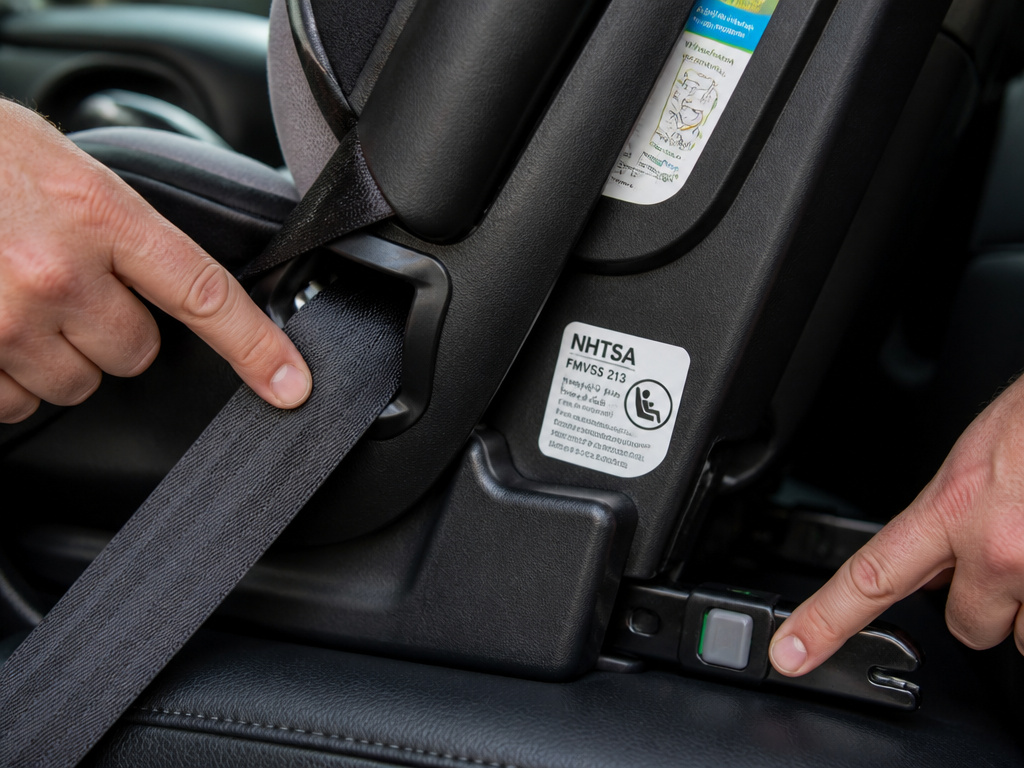 This is the non-commodity fact that reshapes the buying decision. According to an NHTSA regulatory guidance document, a convertible car seat’s shell must be capable of being installed by itself using a vehicle seat belt or LATCH. It cannot rely on a separate, detachable base for those functions.
The ruling addressed a hypothetical “Z Convertible Shell” that needed a “Z Base” to attach to the car. NHTSA stated that because the shell alone was designed to restrain a child, it was itself a Child Restraint System (CRS) under FMVSS 213. Standard S5.3.2 requires a convertible CRS to meet all safety tests when installed by a seat belt alone and by LATCH alone. A shell with no belt path fails. Therefore, a convertible seat sold with a detachable base is non-compliant.
The part nobody mentions: This is why you don’t see convertible seats with click-in bases like infant carriers. Every convertible on the market has the belt paths and LATCH connectors built directly into the shell. If you encounter a product that doesn’t, it’s not legal for sale in the U.S. As a child restraint.
This federal standard is why installation is non-negotiable. The seat in your car is the final product. The manufacturer tested that specific shell with those specific belt paths. Adding aftermarket products like seat protectors, harness strap covers not sold with the seat, or using bungee cords to secure loose items can change how the seat performs in a crash. The manual will list what is and isn’t allowed.
Installation: LATCH vs. Seat Belt
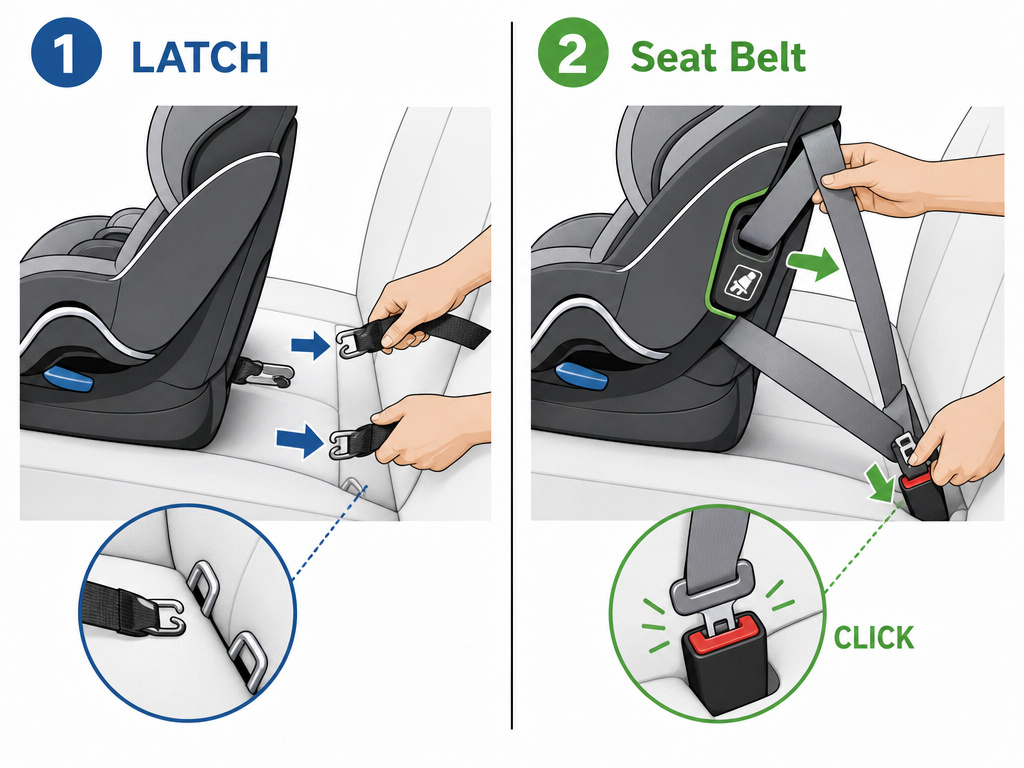 You have two approved methods. Neither is universally safer; the safer one is the one you can install correctly every time.
LATCH (Lower Anchors and Tethers for Children) is a system of metal anchors in the vehicle seat crack. It’s designed to be foolproof. You connect the seat’s lower straps to these anchors and tighten. The advantage is that it’s often easier to get a tight fit, and it’s hard to make the belt too loose. The disadvantage is a weight limit. Combined child and seat weight typically must be under 65 lbs, after which you must switch to the seat belt. Your vehicle manual states the limit.
Seat Belt is the universal fallback. It has no weight limit (the vehicle belt is engineered for adults). The challenge is locking it. Most modern cars have a switchable retractor: pull the belt all the way out and let it retract to hear it click into lock mode. Some belts require a locking clip, a small metal H-shaped piece that comes with the car seat. The manual will show you how.
The tether strap is mandatory for forward-facing. It’s that third strap at the top of the seat that hooks to an anchor in your vehicle’s rear shelf, seat back, or floor. It limits head excursion. For rear-facing, you never use the tether (unless the manual explicitly says you can, as with some European-designed seats).
The final step is the pinch test. After buckling your child in, tighten the harness until you cannot pinch any excess strap material at the child’s shoulder. If you can pinch a horizontal fold, it’s too loose.
Special Cases: Preemies, Low Birth Weight, and Recalls
 The manuals have specific, non-negotiable warnings here. They are not legal boilerplate.
For infants born before 37 weeks or weighing less than 5 pounds at birth, the Evenflo All4Stages Slim manual directs you to the AAP car seat guide for families. The AAP protocol requires a 90 to 120-minute observation period in the actual car seat before the first trip home from the hospital. Hospital staff monitors for apnea (pauses in breathing) or bradycardia (slow heart rate). This is because a semi-reclined position can compromise a preemie’s airway. You don’t guess on this. You get the clearance.
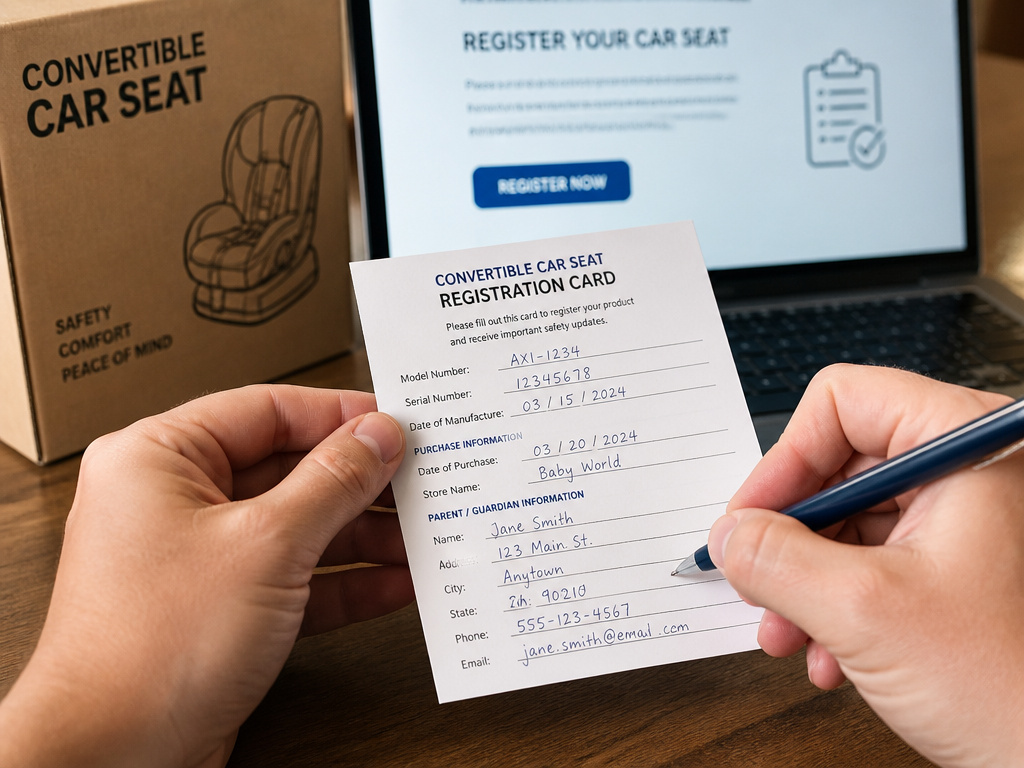
Recalls are not rare. The registration card that comes with every new seat is your direct line. Manufacturers are required to notify you if a recall is issued. If you buy secondhand, you have no way of knowing if the seat was recalled, crashed, or expired. The Chicco NextFit MAX manual states clearly: “Child Restraints could be recalled for safety reasons. You must register this restraint to be reached in a recall.” It takes two minutes online. Do it the day you unbox the seat.
Frequently Asked Questions
Can you use a convertible car seat from birth?
Yes, if the seat is rated for it. Many, like the Chicco NextFit series and the Graco 4Ever, have a starting weight of 4-5 pounds and include infant inserts. You must follow the newborn positioning guidelines in the manual, which often involve using a special head hugger and setting the harness straps at the lowest slot.
When should you turn a convertible seat forward-facing?
When your child exceeds the rear-facing height or weight limit of your specific seat, and is at least 2 years old. The 2-year mark is a strong recommendation from the AAP and most manufacturers, though the legal minimum in most manuals is 1 year. Max out the rear-facing limits first, it’s the single most effective safety step you can take.
How long can a child use a convertible car seat?
Until they exceed the forward-facing harness limits, which are typically 65 pounds and 49 inches. After that, the child will need a belt-positioning booster seat. Some “all-in-one” or “3-in-1” models convert to a booster, but many dedicated convertible seats do not.
Is LATCH or seat belt safer?
Both are equally safe when installed correctly. LATCH is often easier to get tight. The seat belt has a higher weight capacity. Choose the method that lets you achieve a secure, sub-1-inch movement install. You cannot use both systems simultaneously unless the manual explicitly allows it (some seats permit it for certain configurations).
What is the #1 mistake with convertible car seats?
Loose installation. The NHTSA convertible CRS installation study cites “high rates” of misuse, with loose installation being a primary factor. The seat should not move more than 1 inch side-to-side or front-to-back at the belt path. If it does, uninstall and try again, or seek help from a certified Child Passenger Safety Technician.
Before You Go
A convertible car seat is a long-term investment in a single shell that must perform two different jobs. Its meaning is locked in the federal safety standard FMVSS 213: it must secure a child rear-facing and forward-facing using only its own built-in hardware. Your job is to match the seat’s specs to your child’s size, install it with less than an inch of movement, and keep them rear-facing until the numbers on the sticker say stop.
The manuals from Chicco, Evenflo, and Graco define the engineering limits. The 1-inch test is a requirement.The registration card isn’t junk mail. This is the one piece of gear where “close enough” isn’t a thing. Get it tight, get it right, and leave the parenting debates for something less consequential.
