
What Is a Convertible Car Seat? The Essential Specs Guide
This post contains affiliate links. As an Amazon Associate, we earn from qualifying purchases.
A convertible car seat is a single, permanently installed child restraint designed to be used rear-facing for infants and toddlers, then converted to forward-facing for older children, typically accommodating kids from about 5 pounds up to 65 pounds or more with a 5-point harness.
The term “convertible” refers to this dual-mode function, not portability. Unlike an infant carrier with a detachable base, it stays fixed in your vehicle. Its defining specs are the child’s weight and height limits for each mode, the type of installation system (LATCH or seat belt), and whether it includes features like rotation for easier loading.
These seats exist because children outgrow infant carriers long before they’re ready for a booster. A convertible seat bridges that gap. But the numbers printed on its side aren’t just suggestions, they’re the boundaries of its certified safety performance. Misreading them is how a seat that looks fine becomes a liability in a crash.
What follows: a breakdown of the three specs that decide everything, a direct comparison to infant seats, the real data on why people get installation wrong, and a look at the one feature, rotation, that a 2024 study found significantly improves correct use.
Key Takeaways
- Convertible seats have strict, non-negotiable weight and height limits for rear-facing and forward-facing modes; exceeding them voids the seat’s safety certification.
- Field studies show 65% to 94% of all child restraints are misused, but rotating convertible models are linked to nearly 2.6 times greater odds of correct installation.
- You can’t use both the vehicle seat belt and the LATCH system simultaneously, it’s a common error that compromises the seat’s structure.
- A convertible seat is a long-term car fixture, not a portable carrier. For convenience in the first year, most parents start with an infant seat.
- After any crash, even a minor one, the seat may need replacement based on specific criteria outlined in its manual, not just visible damage.
The Core Specs That Define a Convertible Car Seat
Forget marketing terms. A convertible car seat is a piece of regulated safety equipment, and its job is defined by three numbers: weight, height, and age. These aren’t guidelines. They are the limits of the federal safety standard (FMVSS 213) under which the seat was certified.
The Evenflo Revolve360 Slim manual states a child must be at least 2 years old to use the seat forward-facing. It’s a hard rule. Use it forward-facing before that, and you’ve moved outside the tested conditions. The same logic applies to weight. The Peg Perego Primo Viaggio Convertible Kinetic has a maximum LATCH weight limit of 40 pounds rear-facing and 45 pounds forward-facing. Go over those weights while still using the lower anchors, and you’re relying on a system not rated for the load.
Height is the silent limit. A child can be under the weight maximum but too tall. The rule is usually that the child’s head must be at least 1 inch below the top of the seat shell or headrest in rear-facing mode. In forward-facing mode, the tops of the ears must be at or below the seat back. A child who outgrows the seat by height has outgrown its protection, regardless of weight.
The Revolve360 Slim MUST BE LOCKED for proper use when the vehicle is moving. This car seat is not designed to protect your child in a crash when the seat is not locked. THE ROTATED POSITION IS FOR LOADING AND UNLOADING YOUR CHILD ONLY!
Where this goes sideways: Assuming “they still fit” means the seat is safe. A three-year-old who hasn’t hit the weight limit but whose head is above the shell is not safe rear-facing. The seat can’t contain their head in a crash. You must switch to forward-facing mode if they meet the other requirements, or get a new seat.
Weight & Height Limits By Mode
This table shows how the same seat has two different sets of rules. Always check your specific model’s manual.
| Use Mode | Weight Range | Height Range | Key Requirement |
|---|---|---|---|
| Rear-Facing | 5 – 40-50 lbs (model dependent) | Typically up to 49 inches | Head must be ≥1″ below seat top. Harness at/below shoulders. |
| Forward-Facing | 22 – 65+ lbs (and at least 2 years old) | Typically 28 – 49 inches | Ears at/below seat back. Harness at/above shoulders. |
The Recaro Performance RIDE manual puts it bluntly: use only with children who weigh between 5 and 65 pounds and whose height is 49 inches or less. Outside that box, the seat hasn’t been proven to work.
Convertible vs. Infant Seat: A Side-by-Side Look
This isn’t an upgrade path. It’s a choice between a permanent fixture and a portable capsule. An infant seat (or carrier) is designed for the first year, with a handle and a base that stays in the car. You click the seat in and out. A convertible seat is installed once and stays put.
The convenience trade-off is huge. With an infant seat, you can carry a sleeping baby from the car to the house without unbuckling them. You can click it onto a compatible stroller. A convertible seat offers none of that. Your child must be unbuckled and moved every time you get out of the car. For newborns, this is the main reason parents buy an infant seat first.
But the convertible seat wins on longevity. An infant seat is outgrown quickly, often by 12 months or 35 pounds. A convertible seat purchased at birth can last 4 to 6 years. You avoid buying a second seat within a year. Some convertible seats, like the Nuna RAVA, are rated from birth all the way to booster age, making them a true one-seat solution.
The short version: Start with an infant seat if you value portability and stroller compatibility for the first year. Start with a convertible seat if you want to buy only one seat and don’t mind transferring your newborn in and out of the car every trip. For most families, the sequence is infant seat, then convertible seat.
Why Installation Error Rates Are So High (And What Helps)
A 2011 NHTSA study of 16 convertible models found inexperienced subjects could only complete all installation tasks for 9 out of 16 seats within a three-hour window. Earlier research cited in that report found an average of 2 errors per installation. This isn’t about carelessness. It’s about complexity.
The systems fight you. Vehicle seat belts have different locking mechanisms. LATCH anchors are often buried deep in the seat crack. The simultaneous use of LATCH and seatbelt is a classic mistake, it doesn’t make it safer, it stresses the seat’s plastic shell in unapproved ways.
Common mistake: Installing the seat with both LATCH and the vehicle seat belt. The two systems are not designed to work together, and the combined force can distort the seat’s frame in a crash, creating unpredictable failure points.
A 2024 study published in PubMed offers a concrete data point. Analyzing 752 real-world inspections, it found children in rotating convertible seats had 2.6 times greater odds of having the correct recline angle and 1.9 times greater odds of correct lower attachment to the vehicle compared to conventional convertible seats. The rotation feature lets you see and access the installation point easily, reducing guesswork.
The lesson isn’t that you need a rotating seat. It’s that any feature that reduces blind installation, clear belt paths, audible lock confirmations, simple angle indicators, directly translates to a higher chance of getting it right.
The Rotating Convertible: A Feature, Not a Gimmick

Rotating convertible car seats, like the Evenflo Revolve360 Slim or the Cybex Sirona S, have a base that remains installed. The seat shell swivels 90 or 180 degrees toward the door. This isn’t a safety feature in a crash. It’s a usability feature that addresses the top installation errors.
In rear-facing mode, you no longer have to climb into the footwell or contort yourself to buckle a squirming toddler. You rotate the seat to the door, place the child in, secure the harness, then rotate it back to the driving position. The PubMed study numbers suggest this practical benefit has a measurable safety outcome: fewer mistakes.
But they have trade-offs. They are often bulkier and heavier than non-rotating seats. They also have more moving parts, which means more potential points of failure or wear over time. And they command a higher price.
| Aspect | Rotating Convertible | Traditional Convertible |
|---|---|---|
| Ease of Loading | Excellent; swivels to door. | Poor; requires reaching deep into vehicle. |
| Installation Accuracy | Higher odds of correct recline & attachment (per study). | More prone to angle and tightness errors. |
| Size/Weight | Often larger and heavier. | Typically more compact. |
| Price | Premium. | Standard. |
| Best For | Parents with back issues, tight vehicle spaces, or who value convenience. | Budget-conscious buyers, smaller cars, minimalists. |
If your vehicle space is tight, a rotating seat’s larger footprint might not work. For a small car, a dedicated compact convertible car seat is often the smarter pick.
How to Know If a Convertible Seat is Done (Before a Crash Tells You)
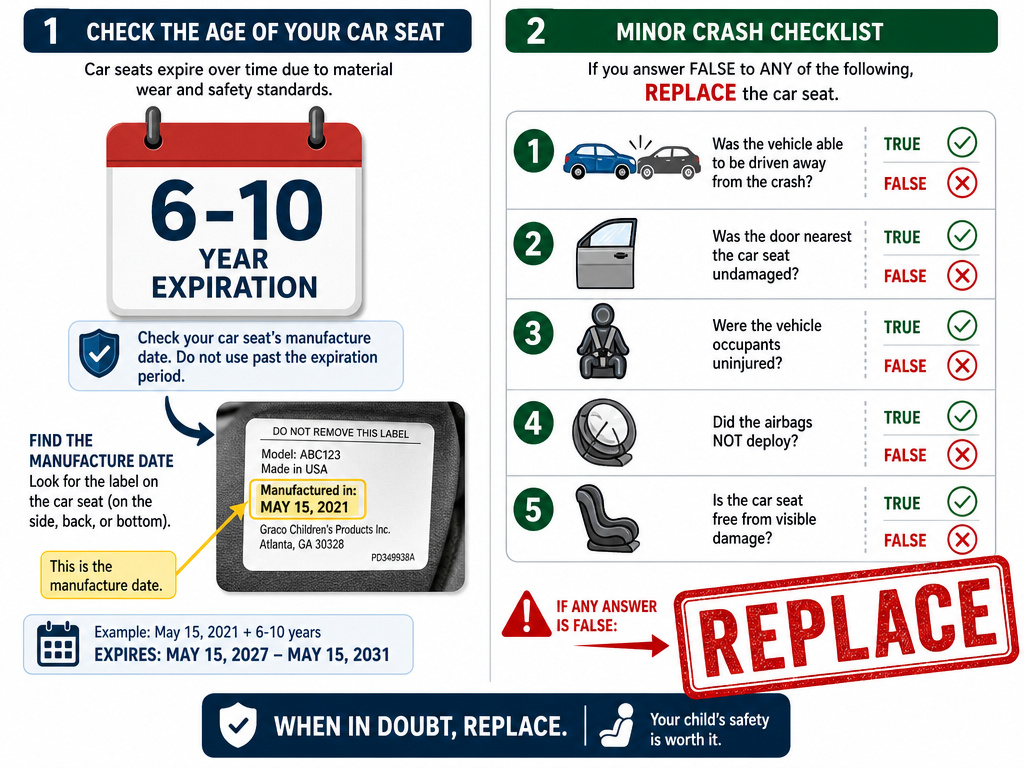
Convertible seats don’t last forever. They expire, usually 6 to 10 years from the manufacture date stamped on the seat. The plastic degrades from temperature cycles and UV exposure, becoming brittle. The Recaro manual explicitly states to discontinue use six years after the “manufactured in” date.
Then there’s crash replacement. This is not a judgment call. The Peg Perego manual provides a five-point checklist for a “minor crash.” If all apply, the seat may be reused: 1. The vehicle was drivable. 2. The door nearest the seat was not damaged. 3. No passengers were injured. 4. Airbags did not deploy. 5. No visible damage to the car seat.
If any one of those is false, the seat must be replaced. The energy-absorbing materials inside the seat are designed to work once. They may be compromised even if you see nothing wrong.
The part nobody mentions: Storage conditions matter. Both Peg Perego and Recaro manuals warn against leaving seats in direct sunlight or extreme temperatures. A seat stored in a garage through summer and winter cycles ages faster than one kept in a climate-controlled closet. Check the expiration date before buying a second-hand seat, its history is everything.
Frequently Asked Questions
Can you use a convertible car seat from birth?
Yes, most are certified for newborns as small as 5 pounds. However, many newborns are too small for the harness to fit snugly and safely. The seat’s lowest harness settings and included infant inserts are crucial. For a guaranteed good fit from day one, look specifically at convertible car seats for newborns designed with smaller infants in mind.
How long should a child stay rear-facing in a convertible seat?
The American Academy of Pediatrics recommends keeping children rear-facing as long as possible, until they reach the maximum height or weight limit of their seat for that mode. This is often until age 3 or 4. The rear-facing position is significantly safer in a frontal crash, as it cradles the head, neck, and spine.
Are convertible car seats safe for air travel?
They are FAA-approved if they bear a label stating “This restraint is certified for use in motor vehicles and aircraft.” However, they are heavy and bulky to carry through an airport. For frequent flyers, a dedicated travel convertible car seat that is lighter and easier to install with just a seat belt is worth considering.
What’s the difference between LATCH and seat belt installation?
LATCH (Lower Anchors and Tethers for Children) is a standardized system of metal anchors in the vehicle seat crack. It can be simpler to get a tight fit but has lower weight limits (usually 65 lbs combined weight of child and seat). The vehicle seat belt is stronger and has no weight limit but can be trickier to lock properly. After the LATCH weight limit, you must switch to the seat belt.
When should I switch from the infant carrier to the convertible seat?
Switch when your child exceeds the infant seat’s height or weight limit, or when the top of their head is within an inch of the carrier’s shell. For many, this happens between 9 and 15 months. Don’t rush it, the infant seat’s portability is valuable. Our guide on when to switch to convertible seat walks through the specific signs.
Before You Go
A convertible car seat isn’t just a bigger infant seat. It’s a long-term safety investment defined by hard numbers on a sticker. The weight limit, the height limit, the expiration date, these are the lines you don’t cross.
The data shows we’re bad at installing them. Leaning on resources like the NHTSA convertible CRS installation study for understanding common errors, or seeking a certified technician for a check, isn’t overkill. It’s how you bridge the gap between having a safe seat and having a seat that’s safely used.
If you take one thing, let it be this: read the manual for your specific model. The proper use of a convertible car seat isn’t intuitive. The manual for the Evenflo Revolve360 Slim, the Peg Perego Primo Viaggio, and the Recaro Performance RIDE all say different, specific things. Your seat’s story is in there, not in a generic blog post. That’s where your child’s safety lives.
