
What Car Seat After Infant Car Seat? The Key 3-Step Decision
This post contains affiliate links. As an Amazon Associate, we earn from qualifying purchases.
The car seat after an infant car seat is a convertible or all-in-one seat used rear-facing. You switch when your baby exceeds the infant seat’s height or weight limit, often before 1 year. Keep them rear-facing in the new seat until they hit its rear-facing limit, which can be age 2, 3, or older. The next stage after that is forward-facing with a harness, then a booster seat.
That “rear-facing as long as possible” clause is where most transitions go wrong. It’s not about hitting a birthday; it’s about matching a printed number on a label to your child’s actual size. The seat’s job is to distribute crash forces across the shell. A child’s spine ossifies around age 6. Before that, forward-facing lets the head whip forward on its under-developed neck tendons.
What follows: the three seat types that qualify as “next,” the exact signs your baby has outgrown the infant carrier, and how to install the new one so it doesn’t move more than an inch side-to-side. By the end, you’ll know whether a convertible, an all-in-one, or a direct jump to a booster fits your child’s current stats.
Key Takeaways
- Switch from an infant carrier when your baby’s head is within 1 inch of the shell top or they exceed the seat’s weight limit, whichever comes first.
- Your next seat must be used rear-facing until your child reaches its maximum rear-facing height or weight limit, which is often 40-50 pounds.
- A convertible car seat is the most common next step; an all-in-one seat skips the booster purchase later but is bulkier.
- Never use a secondhand seat unless you know its full history, and replace any seat involved in a moderate or severe crash.
- Proper installation means the seat base moves less than 1 inch side-to-side or front-to-back at the belt path.
How Do I Know My Child Has Outgrown the Infant Seat?
Look for two physical limits: height or weight. The weight limit is printed on a label on the seat shell, common limits are 30, 32, or 35 pounds. The height limit is trickier. Most manuals state the child has outgrown the seat when the top of their head is within one inch of the top of the hard plastic shell.
This is about containment rather than comfort. In a frontal crash, an infant seat cradles and moves with the baby.If the head can rise above the shell, there’s nothing to stop the neck from over-extending. The one-inch rule leaves a buffer for crash dynamics.
Check the weight monthly. Check the height every time you adjust the harness straps. A baby’s torso can sprout two inches in a month during a growth spurt.
Where this goes sideways: Measuring height with the carry handle up. The handle is not a structural part of the crash shell. Always measure to the top of the actual hard plastic seat back, with the handle in its stowed or driving position as per the manual.
| Outgrowing Sign | How to Check | Why It Matters |
|---|---|---|
| Weight Limit | Compare child’s weight to label on seat shell. | Exceeding the limit stresses the harness anchors and shell integrity. |
| Height Limit | Top of child’s head is <1″ from top of hard shell. | Ensures the head is contained within the protective shell in a crash. |
| Harness Straps | Shoulder straps are at or below child’s shoulders. | Rear-facing harness must be at or below shoulders to hold child down and back into seat. |
| General Fit | Child looks visibly cramped, shoulders above harness slots. | A poor fit increases risk of improper harnessing and ejection. |
The moment any one of these signs is true, the infant seat is finished. Continuing to use it compromises its tested safety performance. This is the non-negotiable trigger for your next car seat stage.
The 3 Types of “Next” Car Seats (And Which One to Pick)
You have three paths forward: a convertible seat, an all-in-one seat, or, if your child is already large, a forward-facing harness seat. Most families land on a convertible.
Convertible Car Seats are the default next step. They install rear-facing for infants and toddlers, then convert to forward-facing with a harness for preschoolers. Brands like Graco, Britax, and Chicco dominate here. * Pros: Typically fit smaller vehicles better than all-in-ones. Often have higher rear-facing weight limits (40-50 lbs) for extended rear-facing. * Cons: You will need to buy a booster seat later. * Pick this if: You drive a smaller car or sedan, and you want to maximize rear-facing time.
All-in-One Car Seats (or 3-in-1 seats) work rear-facing, forward-facing with a harness, and as a belt-positioning booster. The Chicco Fit360 is a prime example. * Pros: One purchase from infancy to booster age. Eliminates the need to shop for a subsequent car seat later. * Cons: Bulky and heavy. Can be difficult to install rear-facing in compact cars. The booster mode may not fit older children as well as a dedicated booster. * Pick this if: You have a larger vehicle (SUV, minivan) and want the long-term simplicity of one seat.
Forward-Facing Harness Seats are a less common next step. These are not convertibles; they are designed only for forward-facing use with an internal harness. Your child must meet the minimum requirements, usually at least one year old AND at least 22 pounds. * Pros: Often simpler, lighter designs. * Cons: You forfeit the safety benefit of extended rear-facing. It’s a single-stage seat. * Pick this if: Your child has completely outgrown the rear-facing limits of a convertible seat but isn’t ready for a booster.
The best car seat for most families is a convertible seat. It offers the best balance of size, extended rear-facing limits, and cost. An all-in-one is a close second if space isn’t an issue.
Why “Rear-Facing As Long As Possible” Isn’t Just a Slogan
The American Academy of Pediatrics and the NHTSA car seat safety guidelines stress this because the physics are unambiguous. In a frontal crash, the most severe and common type, a rear-facing seat cradles the child’s head, neck, and back, spreading crash forces across the entire shell. A forward-facing seat restrains the body at the shoulders and hips, letting the head jerk forward inches on a still- developing neck.
The transition is defined by the seat’s engineering limits, not age. A convertible seat like the Graco Extend2Fit has a rear-facing limit of 50 pounds.A 4-year-old who weighs 38 pounds is safer rear-facing in that seat than forward-facing. The bone structure matters more than the calendar.
I hear the argument that kids’ legs get cramped. It’s a trade-off. A broken leg is treatable. A spinal cord injury is not. Children cross their legs, dangle them over the sides, or prop them on the vehicle seat. They figure it out.
The switch to forward-facing happens only after the child exceeds the rear-facing height or weight limit of their convertible seat. That’s the line. Not their second birthday, not their preschool enrollment. The number on the seat’s label.
The Chicco Fit360 Specs Show How Limits Work
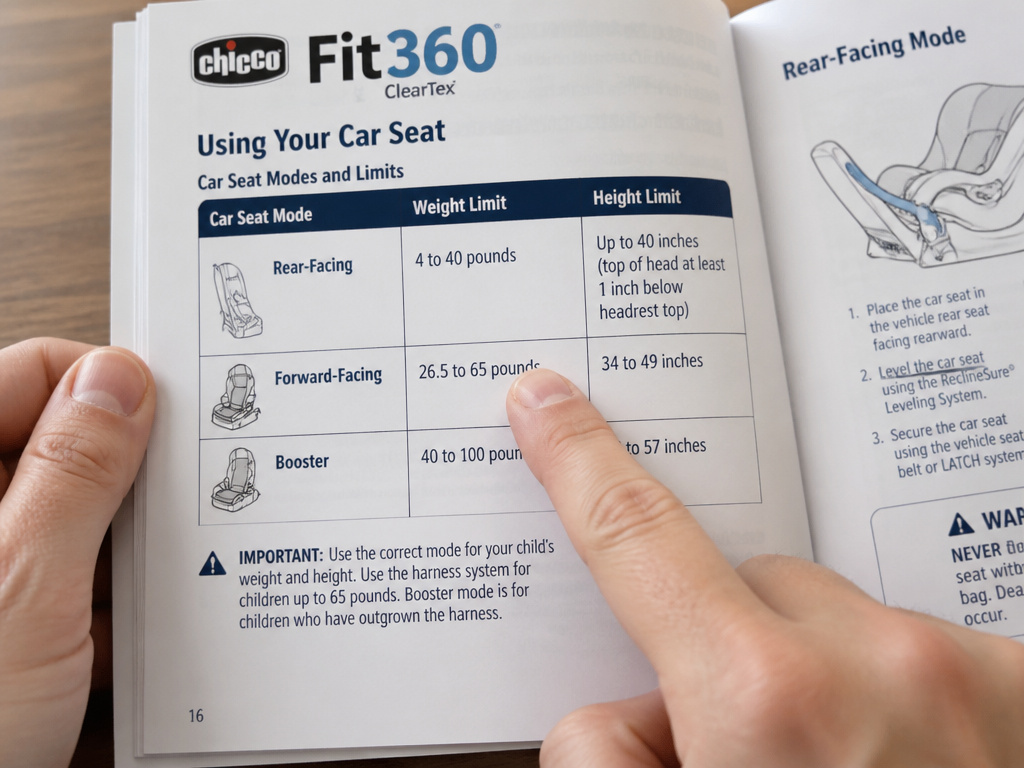
Real numbers cut through the confusion. The Chicco Fit360 all-in-one seat has these published limits from its manual: * Rear-Facing: 4 to 40 pounds. * Forward-Facing (with harness): 26.5 to 65 pounds, AND at least one year old. * Booster Mode: 40 to 110 pounds. * Overall Height Limit: 49 inches.
This means a child who weighs 26 pounds at 18 months old must still ride rear-facing. They haven’t hit the 40-pound rear-facing limit. They can only move forward-facing once they are over one year AND over 26.5 pounds. The “and” is critical.
These limits are the mandatory boundaries of the seat’s certified testing. Using it outside those parameters means its performance in a crash is unknown.This is the concrete data you use to plan your car seat progression.
The 5-Step Installation Check (The 1-Inch Rule)
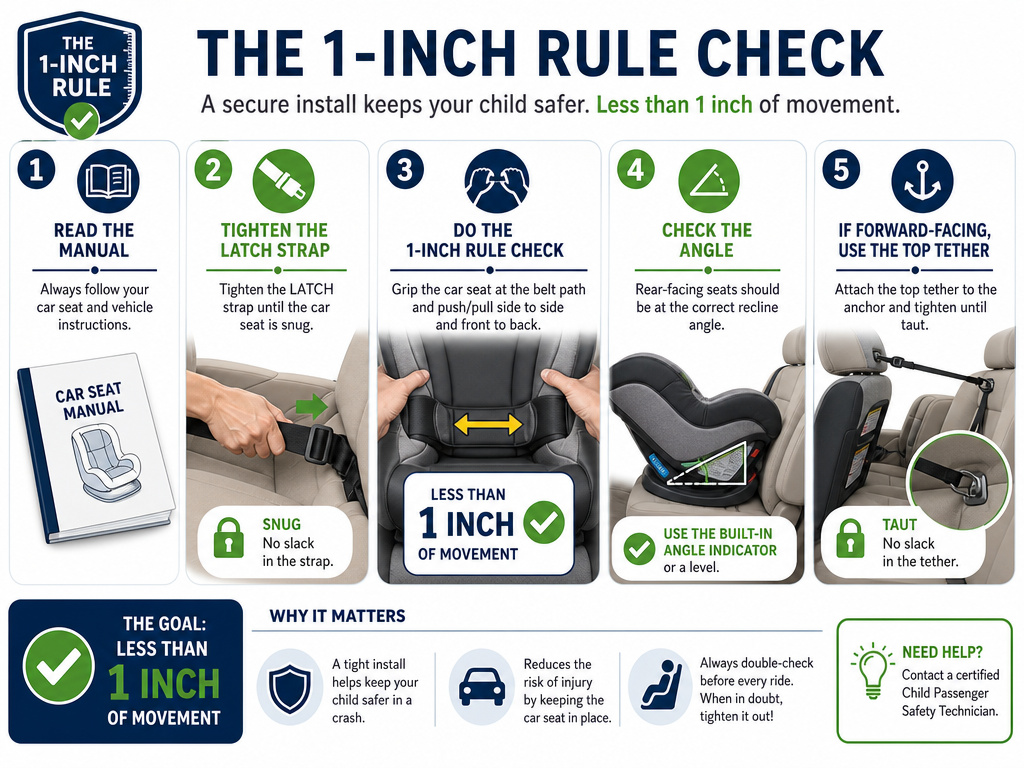
A perfect seat is useless if it’s loose. Installation errors are the single biggest point of failure. A 2012 Canadian peer-reviewed child car seat study found incorrect use rates as high as 70%.
Follow this check every time you install a seat or your vehicle changes. 1. Install per manual. Use either the vehicle seat belt OR the LATCH system, not both simultaneously unless the manual specifically allows it. Thread the belt or LATCH strap through the correct belt path for the mode (rear or forward-facing). 2. Get it tight. Put your weight into the seat and tighten the belt or LATCH strap. You should not be able to pinch any slack in the strap at the belt path. 3. The 1-inch test. Grab the seat at the belt path (where the seat belt or LATCH strap goes through the car seat). Pull and push hard side-to-side and front-to-back. It should not move more than one inch in any direction. 4. Recline angle. For rear-facing, use the built-in angle indicator or level. The correct angle keeps an infant’s head from flopping forward. 5. Tether it. For all forward-facing seats, attach the top tether strap to the vehicle’s tether anchor. This reduces forward head movement in a crash by up to 6 inches.
Common mistake: Installing the seat in the vehicle’s front passenger seat with an active airbag. The back seat is always safer. If you have only one row, you must get the airbag professionally deactivated.
If the seat fails the one-inch test, uninstall it and start over. Often the issue is a twisted belt or a seat belt retractor that needs to be switched to locking mode. Your vehicle owner’s manual explains how to lock its seat belts.
What About a Booster Seat Now?
Probably not. A booster seat is for children who have outgrown the forward-facing harness limits of their convertible or all-in-one seat. This is typically around 65 pounds or 49 inches tall. The booster’s job is to position the vehicle’s adult seat belt correctly across the child’s body.
A child must meet five criteria to ride safely in a booster: 1. Exceeds the forward-facing harness limit of their current seat. 2. Is at least 4 years old. 3. Can sit against the vehicle seat back with knees bent at the edge for the entire ride. 4. Keeps the seat belt properly positioned (lap belt low on hips, shoulder belt across chest) without slouching or playing with it. 5. Mature enough to not unbuckle themselves while driving.
Jumping from an infant carrier directly to a booster seat is a severe mismatch. There is no internal harness to manage crash forces. The seat belt alone will not properly restrain a toddler’s body, leading to high risks of abdominal injury and ejection. This is the progression: infant seat → rear-facing convertible → forward-facing harness → booster. Don’t skip steps.
When to Buy Used, When to Buy New
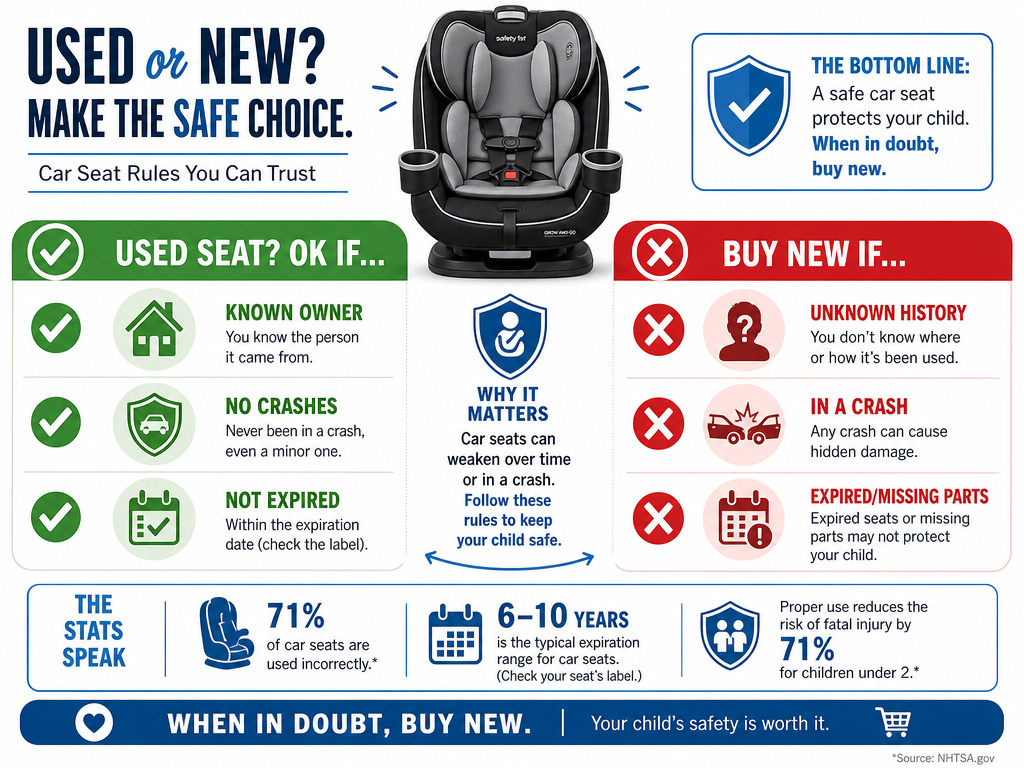
The cost of a new seat gives many parents pause. The AAP car seat information for families strongly recommends buying new. Here’s when a used seat is an acceptable risk, and when it’s a hard no.
You may consider a used seat if:
- You know the previous owner personally and trust them completely.
- You have the complete original manual and all parts.
- You can verify the seat has never been in any crash.
- The seat is not expired and has no visible damage, cracks, or frayed straps.
- It has not been recalled (check the NHTSA website by model number).
You must buy a new seat if:
- The seat is from a thrift store, online marketplace, or garage sale.
- Its history is unknown (“my cousin’s friend used it”).
- It was involved in any crash, even a minor fender-bender.
- It is past its expiration date (usually 6-10 years from manufacture, stamped on the shell).
- Any part is missing, including the manual.
The expiration date exists because plastics degrade with temperature cycles, and safety standards evolve. A seat from 2015 lacks the side-impact protection and improved belt paths of a 2025 model. For your child’s primary seat, new is best. A used seat as a spare for grandpa’s car, if it passes every condition above, is a calculated risk you can make.
Frequently Asked Questions
Can I just turn my infant seat forward-facing?
No. Infant-only car seats are certified for rear-facing use only. They lack the internal structure, different belt paths, and tether straps required for safe forward-facing installation. You must move to a seat designed for forward-facing use.
My 18-month-old is tall. Do they still need to be rear-facing?
Yes. Height is the limiting factor for rear-facing, not age. Keep them rear-facing until they reach the height limit of their convertible seat. Their long legs are not a safety risk; a forward-facing posture for their spine is.
What is the difference between LATCH and seat belt installation?
LATCH (Lower Anchors and Tethers for Children) is a system of built-in metal anchors in your vehicle. It can be easier to get a tight install than with a seat belt. Both methods are equally safe when installed correctly. Use whichever gives you a rock-solid, less-than-1-inch movement install. Note that LATCH has a combined weight limit for child plus seat (often 65 lbs); after that, you must switch to the seat belt.
How long can my child use a convertible seat?
It depends on the seat’s limits and your child’s growth. A typical convertible seat can be used rear-facing from 4-40 lbs, then forward-facing with a harness from 20-65 lbs. Many children use the same convertible seat from infancy until they are ready for a booster around age 5-7.
Do I need to replace my car seat after a minor crash?
Follow the NHTSA’s guideline. A minor crash is one where the vehicle could be driven away, the door nearest the seat was not damaged, no one was injured, airbags did not deploy, and there is no visible damage to the seat. In that specific case, you may continue to use the seat. In any other crash, moderate or severe, you must replace it, even if it looks fine. Internal stress fractures can be invisible.
Before You Go
The move from an infant carrier is your first major car seat transition. It sets the pattern for every switch that follows. Anchor your decision in the numbers printed on the seat’s label, not in milestones or comparisons. Get a convertible seat, install it rear-facing tighter than you think is necessary, and leave it that way until your child’s height or weight forces a change. That’s the sequence. Everything else is just noise on the way to the parking lot.
