What’s the Next Car Seat After Infant? Your Complete Guide
This post contains affiliate links. As an Amazon Associate, we earn from qualifying purchases.
The next car seat after an infant carrier is a rear-facing convertible seat. Your child will use it rear-facing until they outgrow the seat’s rear-facing limits, then forward-facing with its harness, before finally moving to a booster seat. This three-stage progression, infant, convertible, booster, is dictated by your child’s height and weight, not their age.
The height and weight limits printed on your seat’s label are the only numbers that matter. Ignore them, and you move your child too early. Follow them, and you keep them in the safest configuration at each stage.
What follows is the three-stage map. We’ll cover the specific limits that trigger each change, the physical signs your child has outgrown their current setup, and the one common mistake that cuts safety margins in half.
Key Takeaways
- The immediate next seat is a convertible, used rear-facing until your child maxes out the seat’s rear-facing height or weight limit, often 40-50 pounds.
- Transition is driven by height and weight, not age. The top of the child’s head must be at least 1 inch below the top of the infant carrier’s shell.
- Keep your child rear-facing until at least age 2, and ideally longer. State laws and the i-Size standard (15 months minimum) are floors, not ceilings.
- The final stage before a seat belt is a booster seat, which requires the child to be mature enough to sit properly 100% of the time.
- Always consult your specific car seat’s manual for its exact limits, as they vary by model.
The 3-Stage Progression (Infant → Convertible → Booster)
Most parents think “what’s next?” means finding a single replacement seat. That’s wrong. You’re managing a progression with three distinct phases, and the first phase has two parts. The next car seat is just the beginning.
The safest path keeps a child in a rear-facing position for as long as the seat allows, then in a forward-facing harness until the harness is outgrown, and finally in a booster seat until the vehicle’s seat belt fits properly across the lap and shoulder.
Here is the complete sequence, with the governing limits for each jump.
| Stage | Key Configuration | Primary Trigger to Move On | Risks of Moving Too Early |
|---|---|---|---|
| 1. Infant Carrier | Rear-facing only | Head within 1″ of shell top OR exceeds weight limit (often 30-35 lbs) | Spinal injury in crash; poor harness fit |
| 2. Convertible Seat | Phase A: Rear-facing | Exceeds seat’s rear-facing height/weight limit | Same as above; forfeits 5x safer rear-facing position |
| Phase B: Forward-facing (with harness) | Exceeds seat’s forward-facing harness limit (shoulders above top slots) | Internal injury from seat belt; ejection risk | |
| 3. Booster Seat | Uses vehicle seat belt | Child can pass the 5-step seat belt fit test | Belt rides on abdomen/neck; increased injury risk in crash |
The move from an infant carrier into a convertible is the first link in this chain. It is not a standalone event. Getting it right sets the timeline for everything that follows.
Where this goes sideways: Assuming a one-year birthday is the automatic switch date. Age is a legal minimum, not an engineering limit. A 12-month-old who still fits their infant seat by height and weight is safer staying in it rear-facing than moving to a convertible prematurely.
Convertible Seats: The Default Next Step
A convertible car seat is designed to be used both rear-facing and, later, forward-facing. It is the workhorse seat that covers the longest span of time, from infancy through the toddler years and often into early childhood. When people ask for the next stage car seat, this is what they mean.
The Chicco Fit360, for example, is rated for children from 4 to 65 pounds and up to 49 inches tall. It accommodates the entire convertible phase. The Joie Saffron covers an even broader range from 4 to 120 pounds, functioning as a convertible and then a booster.
Common mistake: Installing a convertible seat forward-facing for a child under 2 years old. The NHTSA and AAP are unambiguous: rear-facing is dramatically safer for young children. The force of a crash is distributed across the child’s entire back in a rear-facing seat; forward-facing, that force is focused on the harness straps, which can lead to internal deceleration injuries.
The decision point comes when your child outgrows the infant carrier. You have two choices: a dedicated convertible seat or an all-in-one seat. A convertible is the default, sensible pick for most families. An all-in-one seat adds a built-in booster function for later, but it’s often bulkier and can be harder to install correctly in smaller vehicles.
Why rear-facing is non-negotiable for toddlers: In a frontal crash, the most severe and common type, a rear-facing seat cradles the child’s head, neck, and spine, allowing the seat shell to absorb the crash forces. A forward-facing seat restrains the body, but the head is thrown forward, putting immense strain on the undeveloped neck. This isn’t opinion. It’s basic physics confirmed by decades of crash data.
When to Make the Switch from an Infant Seat
You move when the seat’s limits tell you to move. Not when Grandma says he looks cramped. Not when the bucket carrier gets heavy. The manual holds the only valid answers.
The two universal outgrowing criteria are: 1. Height: The top of the child’s head is less than 1 inch from the top of the infant carrier’s hard shell. 2. Weight: The child’s weight exceeds the seat’s maximum rear-facing limit, which is typically 30, 32, or 35 pounds.
Manufacturer specifications are precise. The Evenflo Triumph manual states a child must be moved from rear-facing mode when they exceed 40 pounds or when the top of their head is less than 1 inch below the seat back. These are “or” conditions, meeting either one demands a change.
The 1-inch headroom rule exists for a reason. In a crash, the seat shell deflects backward. If the child’s head is already at the top, it can make contact with the vehicle seat, resulting in head trauma. That inch is a crash buffer, not a comfort suggestion.
Other signs are secondary but worth noting: * The child’s shoulders are at or above the top harness slots. * The harness buckle tongue is difficult to fasten between the child’s legs.
If you see any of these signs, check the manual. Then start shopping for a convertible car seat. The transition has begun.
Why the Rear-Facing Mandate Lasts Years, Not Months
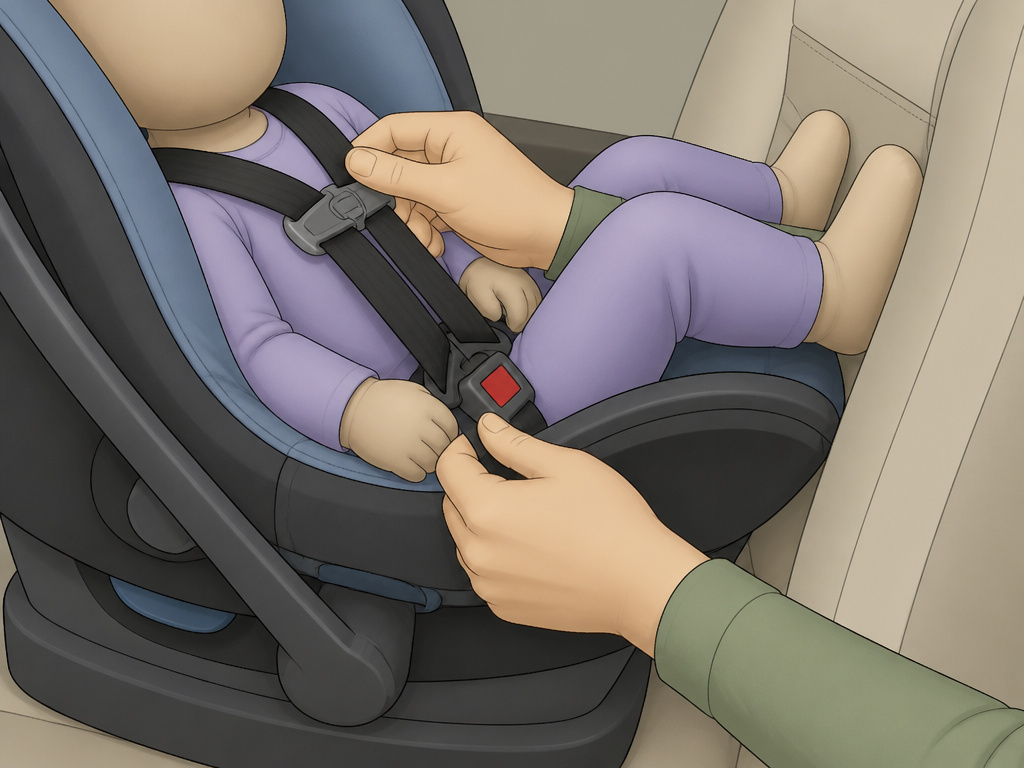 The American Academy of Pediatrics and the NHTSA car seat safety guidelines recommend keeping children rear-facing until at least age 2. This is a baseline. The gold standard is to keep them rear-facing until they hit the height or weight limit of their convertible seat, which, for many seats, can be age 3 or 4.
The science is settled. A 2007 study in the journal Injury Prevention found children under 2 are 75% less likely to die or be severely injured in a crash if they are rear-facing. The European i-Size standard (UN R129) codifies this by legally requiring rear-facing travel until a child is at least 15 months old.
I hear parents worry about legroom. They see a toddler’s legs bent or pressed against the vehicle seat back and think it’s uncomfortable or unsafe. It’s not. Children are flexible and find comfortable positions. A broken leg is fixable; a spinal cord injury is not. The safety trade-off isn’t even close.
Your state law might mandate rear-facing until age 2. Treat that law as the absolute minimum. The seat’s manual will give you the real, often higher, limit. The Chicco Fit360 allows rear-facing up to 40 pounds. The Joie Saffron goes to 50 pounds. Use every pound and inch.
The part nobody mentions: The move to forward-facing is a significant drop in safety margin. You switch because you have to, not because you want to. Maximize the rear-facing phase.
Choosing Your Next Seat: Convertible vs. All-in-One
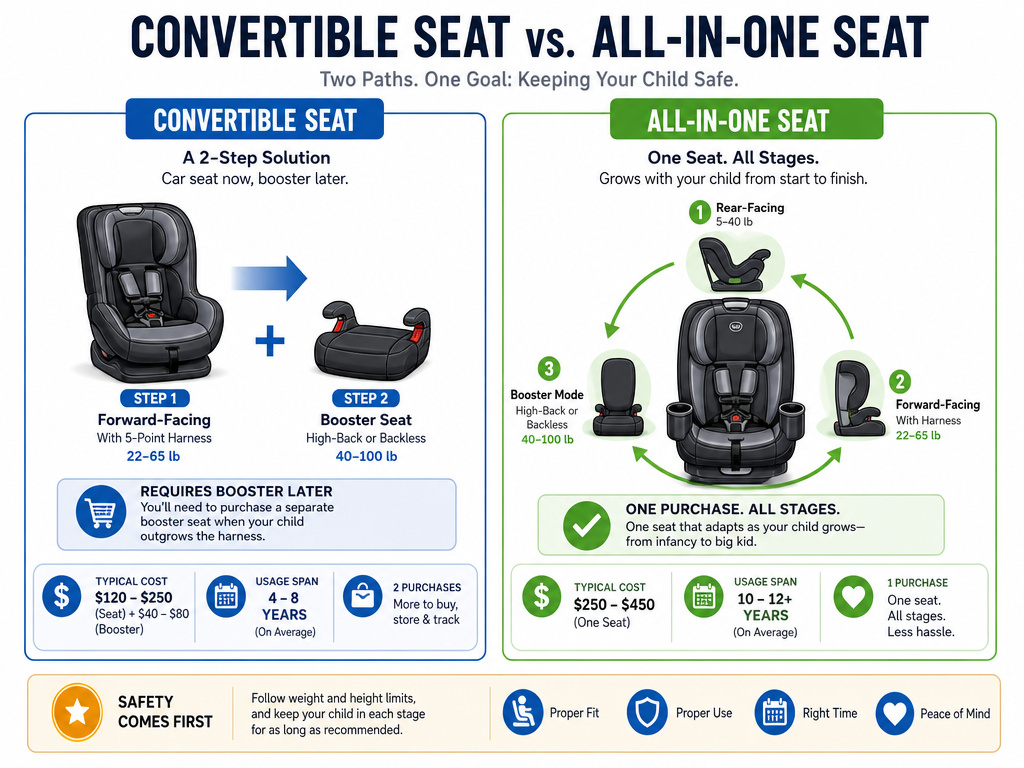 Once you know a change is due, you face a purchase decision. The core choice is between a convertible seat and an all-in-one seat. Both work as the appropriate stage after an infant carrier, but they diverge in longevity and convenience.
A convertible seat (like the Graco 4Ever DLX or the Britax Boulevard) transitions from rear-facing to forward-facing with a harness. It does not become a booster. You will need a separate booster seat later. * Pros: Often lighter, easier to install, and may fit smaller vehicles better. Dedicated design can mean better performance in its specific modes. * Cons: Requires a second purchase (a booster) down the line.
An all-in-one seat (like the Joie Saffron or the Cosco Finale) transitions from rear-facing to forward-facing with a harness, and then converts into a high-back and backless booster. * Pros: One purchase covers from birth to seat-belt readiness. Cost-effective over the long term. * Cons: Bulky and heavy. Can be difficult to get a secure install in some cars. The booster function may not fit every child as well as a dedicated booster.
Which is the best car seat for you? If you drive a smaller car or want the simplest installation, a convertible is the reliable pick. If you have a larger vehicle and want to avoid another big purchase in 4-5 years, an all-in-one is a valid investment.
Skip the extended warranty. The seat will expire (usually after 7-10 years) before its mechanics fail from regular use. That money is better spent on a quality install check.
The Final Stage: Booster Seat Readiness
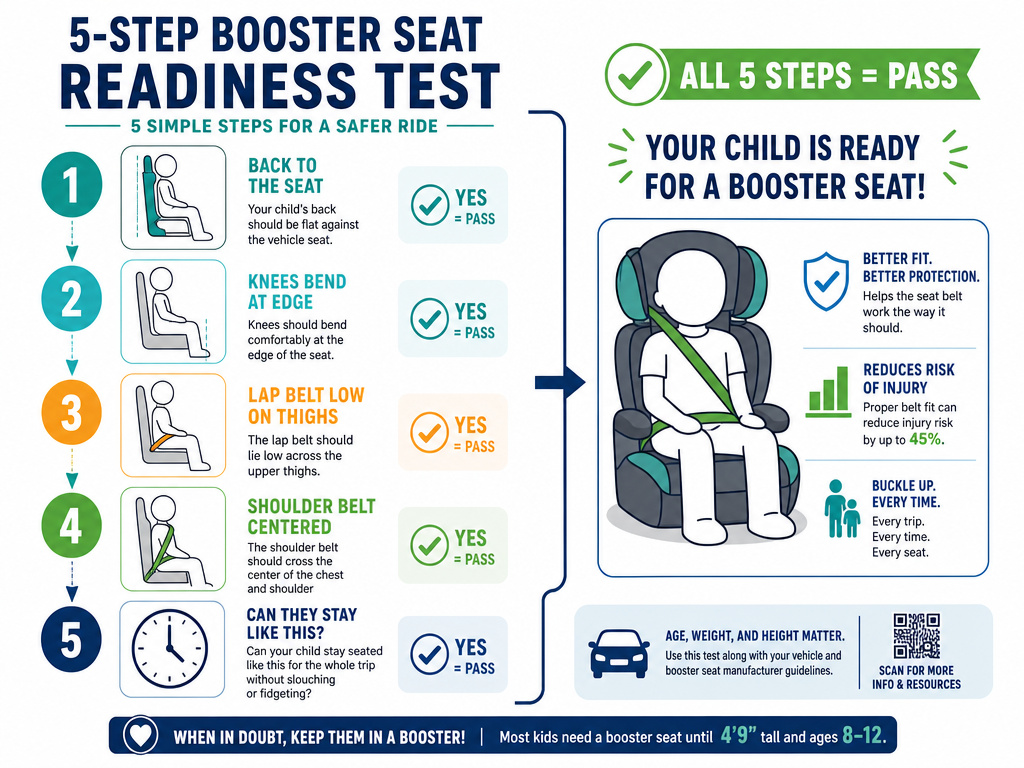 The convertible seat’s forward-facing harness mode has an end date, too. Your child outgrows it when their shoulders rise above the top harness slots or they exceed the seat’s forward-facing weight limit (commonly 65 pounds). This triggers the final transition: the booster seat.
A booster seat’s sole job is to position the vehicle’s lap and shoulder belt correctly on a child’s body. It does not have its own harness. This means the child must have the maturity to stay seated properly for the entire ride.
The official AAP car seat information for families emphasizes that booster readiness is a behavioral and physical milestone. The child must pass the 5-step test: 1. The child’s back is flat against the vehicle seat back. 2. Knees bend at the seat’s edge. 3. The lap belt sits across the upper thighs, not the stomach. 4. The shoulder belt crosses the center of the shoulder and chest, not the neck. 5. The child can maintain this position for the whole trip, including while asleep.
Most children need a booster seat until they are between 8 and 12 years old and at least 57 inches tall. Age is almost irrelevant. Fit is everything.
Worth knowing before you start: High-back boosters are safer than backless boosters. They provide side-impact protection and proper belt guidance for children who don’t yet sit flush against the vehicle seat back. Switch to a backless booster only when the child’s ears are below the top of the vehicle’s seat back while sitting in it.
This stage is about belt fit, not containment. Rushing it because the child “feels old enough” puts the seat belt directly over vulnerable organs. It’s the last checkpoint before adult seating, and it’s worth getting right.
Installation & Registration: Two Non-Negotiables
The safest seat is useless if it’s installed incorrectly. NHTSA estimates that 46% of car seats are misused. After you choose your car seat to get, your next tasks are anchoring it and registering it.
Installation: Use either the vehicle’s LATCH system (Lower Anchors and Tethers for Children) or the seat belt, not both, unless the seat manual explicitly allows it. For forward-facing seats, you must use the top tether. It reduces forward head movement in a crash by 6-8 inches. * The seat should not move more than 1 inch side-to-side or front-to-back at the belt path. * If using LATCH, check your vehicle manual for weight limits. Most vehicles require you to switch to the seat belt once the combined weight of the child and seat exceeds 65 pounds.
Registration: Fill out and mail the registration card that comes with your seat, or register online on the manufacturer’s website. This is how you will be notified of a recall. It takes two minutes and is the only way to know if a critical safety issue affects your model.
Free installation help is available. You can find a certified Child Passenger Safety Technician near you via the NHTSA website or by calling 1-866-SEAT-CHECK. A 30-minute checkup can catch errors you didn’t know you were making.
Frequently Asked Questions
Can I skip the convertible seat and go straight to a booster?
No. A booster seat requires that the child be at least 4 years old, 40 pounds, and mature enough to sit properly. A child who has just outgrown an infant seat is nowhere near meeting those criteria. They must use a forward-facing harness seat (the second phase of a convertible) first.
My 18-month-old hates rear-facing. Should I turn them around?
No. Discomfort is not a safety reason to change. Try adjusting the recline angle, using a sunshade, or adding safe car-friendly entertainment. A tantrum is preferable to a spinal injury. Their safety is not a negotiation.
What is the i-Size standard I keep hearing about?
I-Size (UN R129) is the newer European safety regulation that is phasing out the old weight-based standard. It mandates rear-facing until at least 15 months, classifies seats by height, and requires more rigorous side-impact testing. Many newer seats sold in the U.S. Are i-Size compliant, offering a higher safety benchmark.
How do I know if my car seat has expired?
Look for a manufacturing date sticker on the seat. Most seats expire 7 to 10 years from this date. Plastic degrades, harness materials weaken, and safety standards evolve. Using an expired seat is a gamble with unknown odds.
Are all-in-one seats as safe as dedicated convertible seats?
When used correctly in the appropriate mode, yes. The 49 CFR 571.213 child restraint standard applies to all car seats sold in the U.S. The potential compromise with an all-in-one is not safety in crash testing, but the increased likelihood of installation errors due to its complexity and size.
Before You Go
The path from an infant carrier to a seat belt is a marathon, not a sprint. The next seat is always dictated by the numbers on the label, height and weight, not the calendar or peer pressure.
Your immediate move is to a rear-facing convertible seat. Keep it that way until the seat says stop. Then use the harness forward-facing until those limits are maxed out. Only then do you begin the booster seat conversation.
Print your seat’s manual. Stick it in your glove box. When in doubt, read it. That document, more than any article, holds the specific answers for your child and your seat. Use it, and you’ll navigate every transition with confidence.
