How Can I Get a Free Infant Car Seat | 5 Legitimate Paths
This post contains affiliate links. As an Amazon Associate, we earn from qualifying purchases.
You can get a free infant car seat through five legitimate channels: government assistance programs (WIC, Medicaid), manufacturer recalls and replacement programs, non-profit organizations, hospital or emergency department distributions, and community safety events. Eligibility is often tied to financial need, participation in specific programs, or being the registered owner of a recalled seat.
The word “free” raises immediate red flags. Scams exist. So do unsafe, expired seats handed down without a known history. Your goal isn’t just a seat with no price tag; it’s a safe, certified seat you can trust with your infant’s life. The legitimate paths all involve verification, of your income, your child’s age, or your seat’s model number.
What follows: the five real avenues, the exact paperwork they require, the timelines they operate on, and the critical safety checks you must perform on any seat before you install it. We’ll also cover what “free” should never mean: a gamble on an unknown secondhand seat.
Key Takeaways
- Government programs like WIC and Medicaid often provide free car seats to qualifying families, but you must complete their specific safety education course first.
- Register your car seat immediately. This is the only way manufacturers can notify you of a recall and offer a free repair kit or replacement seat.
- Hospital Emergency Departments (like CCHMC) distribute seats at staff discretion for patients in financial need who lack a seat due to a crash, expiration, or never having one.
- Every car seat has an expiration date, typically 6-10 years from manufacture. The Joie i-Gemm 2 manual states a maximum 5-year lifespan from purchase due to material degradation.
- Never use a secondhand seat unless you know its full history. You need the manual, the model number, and confirmation it was never in a crash.
The 5 Legitimate Ways to Get a Free Infant Car Seat
Navigating the search for a free seat means knowing which doors to knock on. These are the verified systems, not online giveaways or random Facebook listings.
The table below maps each path to its typical eligibility gate and the action you need to take.
| Pathway | Who Qualifies | Primary Action Required |
|---|---|---|
| Government Assistance | Low-income families enrolled in WIC, Medicaid, or TANF. | Complete a state-approved child passenger safety training class. |
| Manufacturer Recall | Registered owner of a specific model with an active safety defect. | Register your seat at purchase and respond to recall notices. |
| Non-Profit Organizations | Families in financial crisis, often referred by social workers. | Contact local organizations like Safe Kids Coalition for an assessment. |
| Hospital Distribution | Emergency department patients with a verified financial need and no safe seat. | Be assessed by hospital staff (e.g., per the CCHMC TR-18 policy). |
| Community Safety Event | Residents of a specific county or city, often first-come, first-served. | Attend a scheduled car seat check event hosted by police or fire departments. |
1. Government Assistance Programs (WIC, Medicaid)
These are the most structured and widespread sources. The car seat is a tool for meeting a public health goal: ensuring every child travels safely. Funding often comes from federal highway safety grants administered by state health departments.
You don’t just show a benefits card and get a seat. The process is a trade: education for equipment. You’ll typically need to attend a 30- to 60-minute class with a certified Child Passenger Safety Technician (CPST). They’ll teach you how to install the seat correctly in your specific vehicle and how to harness your infant snugly. After you demonstrate you can do both, you receive a new, federally compliant seat.
Where this goes sideways: Assuming eligibility is automatic with enrollment. You must call your local WIC clinic or Medicaid office to ask about their car seat program’s current criteria and schedule. Waiting lists exist.
2. Manufacturer Recalls & Replacement Programs
This path is not about need; it’s about owning a product with a known safety defect. When a company like Dorel Juvenile Group issues a recall, for something like lower connectors that may fail (as happened from May 2020 to February 2023), they are legally required to fix it free of charge.
The remedy is often a free repair kit mailed to you. For a major defect, it might be a full seat replacement. In one recall, Dorel offered a free Maxi Cosi Rodi Sport Booster to owners whose children had outgrown the recalled convertible seat.
The part nobody mentions: If you buy a secondhand seat, the recall remedy likely goes to the original registered owner, not you. This is a direct, physical reason to avoid unregistered used seats. Always check the child restraint recall list by model number and manufacture date.
3. Non-Profit Organizations & Charities
Local charities, churches, and chapters of national groups like the Safe Kids Coalition sometimes have donated seats or grant money to purchase them. Access usually requires a referral from a social worker, a case manager at a homeless shelter, or a domestic violence support agency.
The process is more personalized but less predictable. An organization might help you after a house fire destroyed your possessions, or when fleeing an unsafe situation. They focus on immediate crisis intervention.
4. Hospital & Emergency Department Distributions
Some hospitals, particularly those with Level I trauma centers, have policies to provide car seats to discharging patients who lack one. The CCHMC (Cincinnati Children’s) TR-18 procedure is a clear example. It states distribution is at staff discretion for patients in the ED with a financial need, and specifically not for families who simply forgot their seat.
Eligibility hinges on a documented lack: the seat was expired, damaged in a crash, or the child never had one. This is a safety net, not a convenience. If you’re in the hospital after a crash and your seat is compromised, ask the social worker or trauma nurse about this option.
5. Community Safety Events
Police and fire departments frequently host “car seat check” events. While their main service is inspection and education, many also have a limited supply of seats to give away to families whose current seat is expired, recalled, or otherwise unsafe.
These are first-come, first-served. You bring your child, your vehicle, and your current seat (if you have one). A technician will inspect it. If it fails, and if they have stock, they may provide a new one after ensuring you can install it. Find events through your city’s public safety website or the NHTSA car seat safety guidelines inspection station locator.
The Critical Safety Check: Why “Free” Can’t Mean “Unverified”
A seat with an unknown history is a liability. Plastic degrades. Straps fray. Standards improve.
The 5-Year Rule: The Joie i-Gemm 2 instruction manual states plainly: “DO NOT use this infant child restraint for more than 5 years after the purchase date as parts may degrade over time, or from exposure to sunlight.” This isn’t a marketing ploy. UV radiation and temperature cycling weaken plastic, and harness webbing can deteriorate. An expired seat may not perform as designed in a crash.
The Crash Rule: Any seat involved in a moderate or severe crash must be replaced. Even a minor crash can cause hidden stress fractures. Manufacturers and the NHTSA have specific criteria, but if you’re unsure, replace the seat. This is why unknown history disqualifies a secondhand seat.
Common mistake: Taking a hand-me-down seat without the manual. You cannot verify the height/weight limits, proper installation steps, or part compatibility without it. The manual is the law for that specific seat.
Before accepting any seat, run this checklist: – Locate the model number and manufacture date on the label. – Check it against the current child restraint recall list. – Ensure the seat has not expired (typically 6-10 years from manufacture). – Inspect for cracks in the plastic shell, fraying on the harness or LATCH straps, and smooth operation of the buckles and adjusters. – Obtain the original instruction manual. If missing, contact the manufacturer to request a PDF before you use the seat.
If you cannot check every box, do not use the seat. The risk outweighs the savings. For a truly safe, low-cost option, research current budget-friendly car seats from reputable brands.
What About Secondhand, Thrift Stores, or Online Listings?
The short answer: don’t. The financial temptation is real, but the safety unknowns are absolute.
A 2023 academic review highlighted that incorrect car seat use exceeds 70% even with new seats and full instructions. Adding an unknown variable, like a missing part, prior damage, or outdated installation belt path, multiplies the risk. A seat from a thrift store has no verifiable history. A seat from a Facebook Marketplace seller might have been in a crash they deemed “minor.”
There is one narrow exception. The AAP car seat guide for families notes that accepting a seat from a trusted friend or family member is permissible only if you know the complete history, have the manual, and can verify it meets all current safety standards. This is rare.
If you are considering a used seat, our dedicated guide on used car seat safety walks through the exhaustive verification process. It is not simple.
Your Step-by-Step Action Plan
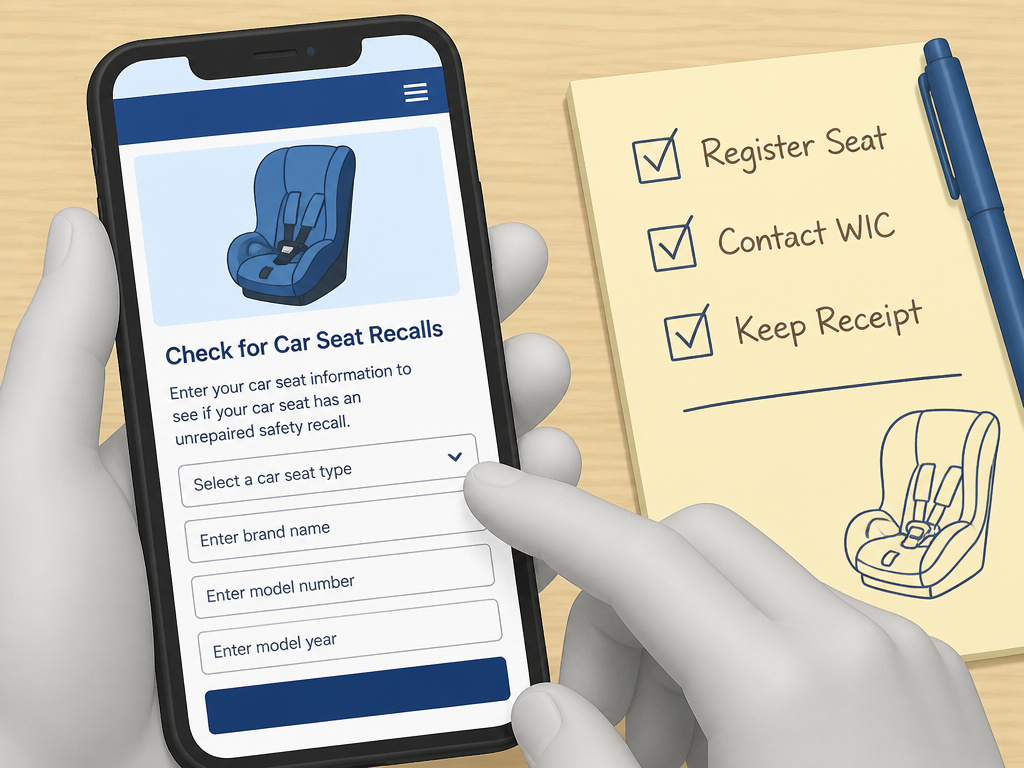 Follow this sequence to maximize your chances of securing a safe, free seat.
- Register Your Current Seat (If You Have One). Do this today. Use the registration card or go to the manufacturer’s website. This is your only direct line for recall notices.
- Check for Active Recalls. Visit NHTSA.gov and enter your seat’s model number and date. If it’s recalled, follow the instructions for a free remedy kit or replacement.
- Contact Your Local WIC/Medicaid Office. Call to inquire about car seat program eligibility, required classes, and wait times.
- Search for CPST Inspection Events. Use the NHTSA station locator. Attend an event even if you don’t have a seat; they may have distribution resources.
- Reach Out to Local Non-Profits. Contact United Way (dial 211), Salvation Army, or Catholic Charities. Explain your situation and ask if they have car seat assistance programs or referrals.
- If All Else Fails, Research the Best Value. If no free options materialize, your next move is to find the safest, most affordable new seat. Consult reviews of top affordable infant car seats to make an informed purchase.
Frequently Asked Questions
Can I really get a free car seat from the hospital when my baby is born?
Maybe, but don’t count on it. Hospital distribution programs are typically for emergency departments and crisis situations, not routine maternity discharges. Some hospitals partner with non-profits for giveaway events, but these are separate from birth admission. Your best bet is to secure a seat through WIC or a community program before your due date.
How do I prove financial need for these programs?
Proof varies. For WIC/Medicaid, your enrollment is sufficient. For hospital or charity programs, you may need a referral letter from a social service agency, proof of participation in SNAP (food stamps), or recent pay stubs below a certain income threshold. They assess need on a case-by-case basis.
What’s the difference between a recall and an expiration?
Recall is a specific defect (e.g., a buckle that fails) requiring repair. An expiration is the planned end of a seat’s usable life due to material degradation. A recalled seat can often be fixed and used again. An expired seat must be retired and recycled.
Are “free car seat with stroller” deals legitimate?
These are almost always marketing promotions from retailers, requiring you to purchase a high-value travel system. They are not assistance programs. Be wary of any offer that seems too good to be true or requires payment for a “shipping fee.” Legitimate free car seat programs do not ask for money.
What should I do with an old car seat I can’t use?
First, destroy it so no one else can use it unsafely. Cut the harness straps, remove the cover, and write “EXPIRED – DO NOT USE” on the shell with permanent marker. Then, look for a retailer take-back program or a community recycling event. Proper disposal prevents it from re-entering the secondhand market.
The Bottom Line
A free infant car seat is attainable, but it requires navigating systems built on verification, not luck. The legitimate paths, government aid, recalls, non-profits, all involve proving something: your income, your ownership, or your need. They exist to close safety gaps, not to provide convenience.
Your first call should be to your WIC clinic. Your first online stop should be the NHTSA recall page. If those doors close, turn your energy toward identifying the best budget-friendly car seats on the market. The goal is never just a free seat. It’s a safe ride home, every time.
