
When Can You Front Face Baby in Car Seat: The 26.5 LB Rule
This post contains affiliate links. As an Amazon Associate, we earn from qualifying purchases.
A child can ride forward-facing in a car seat only after meeting three strict criteria: they are at least 2 years old, they weigh a minimum of 26.5 lbs (12 kg) per the latest NHTSA regulation, and they have outgrown their specific seat’s rear-facing height or weight limit. The safest practice is to keep them rear-facing until they reach the maximum rear-facing limit of their convertible car seat, which is often 40 or 50 pounds.
That 26.5-pound number is new, and it changes everything. The old 20-pound guideline that’s been printed on boxes for a decade is now officially outdated and unsafe.
What follows is a breakdown of the three non-negotiable checks: the law’s new minimum, your pediatrician’s age floor, and your specific seat’s hard cap. Miss one, and you’re moving too soon.
Key Takeaways
- The U.S. Government now mandates that car seats can only be recommended for forward-facing use by children weighing at least 26.5 lbs (12 kg), a significant increase from the old 20 lb standard.
- Pediatric safety groups insist on a minimum age of 2 years before considering a forward-facing move, due to spinal development.
- Your car seat’s manual has the final say. A child must be under both the forward-facing minimums AND the rear-facing maximums to stay rear-facing.
- Always use the top tether strap when forward-facing; it reduces head movement in a crash by up to 6 inches.
- Transitioning too early turns a crash’s force onto the child’s underdeveloped neck and spine, which can’t withstand the load.
The Hard Numbers: Age, Weight, and Height
You need three green lights before you turn that seat around: a weight floor, an age floor, and a height check. These aren’t suggestions. They’re the barriers between a safe kid and a preventable injury.
The weight floor is now 26.5 pounds. That’s the weight of a 95th percentile one-year-old. The NHTSA child restraint final rule made this official in December 2023, updating the standard from 20 lbs. The goal is simple: keep more one-year-olds, and even many two-year-olds, in the safer rear-facing position.
The age floor is two years. The Canadian Paediatric Society states a child must be “at least 2 years old” before moving to a forward-facing seat. This is about bone ossification and ligament strength, not convenience. A one-year-old’s spine is simply not built to handle the forces of a frontal crash when forward-facing.
Height is the silent gatekeeper. The harness straps must be at or above the child’s shoulders in forward-facing mode. If the child’s shoulders are still below the top harness slot when rear-facing, they haven’t outgrown that mode, regardless of weight.
A 50th percentile 1-year-old weighs 22 lb. Under the old 20 lb standard, half of all 1-year-olds technically met the weight to turn forward. The new 26.5 lb standard ensures that even a 95th percentile 1-year-old should still be rear-facing.
| Criteria | Minimum to Go Forward-Facing | Source / Reason |
|---|---|---|
| Weight | 12 kg / 26.5 lb | NHTSA Federal Motor Vehicle Safety Standard (FMVSS) No. 213 |
| Age | At least 2 years old | Canadian Paediatric Society, American Academy of Pediatrics |
| Seat-Specific Weight | Meets seat’s forward-facing minimum (e.g., 22 lb) | Individual car seat manual (e.g., Graco) |
| Developmental Readiness | Can sit upright, not slouching, won’t unbuckle harness | Necessary for proper harness fit and crash protection |
Why Rear-Facing Is Safer (The Physics You Can’t Ignore)
A rear-facing seat cradles the child. A forward-facing seat restrains them. That’s the core difference, and in a crash, cradling wins every time.
In a frontal collision—the most common and severe type—everything flies forward. In a forward-facing seat, the child’s body is caught by the harness, but their head and neck snap forward violently. Their underdeveloped vertebrae and stretchy spinal ligaments are left to handle forces they cannot withstand.
Where this goes sideways: Turning a child forward-facing at 20 lbs because the old label said you could. Data shows that among kids 20-29 lbs, only 22% were still rear-facing. The new rule aims to flip that statistic by making the default “stay rear-facing” clearer.
In a rear-facing seat, the child’s back, head, and neck are all supported by the seat’s shell. Crash forces are distributed across the entire body, not focused on the neck. Think of it as cradling an egg in your palm versus setting it on a counter and slapping it from the front. The physics aren’t subtle.
This isn’t just for babies. A three-year-old is physically stronger, but their skeleton is still maturing. Keeping them rear-facing up to 40 or 50 pounds in a convertible car seat is the single most effective safety choice you can make. It’s why the move to a forward-facing car seat is now seen as a step down in protection, not a milestone.
Check Your Seat’s Manual, Not Just the Box
Your car seat’s manual is the law for that product. The NHTSA sets the national floor (26.5 lbs), but your Graco, Evenflo, or Britax manual sets the specific rules for your model. These two numbers must agree before you switch.
Most convertible seats have two sets of limits: a rear-facing maximum and a forward-facing minimum. The child must outgrow the first to justify using the second.
Take a common Graco convertible seat. Its manual states: * Rear-Facing: 5-40 lb. * Forward-Facing: 22-65 lb (and must be able to sit upright).
This means a 26-pound two-year-old meets the NHTSA’s new rule and the seat’s forward-facing minimum. But they are still under the seat’s rear-facing maximum of 40 lb. The manual doesn’t force you to turn them at 22 lb. It says you can. The safer choice is to keep them rear-facing until they hit 40 lb or the height limit.
Contrast that with an infant carrier. Many have a rear-facing limit of 30-35 lb. A child who hits that limit at 18 months must transition to a new car seat—a larger rear-facing convertible. You don’t jump to forward-facing just because they outgrew the infant carrier. You move to a seat that allows extended rear-facing.
Common mistake: Using the “one-inch rule” for forward-facing. The rule that there must be one inch of shell above the child’s head only applies to rear-facing seats. For forward-facing, the fit check is all about the harness straps being at or above the shoulders.
The Step-by-Step Forward-Facing Transition Checklist
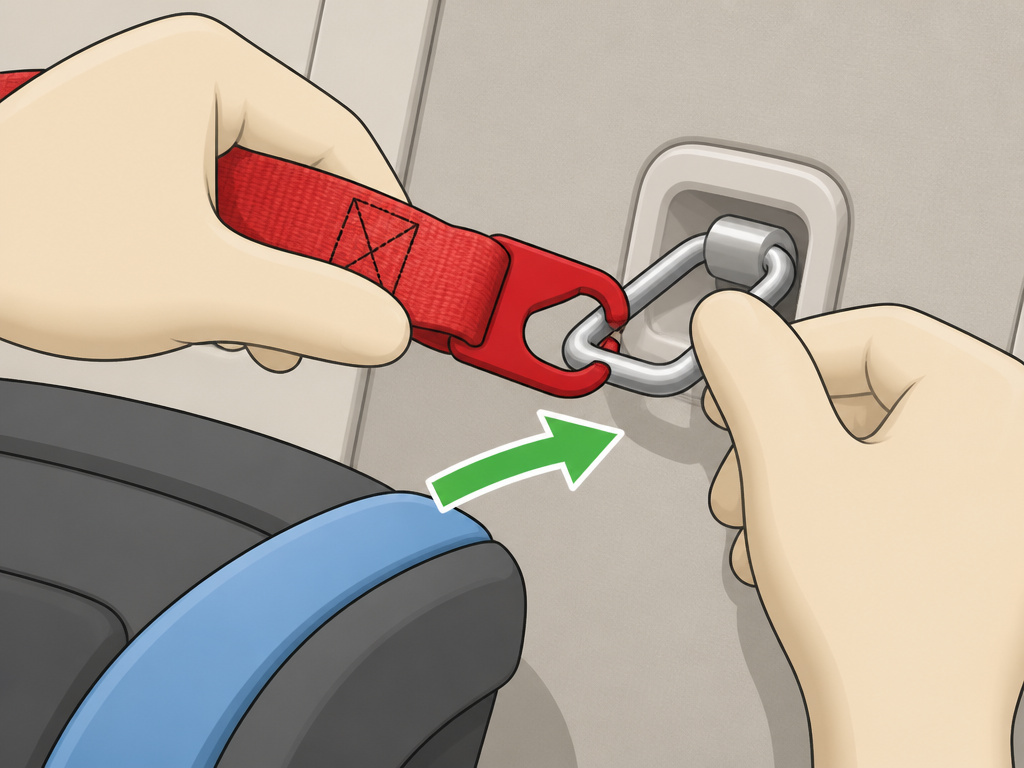 If your child is over two, over 26.5 lbs, and has reached the rear-facing limit of their seat, then you can proceed. Rushing any step here compromises the entire system.
- Install Tightly. Use either the vehicle seat belt or LATCH system, but not both unless the manual specifically allows it. The seat should not move more than one inch side-to-side or front-to-back at the belt path. A loose seat is a projectile.
- Adjust the Harness. The forward-facing harness straps must be at or above the child’s shoulders. You will likely need to move the straps up to the next slot. The chest clip should be at armpit level.
- Attach the Top Tether. This is non-negotiable. The tether strap anchors the top of the car seat to a dedicated point in your vehicle (check your car’s manual). It limits forward head movement in a crash by inches, drastically reducing the risk of head injury.
- Perform the Pinch Test. Buckle and tighten the harness. Try to pinch the strap vertically at the child’s collarbone. If you can pinch any excess webbing, it’s too loose. The straps should lie flat without slack.
- Check for Proper Fit. The child should sit all the way back, with their knees bending comfortably at the seat’s edge. They should not slouch or curl their back to fit.
Skipping the top tether is like installing a seatbelt but not clicking the buckle. It’s a critical load-bearing part of the forward-facing installation. If your vehicle doesn’t have a tether anchor, consult a certified child passenger safety technician—some solutions exist for older cars.
Forward-Facing Car Seat vs. Booster Seat: The Next Boundary
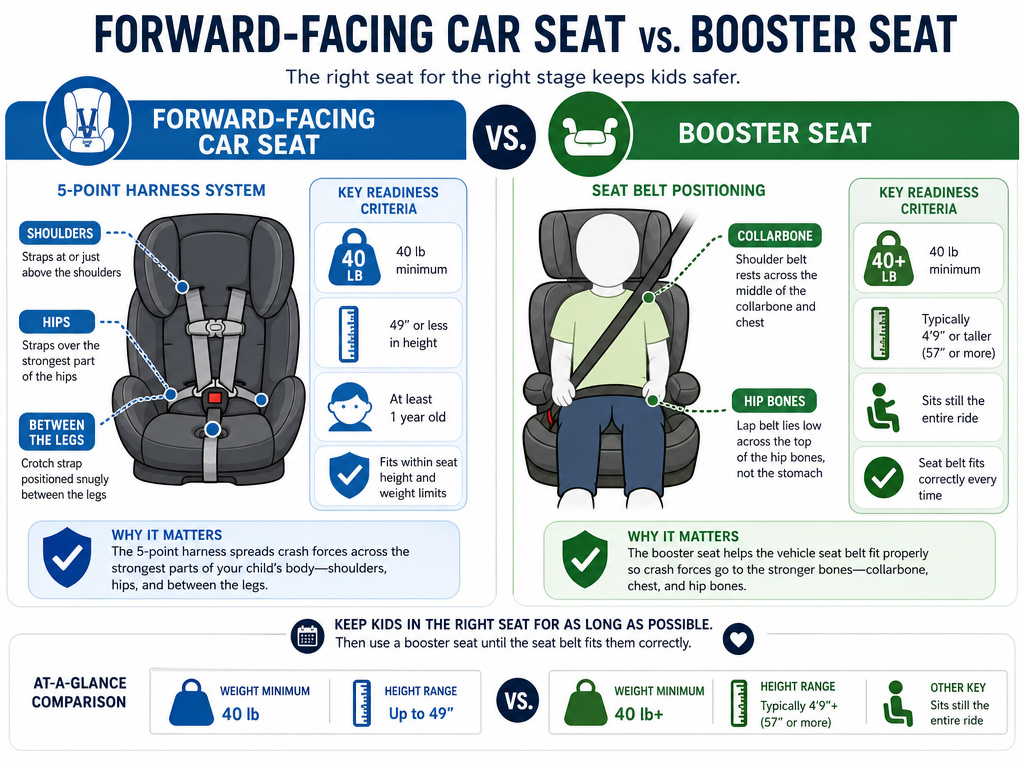 A forward-facing harnessed seat is not the final stage. The next move is to a belt-positioning booster seat, and that boundary is also shifting.
The new NHTSA rule also raised the booster seat minimum weight from 30 lb to 40 lb. A child must be at least 40 lb and mature enough to sit correctly in a booster for the entire ride before leaving the 5-point harness. For most kids, this happens between ages 5 and 7.
| Restraint Type | Primary Protection | Key Readiness Signs |
|---|---|---|
| Forward-Facing 5-Point Harness | Restrains at shoulders, hips, and between legs. | Child is under seat’s harness weight/height limit (often 65 lb). |
| Belt-Positioning Booster Seat | Positions adult seat belt correctly on strong hip bones and collarbone. | Child is over 40 lb, can sit still, and won’t slip the belt behind their back. |
The harness is safer because it removes the child’s ability to compromise the restraint. A booster seat relies on the child’s behavior. Moving to a booster too early is a common error. When in doubt, keep them in the harness. A car seat that grows with your child, like an all-in-one model, often has a high harness weight limit for this reason.
Frequently Asked Questions
My 18-month-old is 28 pounds. Can I turn them forward-facing?
No. They meet the NHTSA’s 26.5 lb weight minimum, but they fail the critical age minimum of 2 years recommended by pediatricians. Their spinal development is the limiting factor, not their weight. Keep them rear-facing in a rear-facing convertible that accommodates their weight.
What if my car seat’s manual says forward-facing from 22 lbs?
You can legally use it forward-facing from 22 lbs, but you shouldn’t. The manual was written to comply with the old standard. The new 26.5 lb federal rule is the updated safety benchmark. Furthermore, if the seat allows rear-facing up to a higher weight (like 40 or 50 lb), that is the safer option. The manual gives you permission; your judgment must prioritize safety.
How do I know if my child has outgrown the rear-facing height limit?
The rule is simple: there must be at least one inch of car seat shell above the top of the child’s head when rear-facing. To check, have the child sit in the seat installed at the correct angle. Place your hand flat on top of their head. If your hand touches the top of the seat shell, they still have room. If their head is above the shell, they have outgrown it rear-facing, even if they’re under the weight limit.
Why is the top tether so important for forward-facing?
In a frontal crash, a forward-facing seat will pivot forward from its lower anchor points. The top tether acts as a third anchor, drastically reducing this forward rotation and the child’s head excursion (how far their head flies forward). According to the official PDF car seat rule, proper use of all components, including the tether, is required for the system to perform as tested. Not using it can increase head movement by several inches, raising the risk of head injury.
My child’s legs are bent or touching the vehicle seat. Is it time to turn them?
No. This is a comfort issue, not a safety one. Children are flexible and comfortably sit with their legs crossed, bent, or dangling. There are no documented cases of leg injuries in rear-facing children due to long legs. The risk of spinal injury from premature forward-facing is far greater. Keep them rear-facing until they max out the seat’s height or weight limit.
Before You Go
The timeline is clear. Maximize rear-facing until your child hits the height or weight limit of a convertible seat—often around age 3 or 4. Then, and only if they’re over two and over 26.5 pounds, use a forward-facing seat with a 5-point harness and top tether. Hold that harness until they are at least 40 pounds and mature enough for a booster.
The new 26.5-pound rule is your guide. It pushes the default toward keeping kids rear-facing longer, where they are best protected. Your seat’s manual has the specifics, but the principle is universal: the longer they ride rear-facing, the safer they are.
