
Is It Safe to Check Your Car Seat on a Plane? FAA Guidance
This post contains affiliate links. As an Amazon Associate, we earn from qualifying purchases.
Checking a car seat as plane luggage is not safe. The FAA strongly discourages it because baggage handling can cause structural damage that isn’t visible, voiding the seat’s crash protection. A car seat is a single-use safety device; once compromised by impact, it may not perform in a vehicle crash. The only FAA-recommended safe use is securing the child in the seat, installed in their own aircraft seat.
That recommendation is based on the physics of composite plastics and webbing under stress. Baggage systems are designed for durability, not precision.A car seat tossed onto a conveyor or crushed under a suitcase absorbs forces in ways its design never accounted for.
What follows is the mechanics behind that warning, the exact label you need to look for, and the inspection routine you must perform if you have no other choice. This is about a device that has one job.
Key Takeaways
- The FAA explicitly states that children under 40 pounds are safest in an approved Child Restraint System (CRS) in their own seat, not as checked baggage.
- Structural damage from baggage handling is often invisible; a cracked shell or stressed harness anchor won’t be seen until it fails in a crash.
- Car seats and boosters must bear the specific red label “THIS RESTRAINT IS CERTIFIED FOR USE IN MOTOR VEHICLES AND AIRCRAFT” to be used on a plane.
- If you must check a seat, use its original cardboard box for maximum protection and conduct a thorough, hands-on inspection upon retrieval before ever using it again.
- For children over 22 pounds, the FAA-approved AmSafe CARES harness is a lightweight, carry-on alternative to checking a bulky car seat.
The FAA’s Official Stance (And Why It Matters)
The Federal Aviation Administration is clear. Their FAA child travel safety guide “strongly discourages” the practice of lap children and “recommends that you secure your child in an approved CRS in their own seat for the entire flight.This is the outcome of crash dynamics research.
An adult seatbelt is designed for a frame at least 40 inches tall and 40 pounds heavy. Below that threshold, the lap belt rides up over the abdomen, and the shoulder belt cuts across the neck. In turbulence or a runway incident, a small child can submarine under the belt or suffer internal or spinal injuries. A car seat’s five-point harness distributes crash forces across the strong bones of the pelvis and shoulders, which is why the FAA pushes for it.
14 CFR § 121.311, the federal regulation governing passenger safety on aircraft, specifies that an approved child restraint system must be “properly secured to an approved forward-facing seat.” It explicitly bans “booster-type child restraint systems” and “lap held child restraints” for use in aircraft. The rule is about proper restraint, not storage.
The gap between “allowed” and “safe” is where the risk lives. Airlines permit you to check a car seat for free as a special item. The FAA says doing so may ruin the seat’s ability to protect your child later. Your airline’s policy and the safety regulator’s guidance are not the same document.
What “Invisible Damage” Actually Means
When people hear “damage,” they picture a cracked shell or a broken armrest. The real danger is micro-fractures in the plastic moldings, stress fatigue in the steel reinforcement bar inside the seat back, or stretched harness anchor loops.
Think of a plastic water bottle. You can crush it, and it pops back into shape. But the polymer chains in the plastic are permanently stressed. The next impact takes less force to cause a rupture. Car seat shells are made from energy-absorbing expanded polypropylene (EPP) foam encased in hard plastic. They’re designed to crumple once, in a specific direction, to manage deceleration. A baggage handler’s toss from a cart applies force from an angle the seat wasn’t engineered for.
| Type of Damage | How It Happens in Baggage | Why It’s Dangerous |
|---|---|---|
| Shell Stress | Crushed under other luggage, dropped on edge | Compromises structural integrity; may crack prematurely in a crash |
| Harness Webbing Abrasion | Rubbed against conveyor belts, caught in machinery | Weakens tensile strength; straps could tear under crash load |
| Anchor Point Deformation | Seat used as a handle, yanked by LATCH straps | Metal loops or belt paths bend, reducing their holding capacity |
| Internal Component Shift | Repeated impacts from rolling and jostling | Critical energy-absorbing foam or locking mechanisms dislodge, rendering them useless |
The car seat as checked luggage problem is that you can’t X-ray a seat for this damage. You can’t see a stretched anchor loop. The 2023 ASTM textile-wear study found that polyester webbing loses significant strength after repeated abrasion—the kind that happens sliding down a baggage chute. The seat might look fine. Its certification is now a question mark.
The One Inspection You Cannot Skip
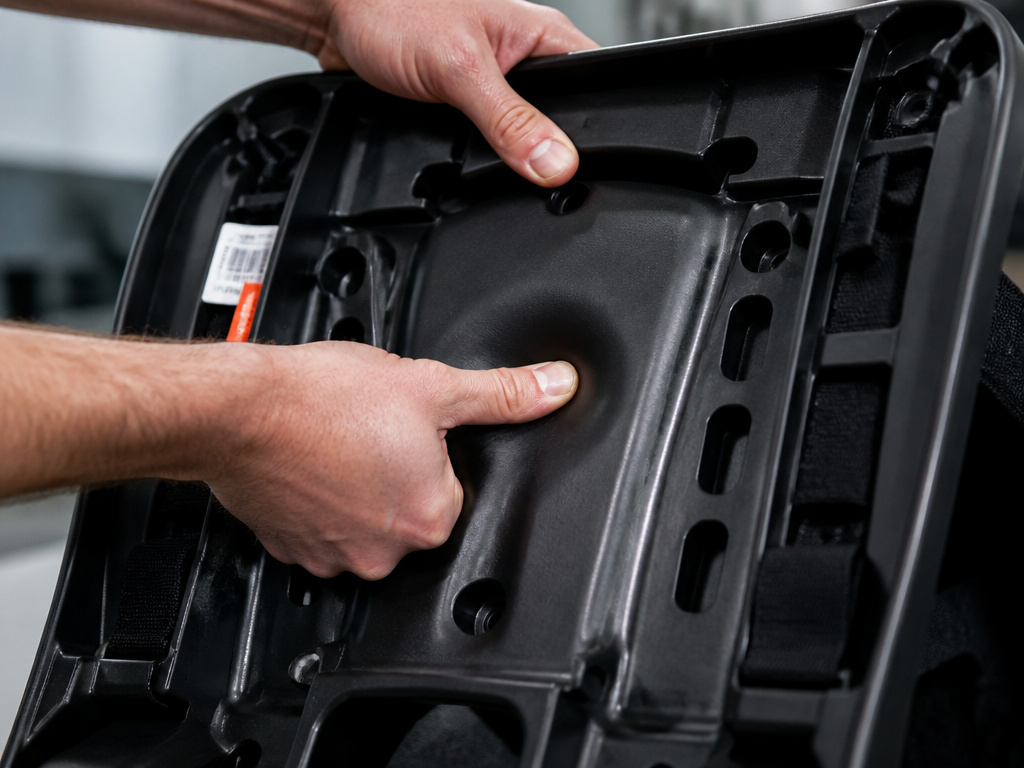
If you’ve returned from a trip and checked an infant car seat, you have one task before it ever goes near your car. This is a forensic check. The manufacturer’s manual, like the one for the Cybex CLOUD T, states: “ALWAYS REPLACE THE CHILD RESTRAINT AFTER A CRASH OF ANY KIND, EVEN IF IT WAS UNOCCUPIED.” Baggage handling is a series of minor crashes.
Do this in bright light. Take the seat cover completely off.
- Flex the shell. Apply firm pressure to the back, sides, and base. Listen for creaks or cracking sounds. Feel for areas that give more than others.
- Inspect every inch of webbing. Run the harness straps, LATCH straps, and top tether through your fingers. Look for cuts, fraying, or discolored, worn patches.
- Check all belt paths and anchors. Look for cracks in the plastic around the seatbelt path openings. Ensure the metal LATCH anchors aren’t bent or warped.
- Test every moving part. Do the harness adjuster, recline mechanism, and buckle work smoothly without sticking? A jammed adjuster is a failed restraint.
Where this goes sideways: Skipping the cover removal. I’ve seen a seat where the harness was frayed against the shell underneath the cover padding. From the outside, it was pristine. Inside, it was compromised.
If you find anything—a scratch deeper than surface level, a fuzzy strap, a sticky buckle—the seat is done. This is the non-negotiable part. The $300 cost of a new seat is the price of a verified safety device. You are not being paranoid. You are following the NHTSA car seat safety rules that treat these as single-use items.
Gate-Checking: A Slightly Safer Gamble?
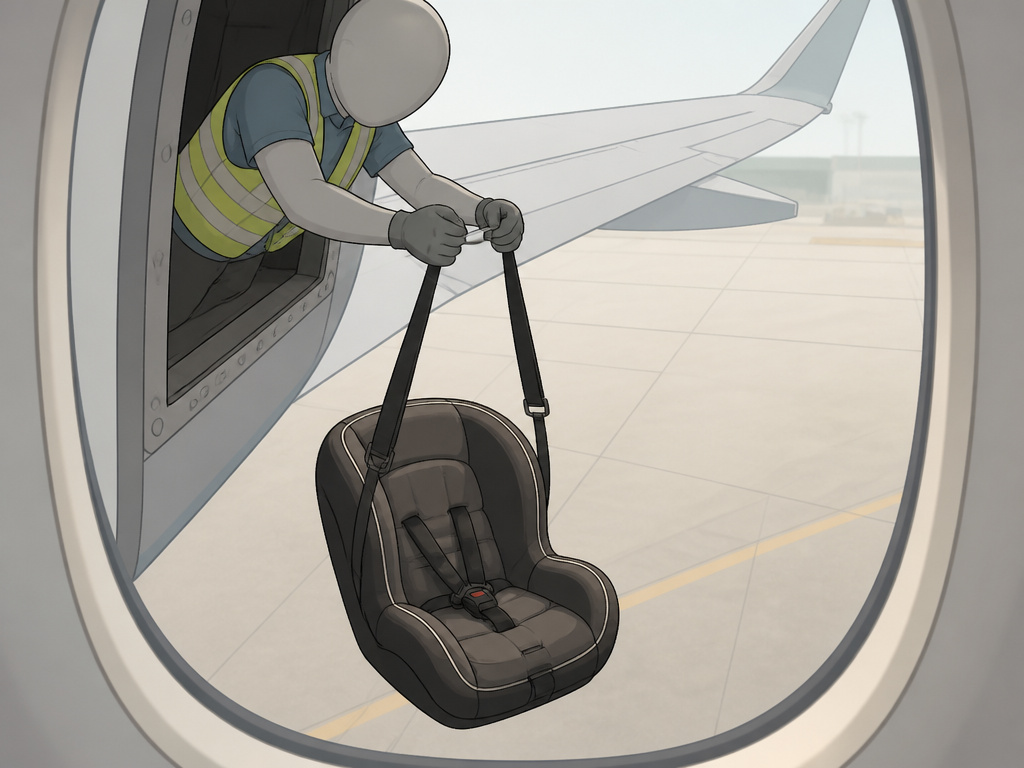
Gate-checking means you hand the seat to an agent at the airplane door, and it’s (usually) placed in the aircraft’s cargo hold last. It avoids the main baggage system’s conveyor belts and sorting machines. This is why many parents choose to gate-check a car seat.
It’s still a gamble. That seat is still going into a hold, often without a protective box. I’ve watched from the window as gate-checked strollers are dropped from the cargo door to the tarmac. The risk of loss is lower, but the risk of damage is not zero. Some airlines even return gate-checked items to the main baggage carousel, negating the gentle-handling advantage.
| Method | Risk of Loss | Risk of Damage | Best For |
|---|---|---|---|
| Checked at Ticket Counter | Higher | Highest | When you have no other option; always use a hard-sided case or original box. |
| Gate-Checked | Lower | Medium-High | When you’re hoping for an empty seat but need a backup plan. |
| Carried On & Used | None | None | The only method that guarantees seat integrity and provides in-flight safety. |
If you need to gate-check both car seat and stroller, ask for two separate claim tags. Gear strapped together gets thrown around as one heavy, awkward unit. Separate items are easier to handle.
Your Real-World Alternatives to Checking
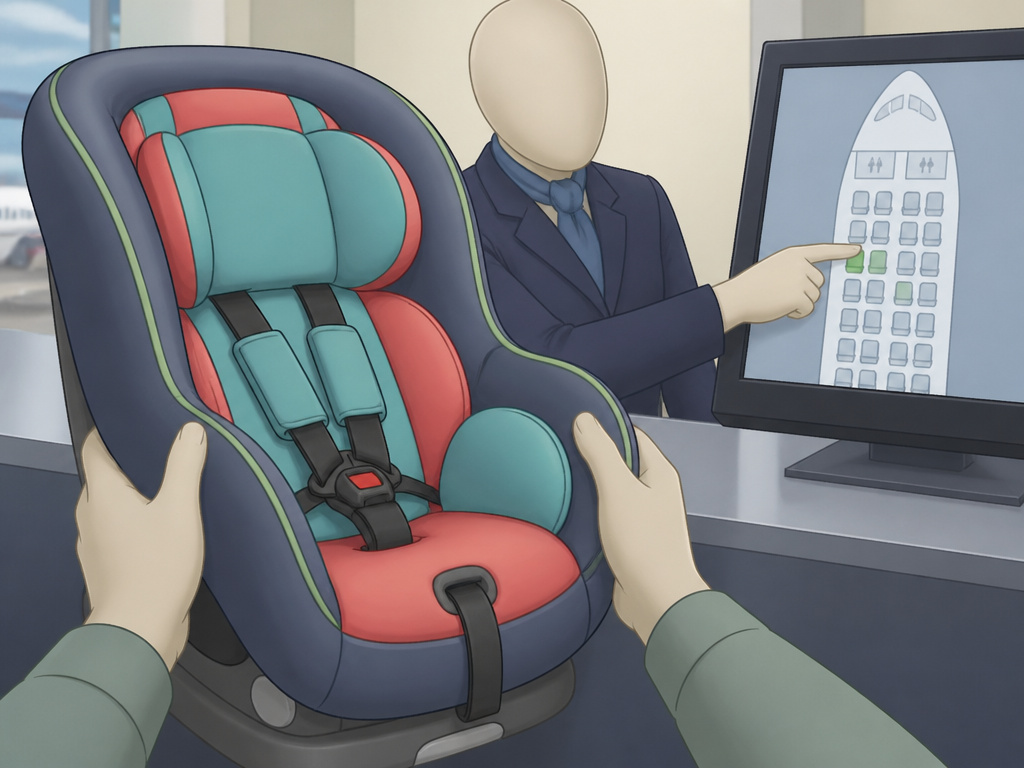
The goal is to keep the seat with you and use it. Every alternative flows from that.
First, always ask at the gate. Walk up with your child in the seat and politely ask the agent if there are any empty seats where you can install it. Airlines would rather have an infant properly restrained than as a lap child during turbulence. It works more often than you’d think. If it does, you can carry a car seat on plane and install it in that empty seat.
For toddlers, use the CARES harness. The FAA-approved AmSafe CARES device is for children 22-44 pounds and up to 40 inches tall. It’s a lightweight harness that turns the airplane seatbelt into a five-point system. It packs into a small pouch. This is the ultimate solution if you travel with stroller and car seat and need to check the seat but want in-flight safety for your walking-age child.
Know what you can bring. You are typically allowed a stroller and a car seat free of charge in addition to your regular luggage. You can bring car seat and stroller through security and decide at the gate your best move. The stroller can be gate-checked in a bag with minimal risk; its structure is simpler and more robust.
What about the base? If you use an infant seat, you can usually check a car seat base in its own bag or box. The base is less complex but should still be protected. The Cybex manual explicitly says not to use the convenience base on an aircraft anyway—you install the seat directly with the airplane belt.
Frequently Asked Questions
Can any car seat be used on an airplane?
No. Only seats with the specific red label that reads “THIS RESTRAINT IS CERTIFIED FOR USE IN MOTOR VEHICLES AND AIRCRAFT” are approved for in-flight use. Booster seats, even high-back boosters, are not approved by the FAA regulation 121.311 for use during taxi, takeoff, or landing.
Do checked car seats fly for free?
Almost universally, yes. Car seats and strollers are considered “child safety equipment” and are checked free of charge by major airlines, whether at the counter or gate. They do not count toward your baggage allowance.
What is the safest way to pack a car seat for checking?
The original manufacturer’s cardboard box is the best protection. It’s designed for shipping. Second best is a hard-sided travel case labeled for car seats. A flimsy nylon bag protects from dirt only, not impact.
How do I know if my checked car seat is damaged?
You must perform the hands-on inspection outlined above. Look, feel, and flex. If you have any doubt, contact the manufacturer. Most will tell you to replace it if it has been checked, as they cannot certify its integrity after unknown handling.
Is it safer to hold my baby during the flight?
No. The FAA is explicit on this. In unexpected turbulence, a lap child can be torn from your arms. The force is physically impossible to restrain. The only safe place for a child under two is in an approved restraint system secured to their own seat.
Before You Go
Checking a car seat turns a precision safety device into luggage. The regulatory guidance, the physics of materials, and the reality of baggage systems all say the same thing: it’s a last resort.
Your sequence is simple. First, aim to use the seat on the plane. Second, if you can’t, protect it in its original box and inspect it like a mechanic before its next car ride. Third, for toddlers, skip the seat entirely and use a CARES harness. The entire airport check-in process for baby gear is built around giving you options that keep your child safe in the air and on the road. Use them in that order.
