
How to Detach Car Seat from Base | Find the Release Handle
This post contains affiliate links. As an Amazon Associate, we earn from qualifying purchases.
To detach a car seat from its base, locate the release handle or lever on the back of the car seat carrier, squeeze it firmly (do not pull), and lift the seat straight up and out of the base. You must hear a distinct click when attaching; a proper detach reverses that click with a single squeeze-and-lift motion. This only works for infant carrier seats, not for convertible “all-in-one” seats.
That click is the sound of a mechanical lock disengaging. Every major brand. Graco, Evenflo, Chicco, Britax, uses a variation of this system, but the handle’s shape and placement shift. Missing the correct motion, usually by pulling the handle instead of squeezing it, is why parents get stuck at the curb with a seat that won’t budge.
What follows: the universal three-step method that works on 90% of seats, the physical reason pulling the handle fails, the critical difference between seats that detach and those that don’t, and what to do when the standard steps don’t work.
Key Takeaways
- Only infant car seat carriers are designed to detach from their bases; convertible and “all-in-one” seats are a single, fixed unit.
- The release handle is always on the back of the car seat carrier, never on the base itself. You must squeeze it inward, not pull it outward.
- A successful attachment produces an audible click. If you didn’t hear it click in, it won’t release cleanly.
- If the seat won’t release, the most common fix is to push down firmly on the seat while squeezing the handle to relieve pressure on the lock.
- Always verify the seat is detached by checking the lock indicators on the base, they should show red or be disengaged.
The Universal 3-Step Release (Works for Graco, Evenflo, Joie)
The process is nearly identical across major infant seat brands. The manuals for the Graco SnugRide SnugLock 35 LX, Evenflo Revolve 180, and Joie Rue all specify the same core action: squeeze and lift.
From the back of the car seat, squeeze the release lever and lift the car seat out of the base. – Graco GoMax Instruction Manual (Source 5)
This 50-word block is the technical heart of the procedure. The release lever is a mechanical bypass for the locking bar. When you squeeze, you retract the bar from its socket in the base.
Here is the fail-proof sequence:
- Locate the Handle: Find the release handle on the rear-facing side of the car seat carrier. It’s often red or grey and may be labeled. On Graco Click Connect seats, it’s a large, horizontal handle. On many Evenflo models, it’s a smaller lever.
- Squeeze, Don’t Pull: Apply firm, inward pressure on the handle. You are compressing a spring mechanism. Pulling the handle away from the seat does nothing and is the number one reason for a failed release. You should feel the handle move an inch or so.
- Lift Straight Up: While maintaining the squeeze, grasp the car seat’s carry handle or sides and lift it vertically out of the base. Do not twist or rock it. A clean lift means the locking bar has fully cleared.
The part nobody mentions: You need your body weight. If the seat is heavily loaded with a child, you might need to use your free hand to push down on the seat near the handle while squeezing. This counter-pressure unweights the locking bar and lets the mechanism slide free. Stubborn seats always yield to push-down-while-squeezing.
| Brand & Common Model | Handle Location & Type | Key Sign of Secure Attachment |
|---|---|---|
| Graco (SnugRide, SnugLock) | Large horizontal red handle across the back. | Audible “click”; locking bar visually seats into base. |
| Evenflo (Revolve, SafeMax) | Smaller grey lever, often centered on the back. | Click felt through the seat; lock indicator window shows green. |
| Chicco (KeyFit, Fit2) | Button or lever at the lower back, near the belt path. | Distinct, loud click; carrier feels rigidly locked. |
| Britax (B-Safe, Willow) | Handle integrated into the carry handle adjustment. | Click accompanies handle movement; seat cannot be lifted. |
Why “Pull the Lever” is Wrong Advice

The language matters. Manuals say “squeeze” or “press” the release lever. If you interpret that as “pull,” you’re applying force in the wrong vector. The release mechanism is a simple latch.
Think of it like a deadbolt on a door. Squeezing the handle is like turning the key, it retracts the bolt. Pulling the handle is like yanking on the door knob while the bolt is still extended. It strains the plastic housing and can actually bend the locking bar over time, leading to a wobbly fit.
The consequence is immediate. A seat that feels stuck, followed by a frantic search online. The fix is almost always the push-down technique. It realigns the components with the force they were designed for.
When Detaching Just Won’t Work: Infant Seat vs. Convertible
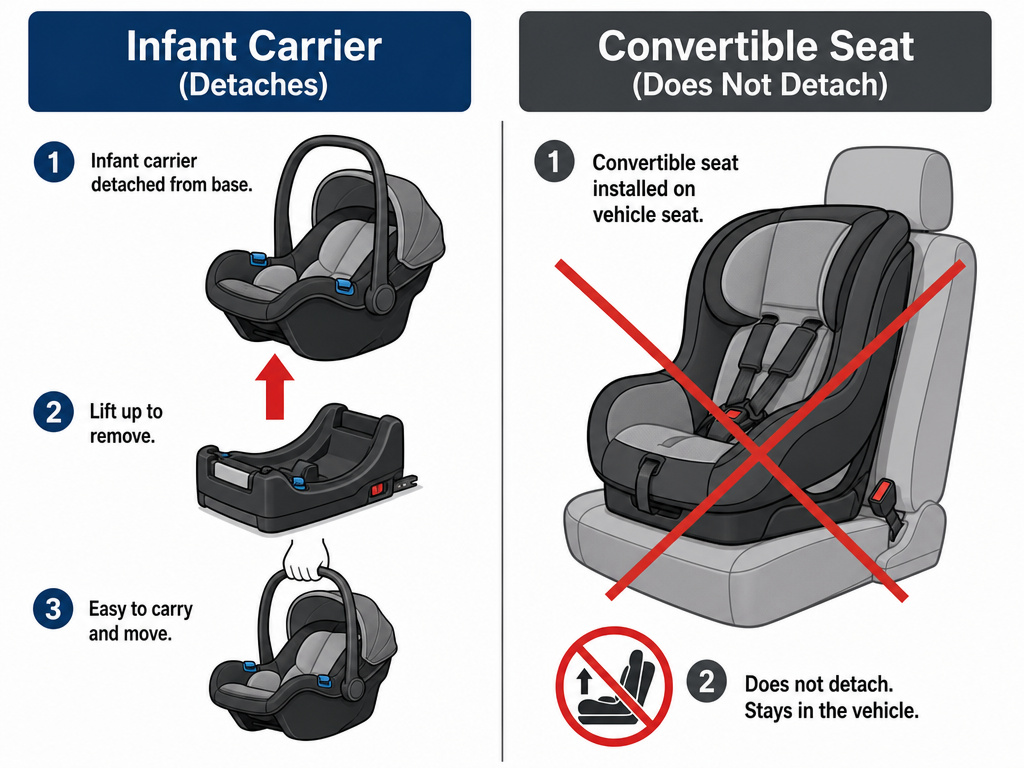
This is the most critical distinction in child car seats, and misunderstanding it causes genuine panic. Parents of newborns buy a “grow with me” convertible seat, then realize at the hospital they can’t carry the baby inside it.
-
Infant Car Seat (Carrier): This is a two-piece system, a carrier that detaches from a base. Brands like Graco SnugRide, Chicco KeyFit, and UPPAbaby Mesa are examples. They have a built-in carry handle and are rated for children typically from 4-35 lbs. These are the only seats designed to detach.
-
Convertible / All-in-One Seat: This is a single, heavy unit that remains installed in the vehicle. The Graco 4Ever, Britax One4Life, and the Graco Turn2Me are examples. They are not carriers. You install the entire seat using LATCH or a seat belt, and you place the child directly into it.
Where this goes sideways: Buying a convertible seat expecting a detachable carrier. A viral review of the Graco Turn2Me lamented vomit trapped in an “impossible to clean” base because the parent didn’t realize the seat is one solid piece. You clean it in place or uninstall the whole 25-pound unit.
The takeaway is binary. If your seat has a prominent carry handle and you bought a separate base, it detaches. If it’s a large, monolithic seat that transitions from rear to forward-facing, it does not. Needing to remove the base is a separate task from detaching the carrier.
Step-by-Step Detach with Visual Cues

Forget the generic steps. Let’s walk through it with the specific checks you should see and feel. This is how you build the muscle memory.
Before You Start: Ensure your vehicle is on level ground and the base is securely installed. A wobbly base can bind the locking mechanism.
- Clear the Area: Move the front vehicle seat forward so you have room to lift the carrier straight up without tilting it.
- Find Your Grip: Place your dominant hand on the release handle. Wrap your other hand under the car seat’s front lip or around the carry handle (if it’s in the carry position).
- The Squeeze and Push: Squeeze the release handle firmly inward. If the seat doesn’t release immediately, use the hand under the seat to apply downward pressure. You are compressing the seat into the base by a millimeter to unload the lock.
- The Lift: The moment you feel a slight give, lift vertically. Don’t twist. A clean release feels smooth.
- Verify: Look at the base. The locking clamps or the indicator windows (on models like the Evenflo Revolve) should now be open or show red. This is your confirmation that the car seat release mechanism is fully disengaged.
If you struggle with the car seat removal process repeatedly, the issue is likely alignment. Detach the seat and re-attach it, listening for that definitive click. A proper connection makes a proper disconnection trivial.
Troubleshooting a Stuck Car Seat
The seat won’t budge. You’re squeezing correctly. Now what? Work through this diagnostic table before forcing anything.
| Symptom | Likely Cause | Immediate Fix |
|---|---|---|
| Handle squeezes but seat doesn’t lift. | Locking bar is under tension from the seat’s weight. | Push down on the seat near the handle while squeezing, then lift. |
| No click was heard when attaching. | Seat is not fully latched onto the base. | Press down firmly on the seat until you hear a click, then try the release. |
| Seat is crooked or tilted in the base. | Carrier was placed in the base misaligned. | Lift the seat out (if possible), realign the locking bar with the base’s locks, and re-seat it squarely. |
| Release handle feels loose or floppy. | Mechanism is obstructed by debris or a damaged part. | Inspect the handle path for food, sand, or fabric. Clean it. If broken, contact manufacturer. |
| Seat releases but feels wobbly when attached. | Locking bar or base locks are worn or damaged. | Stop using. This is a safety-critical failure. Contact the manufacturer for a replacement part or seat inspection. |
For brand-specific issues, the process varies. Figuring out how to remove a Doona car seat from its integrated stroller base involves a different button sequence. Detaching from an ISOFIX base often uses a central release strap rather than a handle.
TL;DR: Push down, then squeeze. If it’s still stuck, the connection wasn’t right to begin with.
Re-attaching Securely: It’s All About the Click
Detaching is only half the cycle. You must re-attach correctly every time, or the next detach becomes a problem. The rule is singular: you must hear and feel a click.
The manuals are unanimous. The Graco SnugRide SnugLock manual states: “Push down on the car seat. You will hear a ‘click’ when it is locked.” This is non-negotiable. The click is the sound of the locking bar snapping into the locked position inside the base.
- Align the carrier with the base. Look for the locking bar at the front and rear of the car seat, these are the metal or thick plastic bars that hook into the base.
- Set the seat into the base. Don’t drop it.
- Place a hand on each side of the seat and press straight down with steady, firm pressure until you hear a definitive click. If you’re not sure, press again.
- Tug Test: Grasp the seat at its front and rear corners and try to pull it up. It should not move. If it lifts without you squeezing the release, it’s not locked. Repeat step 3.
Skipping the tug test is how seats become accidentally detached in a crash. The click is the goal, but the tug is the proof.
Frequently Asked Questions
Why won’t my Graco car seat detach from the base?
The most common reason is pulling the red release handle instead of squeezing it inward. The second is not pushing down on the seat to relieve pressure on the locking bar while you squeeze. Ensure the seat was fully clicked into place to begin with.
Can you detach any car seat from its base?
No. Only infant car seat carriers are designed to detach. Convertible seats (like the Graco 4Ever or Turn2Me) and all-in-one seats are single, fixed units. They do not come apart from their base; the base is integrated into the seat’s structure.
Where is the release button on a car seat base?
The release button or handle is almost always on the car seat carrier itself, not on the base. You must look at the back of the removable infant seat, near the top or center. The base has the locks that receive the carrier’s locking bar.
Is it safe to carry a baby in a detached car seat?
Yes, that is the primary function of an infant carrier seat. It is designed as a travel system. However, it is not safe to place a carrier seat on a high surface like a table or counter, as it can fall. It is also not certified for use as a sleeping device outside the vehicle or stroller.
How do you detach a car seat from a stroller?
The method varies by travel system. Most connect via adapters that have a physical release button on the adapter itself or on the stroller frame. You typically press the button while lifting the seat up. Always consult your stroller manual, as forcing it can damage the latch.
Before You Go
Detaching a car seat is a simple mechanical action, squeeze the handle on the back and lift. The complexity comes from not knowing where the handle is, confusing pull with squeeze, or not realizing you own a seat that doesn’t detach at all.
Your action plan is straightforward. Identify your seat type. Infant carrier? Find the handle, practice the squeeze-and-lift with the push-down trick. Convertible seat? Understand it’s one piece and plan to lift your child in and out of the vehicle. The goal isn’t just convenience; it’s ensuring that every click in and smooth release out contributes to a system that stays secure for the long haul.
