Why Do Babies Face Backwards in Car Seat? The Safety Facts
This post contains affiliate links. As an Amazon Associate, we earn from qualifying purchases.
Babies face backwards in car seats because a rear-facing position cradles the head, neck, and spine during a frontal crash, distributing impact forces across the entire back of the seat. This reduces the odds of injury by 9% compared to forward-facing and cuts the risk of death or serious injury by 75% for children under two. The design is a federal requirement with specific dimensions for back and side support.
That 75% figure comes from a review of 15 years of U.S. Crash data.The mechanics are simple: in a forward-facing seat, a crash throws a child’s head forward while the body stays strapped, stretching the undeveloped spine. A rear-facing seat lets the child’s whole body settle into the restraint, turning a violent jerk into a controlled push.
What follows: the specific physics that make it work, the federal specs every seat must meet, the one absolute rule about air bags, and how to know when your child has genuinely outgrown the rear-facing position, which is almost always later than you think.
Key Takeaways
- A rear-facing seat reduces the odds of any injury by 9% and the risk of death/serious injury by 75% for toddlers, based on U.S. Crash data.
- The federal standard (49 CFR § 571.213) mandates a seat back angle under 70 degrees and minimum support surface areas to properly contain a child.
- Never place a rear-facing seat in front of an active air bag; the CDC declared vehicles without back seats “not suitable” for these restraints in 1993.
- “Outgrowing” rear-facing is about the seat’s height/weight limit, not age or bent legs. Most convertible seats accommodate children to 40-50 pounds rear-facing.
- Correct car seat installation is non-negotiable; a perfectly positioned seat that’s loose offers zero crash protection.
The Physics of a Crash: Why Backwards Works
Forget the abstract “better support” line. The advantage is a direct, physical consequence of how crash forces travel.
In a frontal collision, the most common and severe type, everything not secured flies toward the point of impact. A forward-facing child is strapped at the shoulders and hips. Their head, which is proportionally huge and heavy for their body, whips forward. The neck, with its still-forming vertebrae and ligaments, stretches beyond its limits. Think of a heavy ball on a flexible straw. That force has to go somewhere, so it strains the spinal cord and the base of the skull.
A rear-facing child restraint system positions a child to face the direction opposite to the normal travel direction of the vehicle. During frontal impact testing, the system’s back support surface, which must be at least 85 square inches, cradles the child’s head, neck, and torso, distributing deceleration forces evenly across these areas.
Now picture the same child rear-facing. During that same crash, their body is pushed deeper into the shell of the car seat. The seat back absorbs the energy and supports the head, preventing that whip-like motion. The child’s back takes the load, not their neck.
The data from sled tests is stark. When comparing dummies, forward-facing seats produce much higher neck loads and chest displacement. For a parent, that translates to a specific, sourced risk: children under two were 75% less likely to die or sustain serious injury when rear-facing, according to the NHTSA’s review of crashes from 1988 to 2003.
Where this goes sideways: Assuming a gentle crash is safe enough to justify turning a seat around early. Low-speed collisions still generate forces several times a child’s body weight. The neck-load difference isn’t linear; it’s the difference between a supported push and an unsupported snap.
The Federal Blueprint: What Makes a Seat “Rear-Facing”
A rear-facing car seat is a regulated piece of safety equipment with dimensions written into federal law. The standard (49 CFR § 571.213) defines the geometry that makes the physics work.
| Federal Requirement | Specification | Why It Matters |
|---|---|---|
| Definition | Positions child opposite the normal travel direction. | Ensures the seat is engineered for crash forces from the front. |
| Back Support Surface | Flat or concave, ≥85 sq. In. Area. | Provides the continuous surface needed to distribute crash forces across the child’s back. |
| Back Support Angle | Shall not exceed 70 degrees from vertical during testing. | Prevents a too-reclined position that could allow the child to “ramp up” out of the harness in a crash. |
| Side Torso Support | ≥24 sq. In. For kids ≥20 lbs; ≥48 sq. In. For kids <20 lbs. | Contains the child’s body within the seat shell, preventing lateral ejection in a side-impact. |
| Dummy Retention | The entire torso must be retained; head target points cannot pass the system’s top. | Verifies the seat actually holds a child’s body in place during the simulated 30-mph crash test. |
These are the pass/fail criteria for certification. When you see a seat labeled for rear-facing use, it has been slammed into a test bench at 30 mph with a dummy inside, and it met every one of these geometric and retention rules.
Common mistake: Using an aftermarket head support or bulky coat that changes the fit of the harness against the child’s body. This can create slack between the child’s back and the 85-square-inch support surface, compromising the force distribution the seat was certified to provide.
Your proper installation checklist starts here. If the seat isn’t reclined within the manufacturer’s angle range (often indicated by a level line), it can’t provide that certified support. Too upright, and an infant’s head can fall forward, restricting breathing. Too reclined, and the crash performance is invalid.
The Air Bag Rule: The One Non-Negotiable
This is the oldest and clearest warning in child passenger safety. In 1993, the CDC issued a bulletin that remains unequivocal: a rear-facing child restraint must never be placed in front of an active passenger-side air bag.
The reason is brutal mechanics. In a crash, the air bag inflates at over 200 mph. If a rear-facing seat is in front of it, the back of the seat, where your baby’s head is, is literally in the path of an exploding cushion. The air bag can strike the restraint with enough force to cause catastrophic injury.
CDC air bag safety warning: “Rear-facing child restraints must be used in the rear seat of vehicles with passenger-side air bags. Those vehicles with passenger-side air bags and without back seats are therefore not suitable for rear-facing child restraints.”
The bulletin noted that no real-world injuries had been reported at the time, but the lab test data was conclusive. The rule today is absolute. If your vehicle has a front passenger air bag that cannot be permanently disabled, the front seat is off-limits for a rear-facing seat. This directly impacts families with pickup trucks, two-seater cars, or any vehicle where the only rear seat is already occupied by other children.
Your vehicle manual and the car seat manual will both scream this warning. Heed it. The back seat is the safest location regardless, but with a rear-facing seat, it is mandatory.
How Long to Keep Your Child Rear-Facing
The old “one year and 20 pounds” rule is a legal minimum, not a safety recommendation. It comes from the federal label requirement that convertible seats must state a rear-facing weight limit of at least 20 pounds. Modern seats far exceed that.
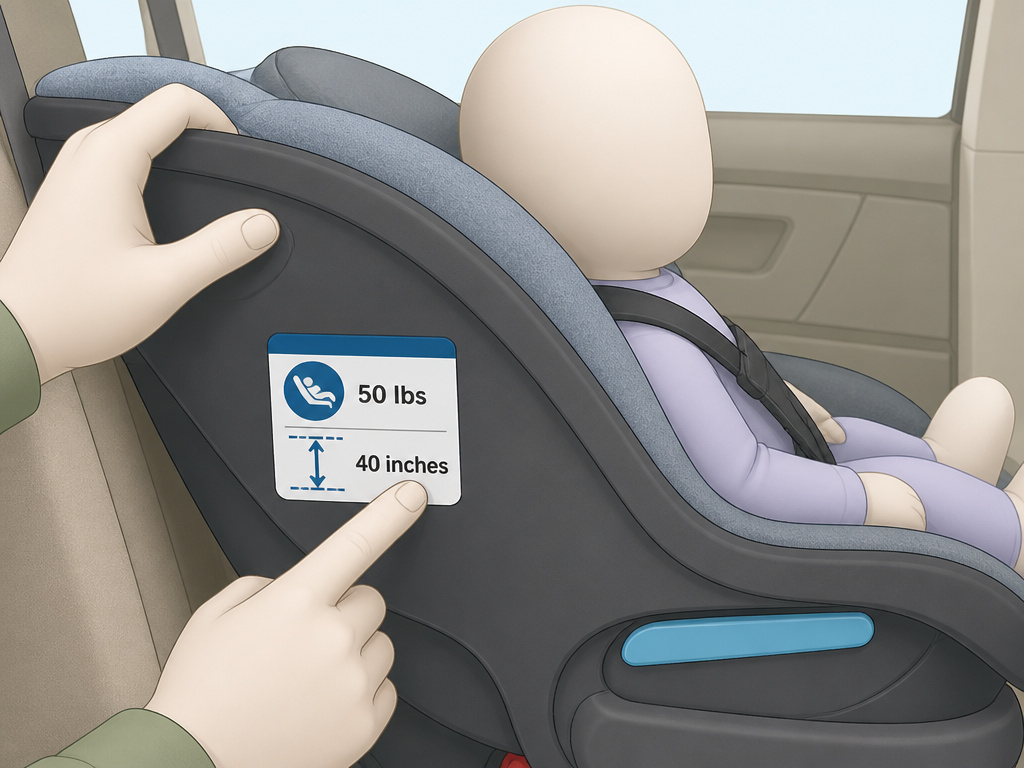
The real answer is: until your child reaches the maximum height or weight limit for the rear-facing mode of their specific seat. For most convertible seats, that’s 40, 45, or even 50 pounds.
| Child’s Size | Best Seat Type | Typical Rear-Facing Limit | What “Outgrown” Looks Like |
|---|---|---|---|
| Newborn to ~1 year | Infant-Only (Bucket) Seat | 30-35 lbs, or height limit | Head within 1″ of shell top. |
| ~1 year to 4+ years | Convertible Seat | 40-50 lbs, and height limit | Shoulders above top harness slot, OR head within 1″ of shell top, OR exceeds weight limit. |
| Preschool Age | Extended Rear-Facing Convertible | Up to 50 lbs. | Child meets any manufacturer limit; legs are bent but not a safety concern. |
The Kansas data (2011-2020) showed a 9% reduction in the odds of any injury for kids up to age 4 in rear-facing seats. The benefit doesn’t magically stop at a birthday.
The part nobody mentions: A child’s legs being bent or touching the vehicle seat back is not a safety reason to turn them forward. In a crash, legs fold naturally. Fractured legs are treatable; spinal cord injuries are not. The safety trade-off isn’t close.
Parents often feel pressure to switch to a forward-facing car seat when a child looks cramped or reaches age two. That’s a social milestone, not an engineering one. The extended rear-facing movement exists because the data is so compelling. A child who is within the seat’s limits is safer rear-facing, full stop.
Check your seat’s manual. The limits are on a sticker on the side of the seat shell. The harness straps should be at or below the child’s shoulders when rear-facing. If you need clarification on your seat’s rules, the NHTSA official car seat interpretation documents provide regulator guidance.
Installation: Making the Physics Work in Your Car
The best seat provides zero protection if it’s not secured properly. Your goal is to eliminate any independent movement of the seat itself, so all the crash energy transfers through its designed structure.
You have two approved methods: the vehicle seat belt or the LATCH system (Lower Anchors and Tethers for Children). Both are equally safe when used correctly. The LATCH system can be simpler, as it involves clicking the seat’s connectors onto rigid metal anchors in the vehicle seat crease.
- Choose your method. Use either the LATCH system anchors or the seat belt. Do not use both simultaneously unless the seat manufacturer explicitly allows it (few do).
- Find the correct recline angle. Use the built-in angle indicator or level. For newborns, this is crucial to keep airways open.
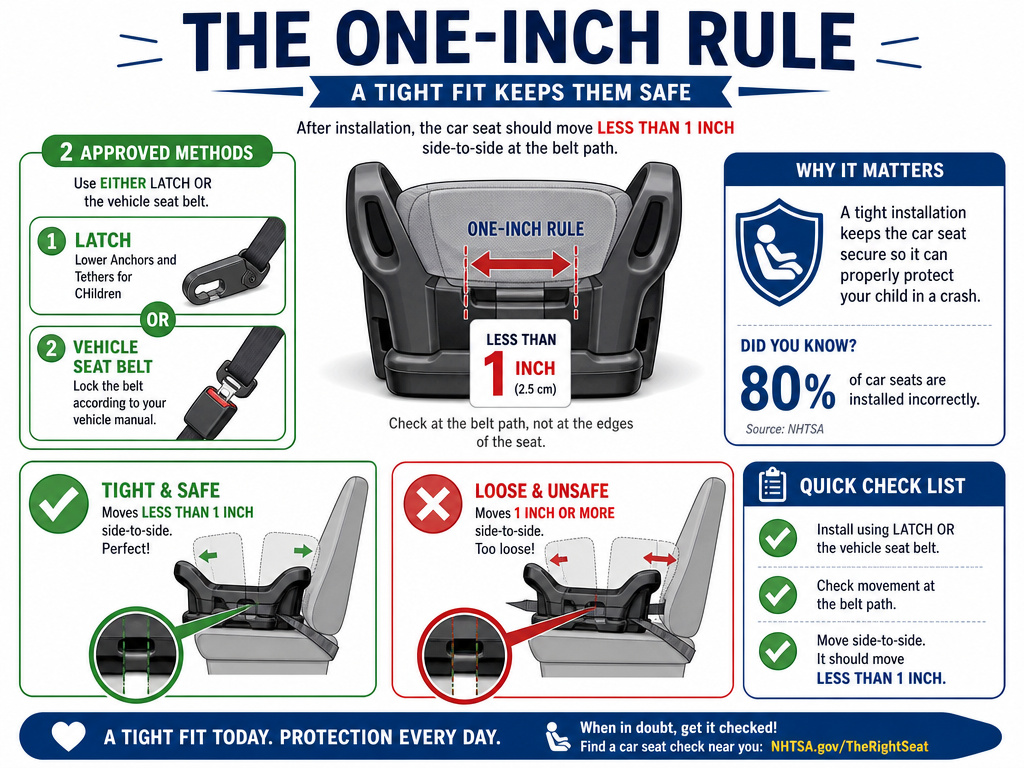
- Get a tight fit. Kneel in the seat, putting your weight into it, and tighten the belt or LATCH strap. When you release your weight, the seat should not move more than one inch side-to-side or front-to-back at the belt path.
- Secure the child. Place the child in, buckle the harness, and tighten. The harness is snug enough when you cannot pinch any horizontal slack at the child’s shoulder.
If your vehicle is older and lacks LATCH, you’ll perform a seat belt install. The principle is identical: weight in, tighten, check for less than one inch of movement. Whether you use LATCH anchors or a seat belt, the one-inch rule is your final exam.
Be wary of accessories. A car seat protectors mat is only safe if it is specifically approved by your car seat manufacturer and doesn’t interfere with the installation. Many are not approved and can compromise the seat’s stability in a crash.
Frequently Asked Questions
Why do rear-facing car seats look so reclined?
The recline is intentional and regulated. The federal standard prohibits a back support angle greater than 70 degrees from vertical. This angle, typically between 30-45 degrees for infants, helps keep a baby’s head back and airway open. It also ensures the child’s body is fully supported by the seat back during a crash.
Is it safe to buy a used rear-facing seat?
Generally, no. A used car seat has an unknown history. It could have been in a crash, the plastic could be degraded from sunlight, or it could be missing parts or instructions. It may also be expired (most seats have a 6-10 year lifespan). Unless you are certain of its full history from a trusted source, a new seat is the only guarantee of integrity.
Can my toddler’s legs be crossed or touching the seat?
Yes. This is a common concern but not a safety issue. Children are flexible and will sit cross-legged, sideways, or with their feet on the vehicle seat. In a crash, their legs will simply fold up. There is no evidence this position causes injury. The risk of leg injury is far lower in a rear-facing seat than the risk of head/spinal injury in a forward-facing seat.
What does the 9% injury reduction actually mean?
The 9% figure comes from a peer-reviewed child restraint analysis of Kansas crash data from 2011-2020. After adjusting for factors like crash severity and seating position, children aged 0-4 in rear-facing seats had 9% lower odds of sustaining any injury compared to those in forward-facing seats. It’s a statistical measure of reduced risk, confirming that the protective effect is real and significant across thousands of real-world crashes.
When is it legally okay to turn my child forward?
Laws vary by state, but most require rear-facing until at least age 2. However, state laws are the floor, not the ceiling. Your car seat’s manufacturer limits are the actual engineering boundary. It is both legal and safest to keep your child rear-facing until they max out the height or weight limit of their convertible seat, which is often well beyond age 2.
The Bottom Line
A rear-facing car seat is a physics lesson welded into plastic and fabric. It works because it turns a child’s strongest body parts, their back and head, into a unified load-bearing structure during a crash. The 75% reduction in serious injury isn’t a marketing claim; it’s a calculation from federal crash databases.
Your job is to match that engineering with correct use. Install it tightly in the back seat, away from air bags. Keep your child in that orientation until the seat’s labels say they can’t fit anymore, not until a birthday or a well-meaning relative suggests it. The bent legs are fine. The wait is worth it.
That’s the whole point: making the safest choice the easiest one to stick with.
