
Are Car Seat Protectors Safe? The NHTSA’s Official Ruling
This post contains affiliate links. As an Amazon Associate, we earn from qualifying purchases.
Car seat protectors are safe to use only if they do not interfere with a secure installation and are explicitly allowed by your car seat’s manufacturer. The federal government does not regulate these aftermarket accessories, but they must not “render inoperative” safety features like flammability resistance if installed by a business. The deciding factor is a physical test: install your seat, then remove the protector. If the seat moves more than one inch at the belt path, the protector is unsafe.
That ruling from the National Highway Traffic Safety Administration (NHTSA) in 2006 is the spine of this whole debate. It draws a line between what a consumer can do and what a commercial entity can do, and it places the burden of proof on the accessory, not the government.
This guide walks through the three things you must check: the federal interpretation, your car seat’s manual, and the physical one-inch test. By the end, you’ll know exactly how to verify if that mat in your cart is a safe buffer or a hidden risk.
Key Takeaways
- The NHTSA states no federal safety standard directly applies to aftermarket car seat protectors, but installing one that degrades a seat’s flammability resistance is a violation if done by a manufacturer, dealer, or repair business.
- Your car seat’s manual has the final say. Brands like Britax and Chicco prohibit protectors; Graco and Baby Jogger often allow them or a thin towel; Diono and Clek only permit their own branded accessories.
- Perform the one-inch movement test: install the seat with the protector, then remove the protector without loosening the installation. If the seat now moves more than an inch side-to-side or front-to-back at the belt path, the protector is too thick and unsafe.
- Compressible or grippy materials can mask a loose installation, creating a false sense of security that fails during crash forces.
- For liability and warranty protection, always follow the manufacturer’s written instructions. Using a banned accessory can void your seat’s warranty and compromise its crash-tested performance.
The Official Rule From the NHTSA
You are not breaking a federal law by using a seat protector. That is the core of the NHTSA’s 2006 interpretation letter. The agency explicitly states there is “no Federal motor vehicle safety standard that directly applies to a car seat cover” sold as an aftermarket accessory for consumer installation.
NHTSA Interpretation 06-001831 (2006): “FMVSS No. 213 applies to child restraint systems… The standard does not apply to accessory items, such as a cover that is used with a child restraint system, which is sold to consumers to install on their child restraints.”
This federal car seat accessory ruling creates a crucial distinction. While the product itself is unregulated, its installation triggers different rules. The prohibition against making a safety feature “inoperative” (49 U.S.C. 30122) applies to manufacturers, distributors, dealers, and repair businesses—not to individual vehicle owners.
This means a car dealership could be fined for installing a non-compliant cover on your new car seat, but you cannot be fined for doing it yourself. The agency’s stance is a permission slip with a giant warning label.
The Flammability Loophole That Matters
The warning concerns FMVSS No. 302, the flammability resistance standard. Child restraint systems must comply with it. If an aftermarket cover made of flammable material is added by a business, that business has “rendered inoperative” the seat’s compliance. It’s a violation subject to a civil penalty.
For you, the consumer, the risk is different. The NHTSA notes you “might wish to inform your client about potential liability under State and common law if the seat covers… Catch fire.” In short, the federal government won’t stop you, but a product liability lawyer might if that cover contributes to an injury. This is a primary reason many car seat covers from unknown brands are a gamble.
What Your Car Seat Manual Actually Says
The NHTSA’s hands-off approach means the car seat manufacturer holds all the authority. Their crash testing validates a specific setup—the seat, installed on vehicle upholstery, with the harness they provided. Adding a layer changes the physics. Some brands test with protectors; most do not.
Common mistake: Assuming a “universal” protector is approved. There is no such thing. Approval is brand-specific and often model-specific.
You must find the manual and read the section on accessories or aftermarket products. Do not rely on store signage or online product descriptions. The manual is your contract for safe use and your warranty document. Violating it gives the manufacturer grounds to deny a warranty claim if your seat fails.
| Car Seat Brand | Protector Policy | Key Restriction / Note |
|---|---|---|
| Britax, Chicco, UPPAbaby | Not allowed | Prohibits any aftermarket accessory between seat and vehicle. |
| Graco, Baby Jogger | Allowed | Often permits a thin towel or blanket as an alternative. |
| Diono, Clek, Evenflo | Brand-specific only | Only their own protector recommendations are permitted. |
| Cosco, Safety 1st | Towel only | Prohibits commercial protectors but allows a single, thin towel. |
| Nuna | Not recommended | Does not expressly prohibit, but strongly advises against use. |
This variance is why a blanket statement on the safety of aftermarket car seat protectors is impossible. A Graco SnugRide might be fine with a thin mat, while a Britax Boulevard next to it in the same car could have its certification voided by the same product. Your search for the best car seat protectors must start here.
The One-Inch Movement Test (Do This)
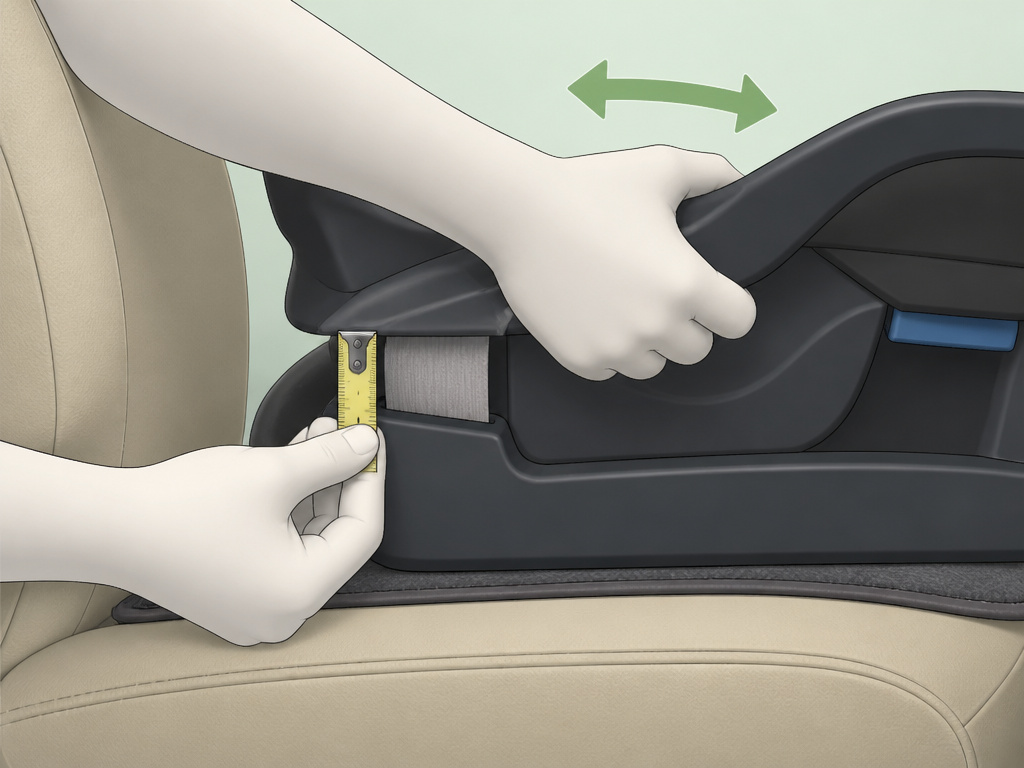
If your manual gives the green light, your work is not done. Permission is not a pass on safety. You must physically test the protector with your specific seat in your specific vehicle. The gold standard is the movement test advocated by Child Passenger Safety Technicians (CPSTs).
The goal is to ensure the protector isn’t creating a false sense of security by filling space or gripping the vehicle seat. You are checking for compression and slack.
- Install the car seat base or restraint WITHOUT the protector. Use LATCH or seat belt, and tighten until you have less than one inch of movement side-to-side and front-to-back at the belt path. This is your baseline.
- Without loosening the installation, slide the protector into place. For LATCH, you may need to detach one connector, slide the mat, and reattach without changing the strap’s tightness. This is tricky but critical.
- Check movement again with the protector in place. It should still be less than one inch.
- Now, remove the protector without loosening the installation. This is the key step. Slide it out or, if necessary, detach one LATCH connector, remove the mat, and immediately reattach.
- Check movement a final time. If the seat now moves more than one inch at the belt path, the protector was acting as a shim or grip. It compressed or shifted, taking up space that is now empty. That mat is unsafe.
A protector that passes this test is likely thin and non-compressible. Many cloth seat protectors fail because their fabric bunches; rigid plastic mats often fail because their grippy rubber feet hold the seat in place artificially. This test is why many experts point to a simple, thin receiving blanket as the safest option for protecting seats from damage.
Why “Seems Tight” Isn’t Good Enough
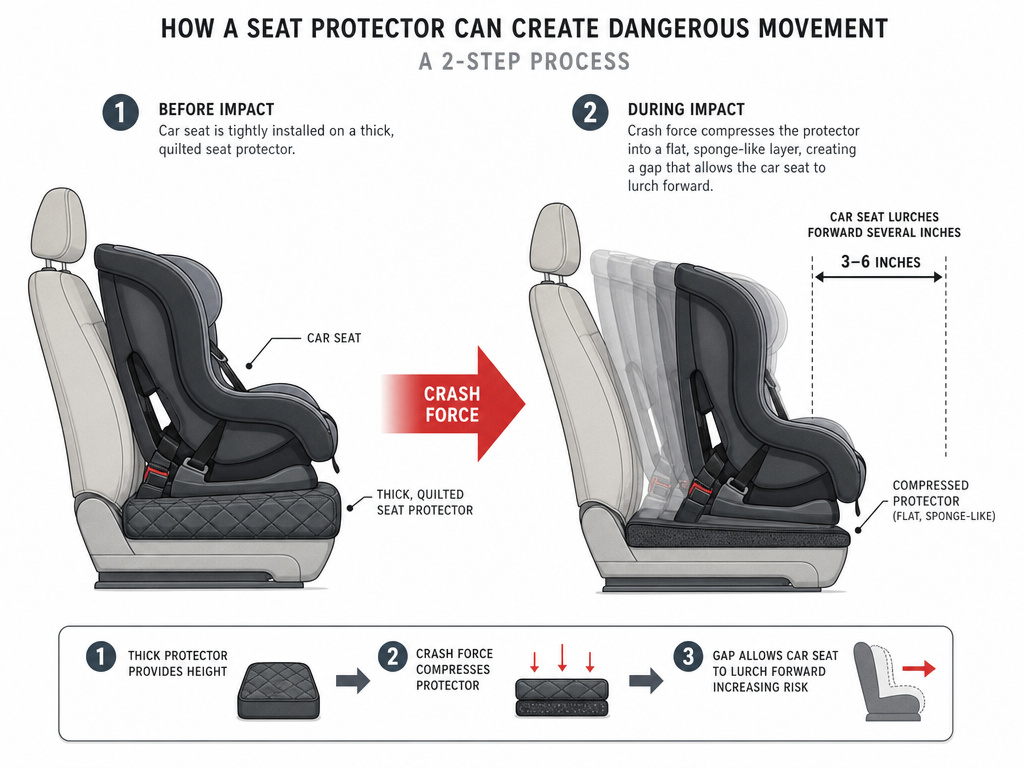
Your hand pressing on the seat is not a crash force. In a collision, everything compresses. A protector that feels firm in your driveway can behave like a sponge at 30 mph.
- Compressible Padding: Thick, quilted, or memory foam materials collapse under crash forces. This introduces sudden slack into the belt path, allowing the car seat to jerk forward several extra inches. That increased travel dramatically raises the risk of head impact with the front seat or door pillar.
- Grippy Backings: Mats with rubberized dots or silicone patterns can make a seat feel rock-solid during your check. The restraint isn’t moving because it’s stuck to the mat, not because the LATCH strap or seat belt is tight. In a crash, that adhesive grip can fail, or the entire mat can shift as a unit.
- Obstructed Hardware: Many protectors cover the vehicle’s lower anchor bars or the seat belt buckle. You might think you’ve achieved a tight connection, but the webbing is riding over a lump of fabric instead of lying flat against the vehicle seat. This changes the angle of the force and can weaken the connection.
The Car Seats For The Littles guide documents this vividly, showing how a “tight” install over a popular rigid mat became several inches of movement once the mat was removed. The force of a crash will find that hidden slack every time.
Safer Alternatives to a Bulkier Protector
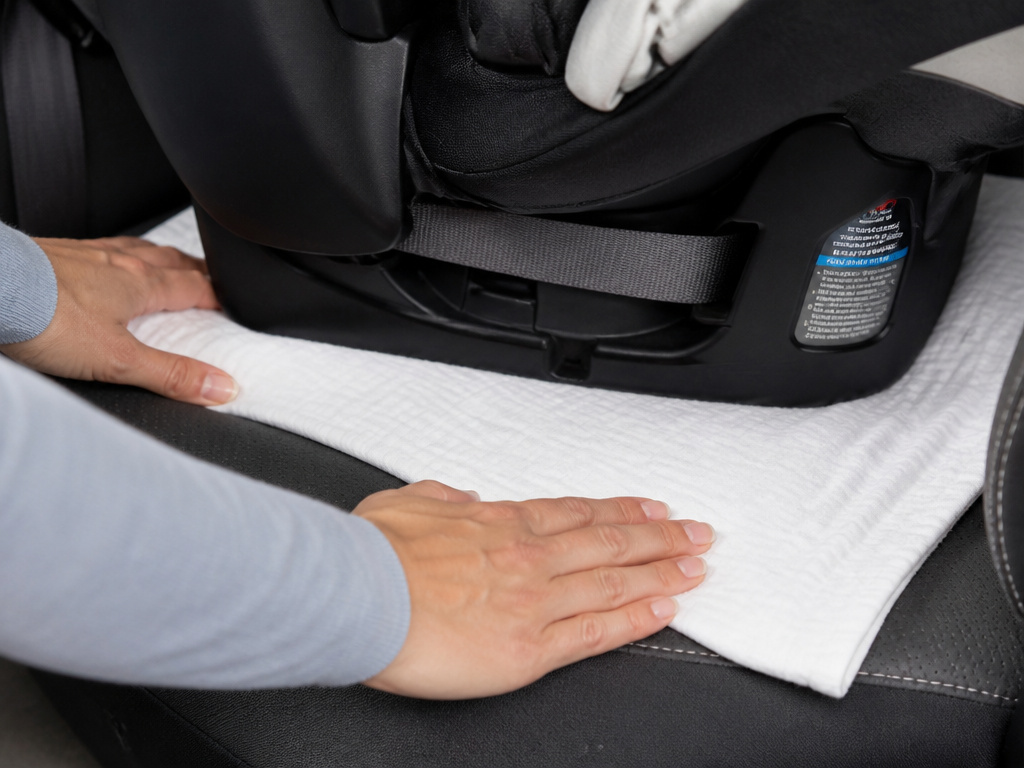
If your manual prohibits protectors or your test fails, you still have options to shield your upholstery. The principle is to use the thinnest, least intrusive barrier possible.
- A Single, Thin Receiving Blanket or Flour Sack Towel: This is the option explicitly listed in many manuals (like Cosco’s). It adds negligible thickness, slides out easily for testing, and catches crumbs and spills. If it wrinkles, smooth it flat.
- Puppy Pads or Incontinence Pads: Unsightly but functional. They are designed to be absorbent and non-slip on one side. Use the absorbent side up and ensure the rubberized backing doesn’t create a grip that interferes with installation.
- Felt Furniture Pads: For preventing indentations on leather seats, a small, thin felt pad placed under the front corner of a car seat base can distribute weight without affecting the belt path. Avoid using them under the entire seat.
The focus should be on cleanability, not cushioning. A leather-conditioning wipe used regularly does more to preserve your seats than a thick mat that traps moisture and dirt against the upholstery. For parents of infants, a protector for baby seats that’s just a waterproof, thin layer is often the best compromise.
Frequently Asked Questions
Do car seat protectors void warranties?
Yes, absolutely. If your car seat manual states “do not use any aftermarket accessories” and you use a protector, you have violated the terms of use. If the seat is involved in a crash and the insurer or manufacturer investigates, they can deny a warranty replacement claim citing improper use. This is a concrete financial risk beyond the safety issue.
Are there any car seat protectors that are crash-tested?
Some car seat manufacturers crash-test their own branded accessories, like the Diono Ultra Mat or the Clek Drape. When a company like Diono says you may use their mat, it means they have validated it with their seats. A third-party mat claiming to be “crash-tested” is making a meaningless claim, as there is no federal standard for that test. Trust only explicit, written approval from your car seat’s maker.
Can I use a towel instead of a car seat protector?
Maybe. Check your manual. Brands like Graco, Cosco, and Safety 1st explicitly permit a thin towel or blanket. The key word is thin—a folded, plush bath towel is a compressible hazard. A flat, cotton kitchen towel is usually acceptable. It must pass the one-inch movement test.
What about seat protectors for booster seats?
The same rules apply, but the risk is different. Boosters position the vehicle seat belt. A thick protector can alter the child’s seating height, affecting belt fit across the shoulder and lap. It can also prevent the booster from sitting flush against the vehicle seat back, causing a dangerous “gap” that allows the booster to tip forward in a crash. Always consult the booster manual.
Are winter car seat covers safe?
They are among the riskiest accessories. A winter car seat cover is typically a bulky, puffy bag that goes over the entire child and restraint. They are notorious for interfering with harness tightness (you can’t see the buckle), creating dangerous hoods around the child’s face, and causing overheating. Most car seat manufacturers and CPSTs strongly advise against them. Dress the child in thin, warm layers instead.
The Bottom Line
Your vehicle’s upholstery is replaceable. Your child is not. The regulatory landscape for car seat protectors is clear: the government sets a floor, but the manufacturer builds the walls. Your first and last stop is the car seat manual. If it says no, the answer is no.
If it says yes, your job is to verify. The one-inch movement test is not a suggestion—it’s the physical proof you need. Any mat that masks slack is a mat that betrays you when it matters most. When in doubt, the safest path is always the simplest: a flat towel, a clean seat, and the confidence that comes from knowing your installation is secure down to its last inch.
