
Can You Bring a Car Seat and Stroller on a Plane? Airline Rules
This post contains affiliate links. As an Amazon Associate, we earn from qualifying purchases.
Yes, you can bring a car seat and stroller on a plane, and airlines typically do not charge extra for them. The car seat must be FAA-approved for in-cabin use, and the stroller can usually be checked at the gate. Critical exceptions exist: JetBlue, for example, prohibits car seats in Mint suites on its A321 NEO and LR aircraft due to incompatible shoulder straps.
That shoulder-strap clause in JetBlue’s policy is where most premium-cabin travelers trip. The airline’s published rules name three specific aircraft types, and the restriction isn’t about space—it’s about a safety harness that cannot secure a child restraint. Get that detail wrong at the gate, and your seat assignment evaporates.
What follows: the exact federal statutes that guarantee your gate-check right, the model-specific installation numbers from a real car seat manual, and the step-by-step move that protects your gear from baggage-handler damage.
Key Takeaways
- Your FAA-approved car seat flies free and should be used in a window seat for safety; booster seats and vests are not approved for flight.
- Federal law (49 U.S. Code § 41726) requires airlines to gate-check your stroller, but they can refuse if its size or weight is a safety risk.
- JetBlue explicitly bans car seats in Mint suites on A321 NEO Mint (3NS) and A321 LR (3NL) aircraft—check your aircraft type before selecting seats.
- Always gate-check, never check at the ticket counter. The baggage system is where car seats get crushed and strollers get bent.
- Register your car seat with the manufacturer. If a recall happens mid-trip, you need to know.
The FAA & Airline Rules: What’s Allowed, What’s Not
The Federal Aviation Administration (FAA) strongly recommends using an approved child restraint system for any child under 40 pounds. An approved seat has a label on it that reads, “This restraint is certified for use in motor vehicles and aircraft.” You cannot use a booster seat, a child vest, or a harness that isn’t explicitly labeled for aircraft use. The reason is physics: an aircraft seatbelt is a lap belt only, designed to work with the seat’s own structure. A booster seat needs a car’s shoulder belt to function, and a loose vest offers zero protection during turbulence.
A child restraint system must bear the appropriate label: “This restraint is certified for use in motor vehicles and aircraft.” The label is often sewn onto the fabric near the child’s shoulders or stamped on the plastic shell. Without it, the airline will not permit its use in the cabin, as it does not meet Federal Motor Vehicle Safety Standard (FMVSS) 213 for aircraft use.
Airlines build their policies on this FAA foundation. Most follow the same script: one car seat and one stroller per child fly free, and they don’t count toward your baggage allowance. The car seat can be used in-cabin if you purchased a seat for the child, or it can be checked. The stroller is almost always gate-checked.
But the devil is in the airline-specific amendments. JetBlue’s policy is the clearest example of a rule that looks standard until you hit a specific cabin and aircraft type.
The JetBlue Mint Exception That Changes Your Seat Map
JetBlue states that car seats are allowed in Mint suites only on the A321 Classic Mint (32S) aircraft. They are not permitted in Mint seats on the A321 NEO Mint (3NS) or A321 LR (3NL) aircraft. This isn’t a suggestion. It’s a prohibition tied to the physical design of the shoulder straps in those specific suites, which cannot secure a child restraint properly.
If you book a Mint seat for your child on those aircraft types, you will be moved to a standard economy seat at the gate. There is no workaround. You must check the aircraft type during booking and again before you select seats. This specific restriction is a perfect example of why generic airline policies summaries aren’t enough—you need the model number.
| Aircraft Type | Mint Suite Car Seat Allowed? | Reason |
|---|---|---|
| A321 Classic Mint (32S) | Yes | Standard seatbelt configuration compatible with CRS installation. |
| A321 NEO Mint (3NS) | No | Shoulder strap design is incompatible with securing a child restraint system. |
| A321 LR (3NL) | No | Shoulder strap design is incompatible with securing a child restraint system. |
The takeaway is blunt. Never assume your premium cabin ticket includes a car seat spot. Verify the aircraft type against the airline’s own help page.
Your Legal Rights: Gate-Checking and Stowage Priority
Your ability to gate-check a stroller isn’t just airline generosity; it’s federal law. The statute 49 U.S. Code § 41726 states a covered air carrier shall not deny a passenger the ability to check a stroller at the departure gate if it’s being used to transport a child on the same flight. The only exception is if the stroller’s size or weight poses a safety or security risk.
Common mistake: Checking the stroller at the ticket counter. The baggage conveyor system is a maze of steel rollers and high-drop chutes that can snap frames. Gate-checking means it’s hand-carried down the jet bridge and loaded last, coming out first at your destination.
This law is your backup. If a gate agent tries to tell you to go back to the main counter, you can point to the U.S. Code on stroller carriage. It rarely comes to that, but knowing the rule exists changes how you approach the conversation.
A separate but powerful regulation covers priority stowage. 14 CFR § 382.123 requires airlines to give priority in onboard stowage areas to wheelchairs and other assistive devices. They must move their own crew luggage or an onboard wheelchair to make room. While this rule is written for wheelchairs, it sets a precedent for the care required for mobility devices. It underscores that airlines have a heightened responsibility for essential equipment, a principle that savvy parents extend to their travel gear. Understanding these federal stowage requirements for devices helps you frame a request for careful handling.
Will Your Car Seat Actually Fit? The Manufacturer’s Numbers
An FAA approval label doesn’t guarantee the seat will physically install in an airplane seat. Airlines publish seat width charts, but they are averages. The only reliable numbers come from the car seat manufacturer’s manual.
Take the Evenflo Shyft DualRide, a common travel combo seat. Its manual specifies two critical measurements for aircraft use: 1. A minimum 45.7 cm (18 in) aisle width for use in stroller mode. 2. A minimum 45.7 cm (18 in) seat width for aircraft installation.
Most economy airline seats are about 17-17.5 inches wide. A seat requiring 18 inches might not install tightly, if at all. The manual also states the child must weigh between 3 and 35 lbs and be under 32 inches tall, with the top of the child’s head at least 1 inch below the headrest.
Where this goes sideways: Assuming “FAA-approved” means “fits.” The approval is about crash dynamics, not dimensions. A seat that’s too wide will rock side-to-side no matter how hard you tighten the belt, compromising safety.
Here is a quick reference from the Evenflo manual. Your own seat’s manual will have a similar section.
| Specification | Evenflo Shyft DualRide Requirement | Why It Matters on a Plane |
|---|---|---|
| Minimum Seat Width | 45.7 cm (18 in) | If the airplane seat is narrower, the car seat will overhang and cannot be secured tightly. |
| Child Weight Limit | 1.4 – 15.8 kg (3 – 35 lbs) | Exceeding the limit voids the certification and protection. |
| Child Height Limit | 40 – 81 cm (15.7 – 32 in) | The child’s head must be at least 2.5 cm (1 in) below the seat’s headrest. |
| Carry-All Bag Load | Max 3.2 kg (7 lbs) | Overloading the stroller bag attached to the frame can make it unstable when pushed. |
Check your manual. If you’ve lost it, search the model number and “PDF manual” online. The installation section is non-negotiable data.
Step-by-Step: Gate-Checking and In-Cabin Use

The process splits into two paths: using the car seat on the plane, or checking everything. Using it on board is safer and keeps the seat from being damaged. This is the sequence that works.
Before You Leave Home:
- Find the FAA approval label on your car seat and take a photo of it.
- Register your car seat with the manufacturer. If a recall is issued, this is how they contact you. The Evenflo manual directs users to call the U.S. Vehicle Safety Hotline (1-888-327-4236) or visit NHTSA.gov for recall info.
- Practice installing the seat in a chair at home using only a lap belt. You’ll be doing this in a cramped space.
At the Airport:
- Use the stroller to get to the gate. Do not check it at the ticket counter.
- At the gate, ask for gate-check tags for both the stroller and the car seat (if you’re not using it on board). The agent will tag them.
- Fold the stroller and leave it in the designated spot at the jet bridge door. Take the car seat with you onto the plane if you’re using it.
On the Aircraft:
- Install the car seat in a window seat. This is an airline rule—it cannot block anyone’s path to the aisle. A middle seat is only allowed if both adjacent seats are empty.
- Thread the airplane lap belt through the belt path indicated on the car seat. Pull it tight. The seat should not move more than an inch side-to-side or front-to-back.
- For rear-facing seats, they may not recline fully due to the seatback in front. That’s okay as long as the seat is level according to its built-in indicator.
- The seat must remain secured at all times, even if the child is out of it.
I watched a parent in front of me struggle for ten minutes because they’d only ever installed their seat with the car’s LATCH system. They didn’t know how the lap-belt path worked. The flight attendant couldn’t help. They had to gate-check the seat at the last second. Practice the belt path.
Gate-checking is the superior method for a reason. The gate-checking procedures are designed for fragile items. When you check a car seat as regular luggage, it goes through the same automated system as suitcases, risking cracks in the plastic shell that you might not see until the next car ride.
What Not to Bring: Banned and Risky Items
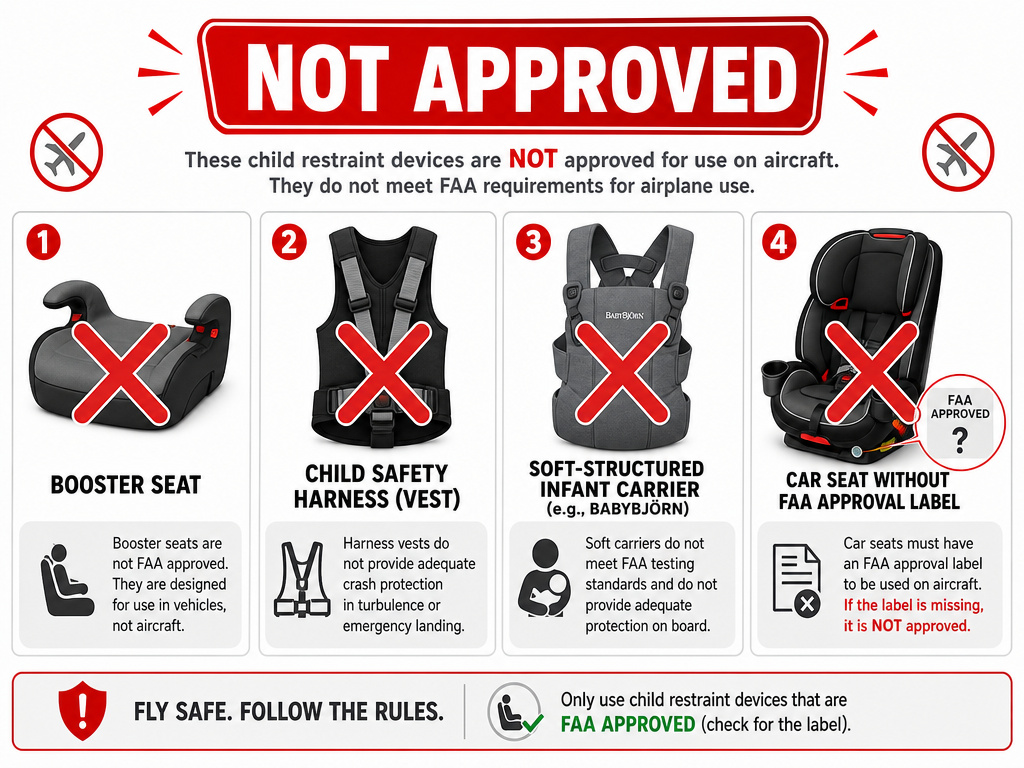
The list of what you can’t use is shorter but critical. Knowing these bans prevents a last-minute surrender of your gear at the gate.
- Booster Seats: Not approved for aircraft use. They require a shoulder belt, which airplane seats lack.
- Child Vest or Harness Restraints: These are not approved for takeoff, landing, or taxiing unless they are explicitly FAA-approved devices (very few are).
- Infant Carriers (like a BabyBjörn): These are not child restraint systems. You cannot secure them to an aircraft seat.
- An Unapproved Car Seat: No label, no fly. Even if it’s a top-rated seat for the car.
The government of Canada’s travel page explicitly states these items are not approved for use as child restraint systems on an aircraft. U.S. Airlines follow the same FAA guidance. If your only restraint is a booster, your child will need to sit directly on the airplane seat using the lap belt. For a toddler, that belt will ride up over the abdomen, which is not safe in turbulence. This is why the FAA pushes for an approved CRS.
The practical tips for air travel with baby gear always start with the right hardware. A booster seat is the wrong hardware for a plane.
Travel Systems vs. Separate Pieces: The In-Cabin Reality
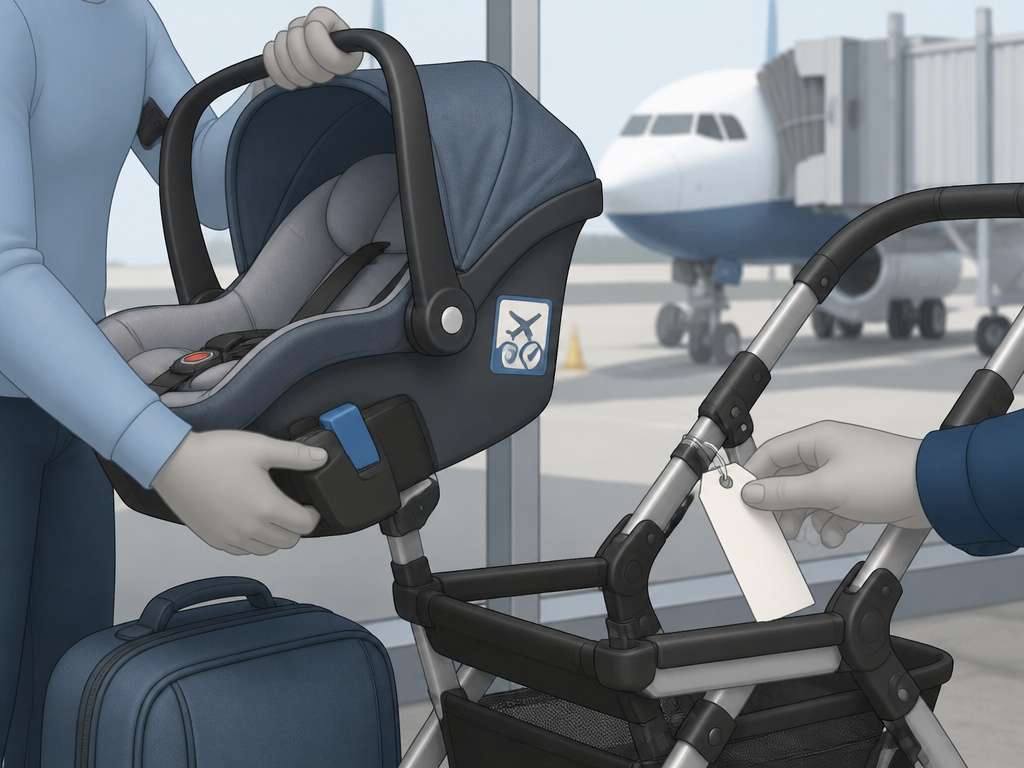
A travel system—where the infant car seat clicks into a stroller frame—is fantastic for the airport. But it changes your in-cabin strategy. You have two pieces: the infant carrier (the car seat) and the stroller frame.
The infant carrier, if FAA-approved, can be used on the plane if you bought a seat. The stroller frame must be gate-checked. You cannot use the frame in the cabin. This means you’ll carry the infant carrier to your seat and install it separately.
Some parents prefer a lightweight, standalone stroller like the GB Pockit for travel and a separate car seat. The advantage is that the stroller folds so small it might fit in the overhead bin, avoiding gate-check entirely. The disadvantage is you’re managing two independent items.
The best choice depends on your child’s age and your tolerance for lugging gear. For an infant, the travel system’s convenience through the terminal often outweighs the minor hassle of separating components at the gate. Your strategies for flying with a car seat and stroller should match your physical capacity to carry them when they’re not rolling.
Frequently Asked Questions
Does a car seat count as a carry-on?
No. An FAA-approved child restraint system does not count as your carry-on bag or personal item. You can still bring a carry-on suitcase and a diaper bag. The car seat is considered an additional, essential piece of equipment for the child.
Can you gate-check both a car seat and a stroller?
Yes, you can gate-check both items. This is the standard and recommended procedure. You will receive two gate-check tags at the departure gate. The items will be returned to you at the aircraft door upon arrival, not at the baggage carousel.
What is the best car seat for airplane travel?
The best seat is the one that is FAA-approved, fits your child, fits in an airplane seat, and that you can carry easily. Lightweight models like the Cosco Scenera Next are popular for travel because they are narrow, inexpensive, and meet all standards. Always verify its width against your airline’s seat map.
Can flight attendants help me install a car seat?
Flight attendants are not required or trained to install car seats. They can ensure you are using an approved seat and that it’s in a window seat, but the actual installation is your responsibility. This is why practicing with a lap belt at home is non-negotiable.
What if my stroller is damaged when gate-checked?
Airlines assume liability for damage to gate-checked items, but their contracts often limit this liability for strollers. JetBlue’s Contract of Carriage, for example, states it assumes no liability for loss, damage, or delay of checked strollers. Report any damage immediately at the arrival gate and file a claim. The airline policies page will have the specific claims procedure.
The Bottom Line
You can bring a car seat and stroller on a plane. The system is designed for it. Your job is to navigate the specifics: the FAA label, the aircraft-type bans like JetBlue’s Mint rule, and the mechanical reality of installing a 18-inch-wide seat into a 17-inch space.
Gate-check everything you aren’t using in-cabin. Never send a car seat into the main baggage system. Know the federal statute that backs your gate-check request, and practice the lap-belt install until it’s muscle memory. The difference between a smooth journey and a gate-side argument is a photo of your seat’s certification label and the exact name of your aircraft type from the booking confirmation.
