
Are Infant Car Seat Bases Universal? Compatibility Guide
This post contains affiliate links. As an Amazon Associate, we earn from qualifying purchases.
Infant car seat bases are not universal. They are designed to lock only with specific car seat models from the same manufacturer. A Nuna PIPA seat clicks only onto a Nuna PIPA or PIPA RELX base. A Graco SnugRide Click Connect seat fits only a Graco Click Connect base. Using a mismatched seat and base voids the warranty and can fail in a crash, because the attachment mechanisms and crash-testing are not cross-compatible.
That answer kills the “universal base” idea outright. It’s the first thing a new parent Googles, and the first thing a well-meaning relative gets wrong.
The rest is about navigating the system you’re locked into: which bases work with which seats, why the rules are so strict, and how to install the one you have so it doesn’t move more than an inch at the belt path. You’ll also need to track a hard expiration date, most bases must be thrown out 7 years after manufacture.
Key Takeaways
- Zero cross-brand compatibility. A Chicco KeyFit seat will not securely lock onto a Graco, Nuna, or Evenflo base. The connection points are proprietary.
- Check the manual for your exact model. A Nuna PIPA base fits all USA PIPA series seats except the PIPA urbn. Graco’s SnugRide SnugLock 35 DLX base works with SnugRide Click Connect 22, 30, 35, and 40 carriers. These specifics matter.
- Bases expire. Most manufacturers, including Graco, Baby Jogger, and BeSafe, mandate disposal 7 years after the manufacture date. Maxi-Cosi sets an 8-year limit.
- Never use both installation systems. You install the base with your vehicle’s seat belt OR the Universal Anchorage System (UAS/LATCH). Using both at once is prohibited and can overstress the base.
- i-Size bases add a layer. Models like the Joie i-Base 2 require a vehicle with official i-Size compatible seating positions, which you must verify in your car’s manual, not just the presence of ISOFIX anchors.
The Short, Direct Answer
A universal infant car seat base does not exist in the consumer market. Every major manufacturer. Graco, Chicco, Nuna, Evenflo, Britax, designs its base to interface solely with its own lineup of infant carriers. This lock-and-click mechanism is a patented, physical shape that prevents a competing brand’s seat from latching.
The belief in a universal base usually comes from a logical hope: wouldn’t it be easier if all seats fit all bases? Grandparents might swear they have one. The reality is a landscape of intentional incompatibility driven by safety certification, liability, and design patents.
When you buy an infant car seat, you are buying into an ecosystem. The seat and its base are crash-tested as a single system. Transport Canada and the U.S. National Highway Traffic Safety Administration (NHTSA) certify that specific seat on that specific base. Swapping parts invalidates the certification.
Why Manufacturers Lock You In
It’s not a conspiracy to sell more bases. It’s physics and legal liability.
The connection between seat and base is a load-bearing latch. In a collision, forces are transferred from the seat shell, through that latch, into the base, and then into the vehicle’s seat belt or LATCH anchors. If the latch doesn’t seat perfectly, if there’s a millimeter of play a different manufacturer didn’t account for, the seat can detach or deform.
Manufacturers explicitly warn against mixing brands. The Nuna PIPA series manual states: “Never attempt to use another manufacturer’s seat on this base.” The BeSafe iZi Modular i-Size base manual voids the warranty if non-original parts are used.
Those warnings exist because they’ve tested it. The results aren’t public, but the stance is unanimous.
The One Exception: Within a Brand Family
Compatibility exists, but only inside a brand’s own product lines. You must read your specific model manual.
| Brand & Base Model | Compatible Car Seat Models | Key Restriction |
|---|---|---|
| Nuna PIPA series base | All USA PIPA series infant car seats | Except the PIPA urbn |
| Graco SnugRide SnugLock 35 DLX Base | SnugRide Click Connect 22, 30, 35, 40 | SnugRide 40 carrier limits child height to 32″ |
| Chicco KeyFit Base | KeyFit, KeyFit 30, KeyFit 35 | Must be Chicco KeyFit series |
| Baby Jogger Base | Baby Jogger infant car seats only | No other brands |
This is where most car seat base differences become practical. A base designed for a smaller infant carrier might not adjust to properly secure a larger one, even from the same brand.
The 7-Year Clock Starts at Manufacture
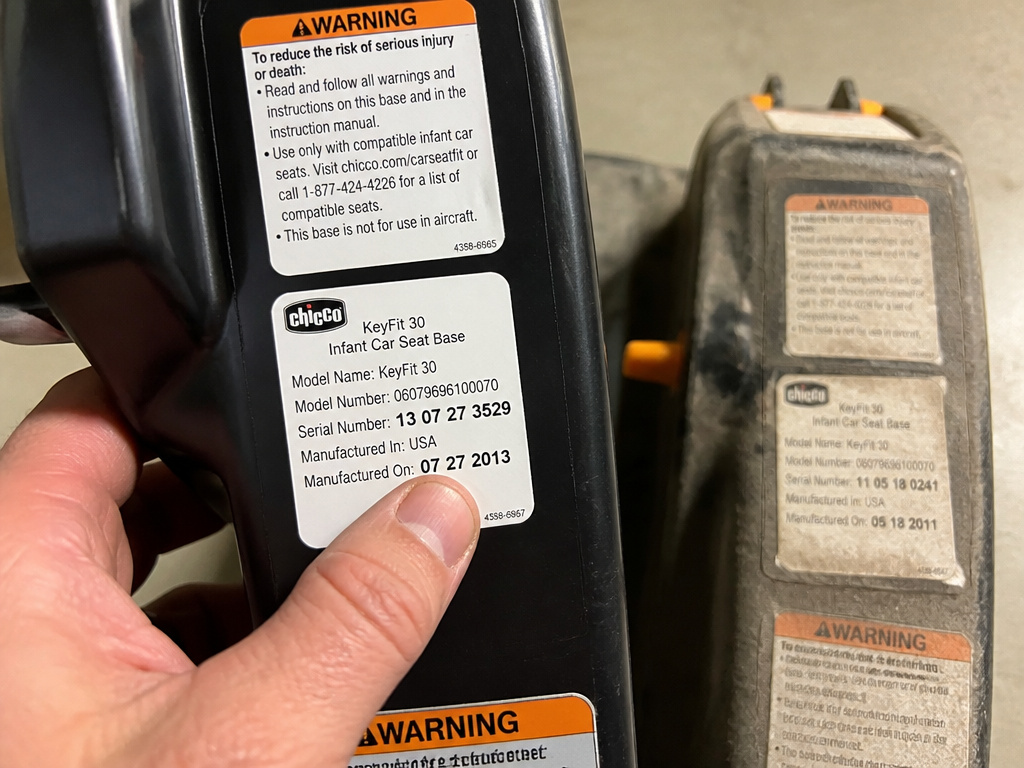
Common mistake: Assuming a hand-me-down base is safe if it “looks fine.” Plastic degrades. UV exposure, temperature swings, and stress fatigue weaken the shell and internal components over years. You cannot see this damage.
This is a non-negotiable, dated rule from every manual we reviewed: * Graco, Baby Jogger, BeSafe: 7 years from the manufacture date. * Maxi-Cosi: 8 years from the manufacture date.
The manufacture date is stamped on a label on the base itself. It’s not a suggestion. It’s the point after which the manufacturer will not guarantee the base’s structural integrity in a crash.
Think of it this way: the plastic in that base has been sitting in a car, baking in summer heat and freezing in winter, for years. It becomes brittle. In a collision, a brittle base can crack instead of absorbing and transferring energy as designed.
If you’re using a second-hand base, checking this date is your first step. If it’s expired, your next step is learning about disposing of bases responsibly, most retailers have recycling programs, and they should never go to a general thrift store.
How to Install Your (Non-Universal) Base Correctly
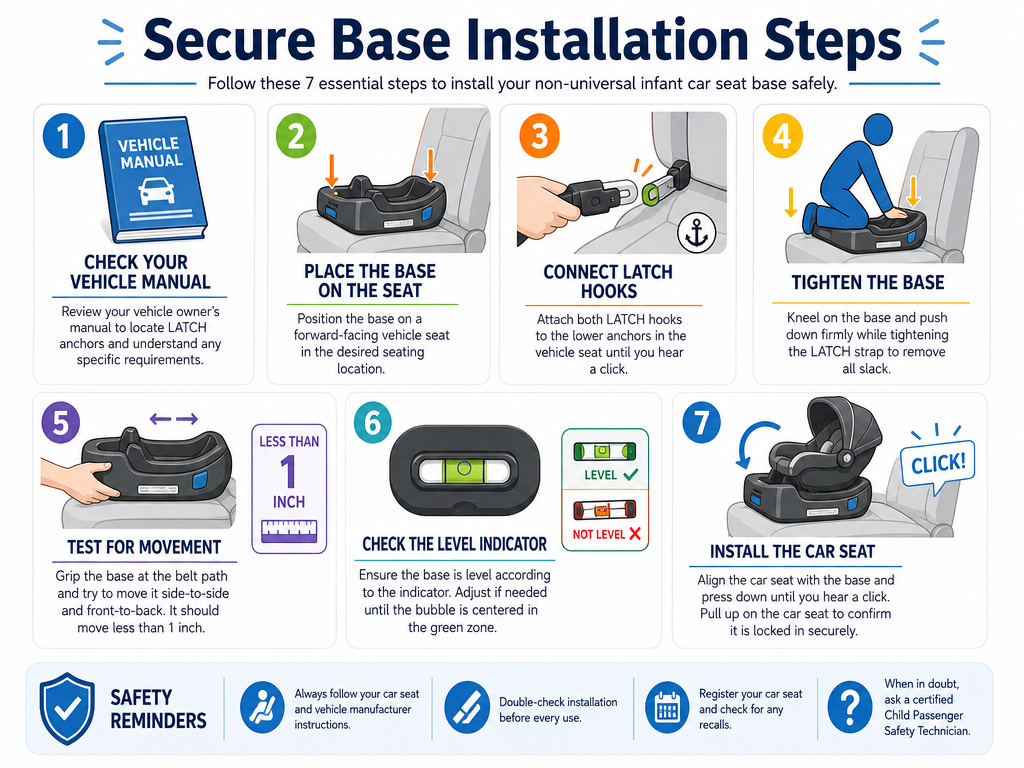
You have two approved methods: your vehicle’s seat belt or the Universal Anchorage System (UAS, also called LATCH). Both are equally safe when done right. The Graco manual is emphatic: “DO NOT USE BOTH AT THE SAME TIME.”
Where this goes sideways: Trying to get “extra safe” by using both the seat belt and LATCH straps. This can create conflicting pressure points on the base, preventing either system from tightening properly. In a crash, the base could pivot or snap.
Here’s the step-by-step for a secure install, which applies to any base installation.
- Consult your vehicle manual first. Identify which rear seats have LATCH anchors (U-shaped metal bars in the seat bight) and if there are any restrictions. Some cars only have anchors for the outboard seats, not the center.
- Place the base on the vehicle seat. Push it back firmly until it contacts the seat back.
- Choose your method and route the belt. For LATCH, connect the base’s hooks to the vehicle anchors. For seat belt, thread it through the base’s belt path as shown in the manual.
- Apply your weight and tighten. Kneel into the base, putting your full weight on it. Then pull the LATCH strap or seat belt tail as tight as you can. The base should compress into the vehicle seat cushion.
- Check for movement. Grasp the base at the belt path (where the seat belt or LATCH strap goes through it) and try to move it side-to-side and front-to-back. It should not move more than 2.5 cm (1 inch).
- Adjust the recline angle. Most bases have a recline foot or adjuster. Use the built-in level indicator to ensure the base is at the correct angle for your child’s weight.
- Click the seat in. Place your infant carrier onto the base. You should hear and feel a distinct click. Always pull up on the carrier handle to verify it’s locked before driving.
i-Size Bases: The “Universal” Standard That Isn’t

ISOFIX is the international standard for built-in vehicle anchor points. I-Size (UN Regulation No. 129) is a newer, stricter standard that uses ISOFIX but adds side-impact testing and mandates rear-facing until at least 15 months.
Bases like the Joie i-Base 2 and BeSafe iZi Modular i-Size Base are i-Size approved. Here’s the critical gap: an i-Size base is only “universal” for i-Size approved seating positions in your specific car.
Your vehicle manual has a section listing which seats are i-Size compatible. It’s not enough to have ISOFIX anchors; the vehicle manufacturer must have certified that specific seat position for the i-Size standard. You have to check.
What to Do When You Need Multiple Bases
Since bases aren’t universal, multi-car families need a plan.
Buy a second base. This is the simplest, safest route. Purchase an additional base that matches your exact car seat model for the second vehicle. It guarantees a correct, convenient fit every time.
Use the seat without the base. Every infant car seat on the market can be installed directly into a vehicle using just the seat belt. It’s a bit more fiddly, you have to thread the belt through the carrier’s built-in belt path each time, but it’s fully safe and certified. This is the official solution for taxis, rental cars, and grandparents’ cars where a permanent base isn’t practical.
Practice this installation at home before you need it. The goal is a tight fit, with the carrier not moving more than an inch at the belt path.
Frequently Asked Questions
Can I use an older base with a newer car seat from the same brand?
Maybe. You must verify compatibility in the manual for both the seat and the base. A new seat model might have an updated connection design that isn’t backward-compatible with an older base. Never assume.
Do car seat bases have expiration dates?
Yes. The lifespan is based on the manufacture date, not the purchase date. For most brands, the infant car seat base expiration dates is 7 years. The date is on a label on the base itself.
What does the “universal” in Universal Anchorage System (UAS) mean?
It refers to a standardized vehicle anchor system, not base compatibility. UAS (or LATCH) is a set of anchors built into vehicles made after September 2002. It provides a standardized way to attach compatible child restraints, but the base itself must still be designed to use it and match its specific car seat.
Are European car seat bases universal?
No. European seats use the ISOFIX standard, which is more uniform than the North American LATCH system. However, compatibility is still largely brand and model-specific. An i-Size base must be used with an i-Size seat and in an i-Size approved vehicle seating position.
Can I add aftermarket accessories to make a base universal?
Absolutely not. Adding any non-approved part, cushion, or adapter voids the warranty and compromises safety. This includes aftermarket infant inserts not sold by your car seat’s manufacturer. Use only the accessories that came with your seat or are listed as approved in its manual.
The Bottom Line
Forget the idea of a universal infant car seat base. It’s a safety myth.
Your reality is matching a specific seat to its specific base, installing it tightly with one method only, and replacing it when the 7-year clock runs out. The system feels restrictive because it’s built around predictable, crash-tested performance.
Your move is to learn your gear’s specifics. Read the manual for your seat and base. Find the manufacture date. Practice the seat-belt-only install. That knowledge is what actually makes your child safer, not a fictional universal adapter that doesn’t exist.
