
Can a Convertible Car Seat Be Used in a Stroller? The Answer
This post contains affiliate links. As an Amazon Associate, we earn from qualifying purchases.
A convertible car seat cannot be used in a stroller. They are incompatible by design. Strollers that accept car seats are engineered for specific infant-only car seats, usually as part of a branded travel system. Using a convertible seat, designed for long-term vehicle use from birth to toddlerhood, in a stroller creates an unstable, unsafe connection that every major manufacturer explicitly warns against.
That design incompatibility is absolute. It’s not a matter of finding the right adapter or a clever hack. The physical shapes, attachment points, and safety certifications are fundamentally different. A convertible seat lacks the reinforced base and specific latching hardware that lets an infant car seat click securely into a stroller frame.
What follows is the breakdown of that design wall, the specific warnings from manufacturer manuals, and the only safe path forward for parents who want the convenience of a car seat that clicks into a stroller.
Key Takeaways
- Convertible car seats are for vehicles only. Their design, a single, rigid shell meant to be secured with a seat belt or LATCH, has no mechanism to lock into a stroller.
- Every major stroller and car seat manual contains explicit warnings against mixing brands or using non-approved seats. Graco, Chicco, and Evenflo all state that doing so “may result in serious injury or death.”
- The safe solution is a travel system: an infant car seat and a compatible stroller sold as a pair or with a verified adapter. These use a proprietary click-connect latch for a secure, tested fit.
- A stroller must lay completely flat to be used safely with a newborn without a car seat. Most standard strollers cannot do this, which is why the infant car seat is necessary for the first 4-6 months.
- Car seats have expiration dates, typically 6-10 years from manufacture. Using an expired convertible seat in any context voids its safety certification.
Why Convertible Car Seats Don’t Fit Strollers (The Design Problem)
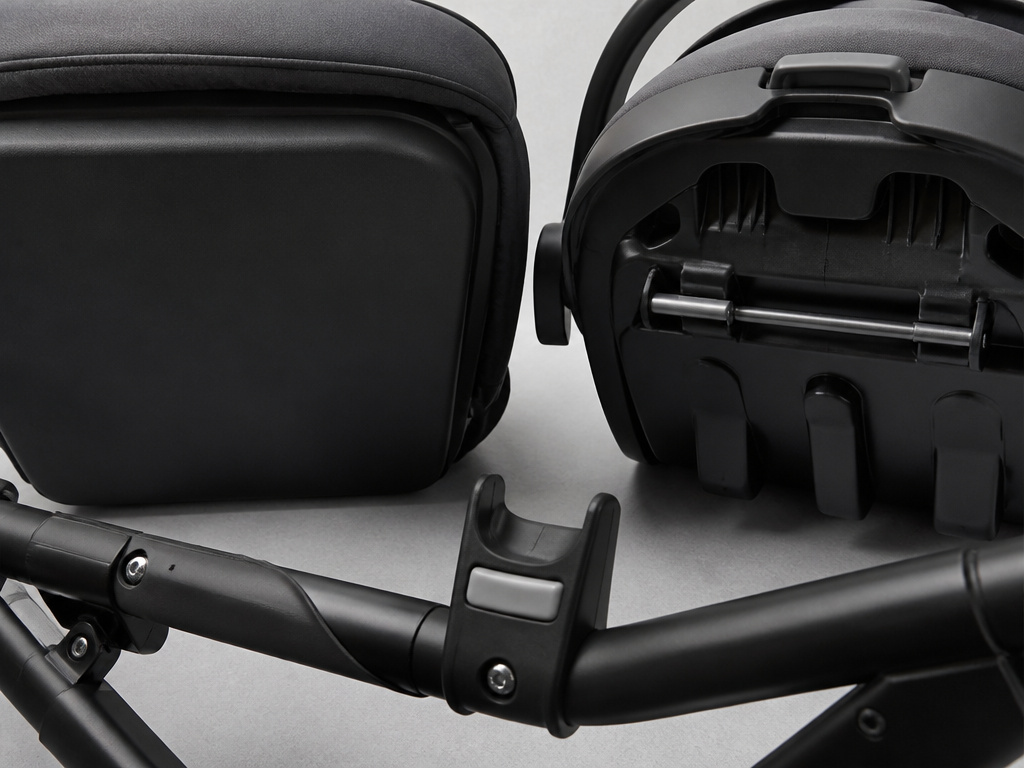
The core issue is purpose. A convertible car seat is a long-term vehicle restraint. A stroller-compatible infant car seat is a short-term carrier that also functions as a vehicle seat.
Convertible seats use a one-piece shell designed to absorb crash forces in a fixed, rear- or forward-facing orientation in a vehicle. They attach via the vehicle’s seat belt or LATCH system. Infant seats have a separate, reinforced base that stays in the car and a carrier that detaches, featuring built-in handles and stroller-specific attachment points on its underside.
Look at the bottom of a Chicco KeyFit or a Graco SnugRide. You’ll find molded grooves or a bar designed to engage with a specific latch on its matching stroller frame. Now look at the bottom of a convertible seat like the Chicco NextFit MAX Zip. It’s flat or has vehicle installation guides. There’s nothing for a stroller to grab.
This isn’t an oversight. It’s physics. The forces on a seat in a strolling scenario are different from those in a crash, but the need for stability is the same. A loose seat can tip, twist, or detach entirely if a stroller wheel hits a curb. The click-connect system in a travel system is engineered to prevent that movement. A convertible seat sitting in a stroller basket or strapped loosely with a bungee cord has no such engineering.
The part nobody mentions: Even if you could physically wedge a convertible seat into a stroller seat, the center of gravity would be dangerously high. The seat is too tall and top-heavy compared to the low-slung profile of an infant carrier, making a tip-over almost inevitable on any uneven surface.
The Manufacturer Warnings Are Not Suggestions
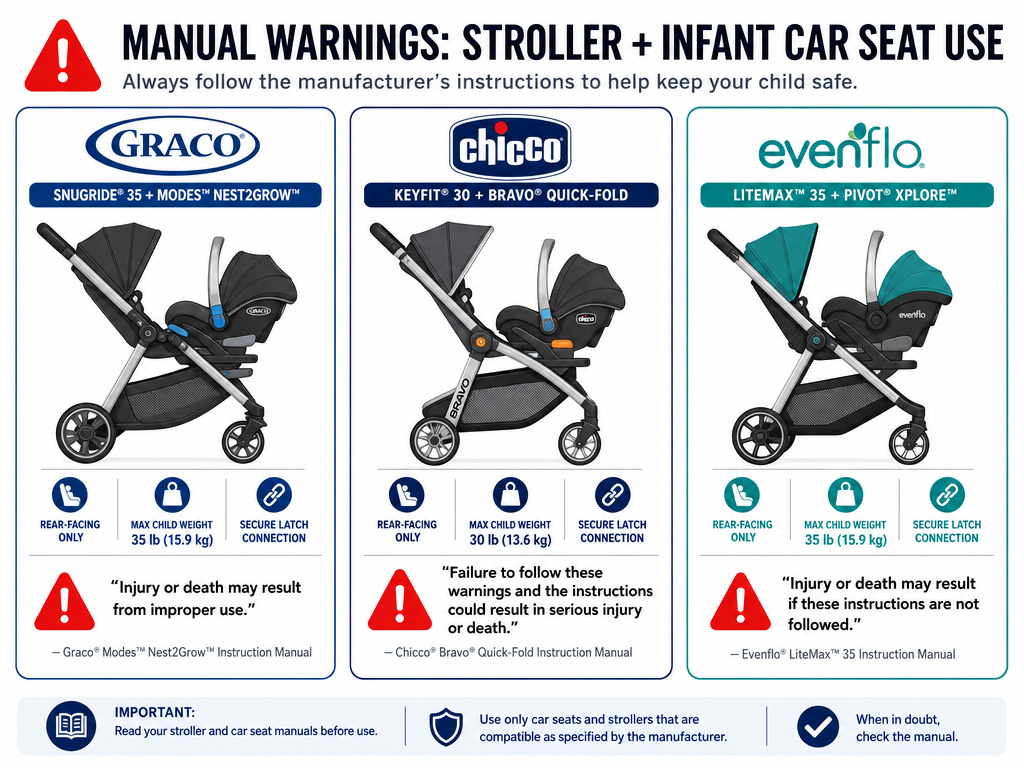
This is where the research gets blunt. I pulled the official owner’s manuals for major brands. The language is not cautious; it is prohibitive and dire.
- Graco: The manual for the Graco SnugRide Click Connect Travel System states, “USE ONLY A GRACO® SNUGRIDE® CLICK CONNECT™ CAR SEAT with this travel system. Improper use of this stroller with other manufacturers’ car seats may result in serious injury or death.”
- Chicco: The Chicco Corso LE Stroller manual reads, “ONLY USE a Chicco infant car seat with this product. Do not attempt to attach any infant car seat to the stroller other than the Chicco infant car seat. Injury or death may result.”
- Evenflo: Warnings across the Omni Ultra, Pivot Xpand, and Clover travel systems are identical: “Only use Evenflo [specific model] infant car seats with this stroller… If any car seats are used that are not specified in the instructions, this may result in serious injury to your child.”
These warnings exist for liability, yes. But they exist primarily because the brands’ own safety testing never evaluated, and therefore cannot certify, any other configuration. Using a non-approved seat instantly voids any safety validation.
| Brand | Stroller Model | Approved Car Seat(s) | Direct Warning Quote |
|---|---|---|---|
| Graco | SnugRide Click Connect System | Graco SnugRide Click Connect only | “Improper use… May result in serious injury or death.” |
| Chicco | Corso LE Stroller | Chicco infant car seats only | “Injury or death may result.” |
| Evenflo | Omni Ultra Travel System | Evenflo LiteMax, LiteMax NXT, Revolve LiteMax 180° NXT | “May result in serious injury to your child.” |
The Travel System Alternative: How It Actually Works
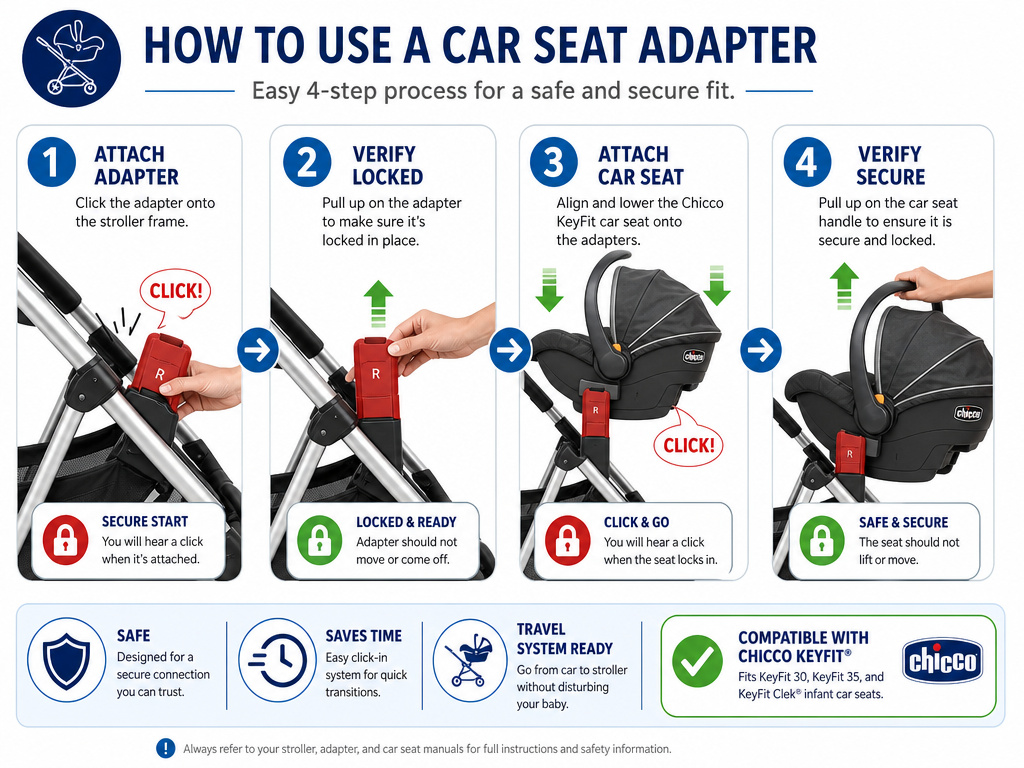
Since a convertible car seat won’t work, what does? The answer is a travel system or a stroller with a verified infant car seat adapter. This is the only safe way to achieve the “click and go” convenience.
A true travel system, like many of the best travel systems, is a package where the infant car seat and stroller are designed as a single, compatible unit. The seat clicks directly into the stroller frame without any extra parts. The latch mechanism is built into both pieces.
For strollers sold separately, compatibility is achieved through an adapter. This is a rigid plastic or metal frame that attaches to the stroller, creating the proprietary mounting points for a specific brand of infant seat. For example, a universal stroller might need a “Chicco adapter” to accept a Chicco KeyFit seat.
Here’s the critical sequence:
- The adapter clicks or bolts securely onto the stroller frame.
- You verify it’s locked by pulling up on it.
- The infant car seat carrier, with the baby already buckled in, then clicks down onto the adapter.
- You pull up on the seat handle again. It should not budge.
If the seat wobbles or lifts off, the connection is not secure. Stop. This is the exact scenario the manuals warn about. The entire value of a travel system is this tested, rigid connection.
What About Strollers That Recline Flat?
Some parents ask: if I can’t use the car seat, can I just lay my newborn flat in the stroller itself? The answer depends on one feature: a true, fully flat recline.
Where this goes sideways: Using a stroller that only “reclines a lot” for a newborn. If the seat doesn’t go completely horizontal (a 180-degree lay-flat bassinet mode), an infant’s airway can become compromised, a risk factor for positional asphyxiation.
Most standard stroller seats, even when fully reclined, leave a slight angle. This is fine for an older baby with head control but is not safe for a newborn. True bassinet attachments or strollers with a certified flat recline are designed for this. If your stroller doesn’t have this, your child needs the support of an infant car seat until they can sit upright unassisted, usually around 6 months.
This is why the infant car seat travel system is the default for the first half-year. It provides a safe, contained, and properly angled sleep space both in the car and on the go.
Convertible Car Seat vs. Travel System: Picking Your Path
Your choice here defines your first 2-3 years of gear. You can’t mix them, so you pick one primary strategy.
| Aspect | Convertible Car Seat Path | Infant Car Seat + Travel System Path |
|---|---|---|
| Core Use | Long-term vehicle seat only. | Vehicle seat + stroller carrier for first 9-18 months. |
| Newborn Solution | Use the convertible seat rear-facing in the car. Baby must be carried or use a flat-recline stroller/bassinet. | Use the infant seat. It clicks from car base to stroller without disturbing baby. |
| Convenience | Lower upfront cost, fewer pieces. Less convenient for errands or moving a sleeping baby. | Higher convenience factor. The “click-connect” system is invaluable for quick transitions. |
| Longevity | One seat from birth to booster (4-10 years). | Requires transitioning to a convertible seat after the infant seat is outgrown (~1 year). |
The benefits of convertible car seats are economic and simple: you buy one seat. But you sacrifice the seamless portability of an infant carrier. The travel system path is about convenience and preserving nap schedules, at the cost of buying two dedicated seats over time.
If your lifestyle involves lots of short trips, doctor visits, or daycare drop-offs where you don’t want to unbuckle a sleeping baby, the travel system is worth the investment. Look for a growing travel system with a stroller that accommodates a toddler seat after the infant carrier is retired.
Safety and Compatibility Checklist
Before you assume anything fits, run through this list. It applies whether you’re buying new or using hand-me-downs.
- Check the manual. Not the website summary, the actual PDF owner’s manual. Find the “Compatibility” or “Use With” section. This is non-negotiable.
- Look for the click. A secure connection makes an audible click and has no play when you pull up on the seat. A snug fit is not secure. It must be locked.
- Verify the adapter. If using one, ensure it is the exact model specified for your stroller and car seat brand. Universal adapters are not universal across all brands.
- Inspect for damage. Check the stroller’s latch receivers and the car seat’s attachment bars for cracks, wear, or dirt that could prevent locking.
- Know the limits. Observe the infant seat’s height and weight limits. Using an outgrown seat is as dangerous as using an incompatible one.
Remember, car seat compatibility is a binary switch. It’s either explicitly approved by the manufacturer or it is not. There is no middle ground.
Frequently Asked Questions
Can you use a convertible car seat with a stroller adapter?
No. Stroller adapters are designed exclusively for specific models of infant car seats, not convertible seats. The adapter creates a link between the stroller’s latch system and the infant seat’s built-in connection points, which a convertible seat lacks.
What is the difference between a convertible car seat and an infant car seat?
convertible car seat is a permanent vehicle seat that transitions from rear-facing (for infants) to forward-facing (for toddlers). An infant car seat is a rear-facing-only carrier with a handle; it detaches from a base in the car and is designed to click into a compatible stroller.
Are there any strollers that work with convertible car seats?
There are no major, safety-certified strollers designed to work with convertible car seats. The products that sometimes cause confusion are “car seat frames” or “travel system frames,” which are minimalist strollers designed only for an infant car seat carrier, not for a convertible seat.
Why do car seats expire?
Plastic degrades over time due to temperature cycles, UV exposure, and stress. The materials can become brittle and fail to perform as designed in a crash. The Chicco NextFit MAX Zip, for example, has an 8-year expiration from its manufacture date. Always check the label on the seat.
Where can I find official car seat safety guidelines?
The National Highway Traffic Safety Administration (NHTSA) sets the federal standards. Their NHTSA car seat safety guide is the primary source for installation rules, best practices, and recall information.
Before You Go
The takeaway is simple but rigid: a convertible car seat and a stroller are two separate tools for two separate jobs. Forcing them together compromises your child’s safety for zero gain.
If you want the convenience of a car seat that moves with your stroller, invest in a well-reviewed integrated travel system. If you choose the long-term value of a convertible seat, plan on carrying your infant or using a stroller with a certified bassinet. Don’t waste time looking for an adapter that doesn’t exist. Put that energy into ensuring whatever system you choose is installed and used exactly as the manual instructs. That’s what actually keeps kids safe.
