
Are Booster Seats as Safe as Car Seats? Key Safety Facts
This post contains affiliate links. As an Amazon Associate, we earn from qualifying purchases.
A booster seat is not as safe as a forward-facing car seat with a 5-point harness. The harness is the gold standard for crash protection. A booster seat’s job is to position the vehicle’s seat belt correctly on a child who has outgrown that harness. Compared to no restraint, boosters cut overall injury risk by 27% but can increase neck and chest injury risk compared to seat belts alone.
That 27% figure comes from a peer-reviewed study of real crash data. It tells a more complicated story than the simple “yes” or “no” you might expect. The safety question hinges entirely on timing: a booster seat is the safest option only after a child exceeds the height and weight limits of their forward-facing harness seat. Before that point, it is a dangerous downgrade.
What follows is a breakdown of the actual data, the specific injury trade-offs, and the federal rules that changed after 912 reported incidents. By the end, you’ll know exactly when a booster seat is the right move, and when sticking with a harness is non-negotiable.
Key Takeaways
- A forward-facing car seat with a 5-point harness provides superior crash protection; a booster seat is a positioning device for a seat belt.
- Data shows booster seats reduce overall injury risk by 27% compared to no restraint, but may increase neck and chest injuries compared to seat belts alone.
- The CPSC’s 2018 federal safety standard, 16 CFR Part 1237, mandates an active attachment system to the adult chair to prevent falls.
- Transition timing is critical: move to a booster only when your child maxes out the harness seat’s height or weight limit.
- Proper belt fit, lap belt low on hips, shoulder belt across chest, is the sole measure of booster seat readiness.
What the Studies Actually Say
The most cited data comes from a study analyzing the 1998–2009 National Automotive Sampling System Crashworthiness Data System. It’s the source of the 27% overall injury reduction figure. But the same study reveals a critical nuance most summaries skip.
Booster seats with seat belts provided a 27% reduction in overall injury risk (Risk Ratio = 0.73) compared to children with no restraint. However, compared to children using only seat belts, those in booster seats had equal overall injury risk but higher risks of neck (adjusted RR = 1.86) and thorax (adjusted RR = 2.86) injury.
The numbers are stark. A child in a booster is nearly twice as likely to suffer a neck injury and almost three times as likely to suffer a chest injury as a child using just a seat belt. The researchers suggested this could be due to improper use or specific booster seat designs.
This is a reason to use boosters only when they are the correct next step. A seat belt alone is only safe when it fits the child perfectly, the lap belt low on the hips, the shoulder belt snug across the chest.If the belt rides up onto the abdomen or cuts across the neck, the injury risk skyrockets. A booster seat corrects that fit. But if the child still fits in a harness, the harness is safer.
Why the Safety Data is Complicated
Safety stats often get flattened into a single percentage. The reality is layered. The National Transportation Safety Board states booster seats are 65–68% effective in reducing moderate-to-critical injuries for 5-year-olds compared to improper restraint. That’s a powerful number, but it measures a specific scenario: a child who is too big for a harness but too small for a seat belt.
The Royal Children’s Hospital puts a finer point on it. They report the risk of serious abdominal, head, neck, and spinal injuries increases up to 3.5 times for a child who fits in a booster seat but does not use one, compared to using an adult lap-sash seat belt alone. The booster’s entire value is in achieving that proper belt fit. Without it, you’re comparing a well-fitted seat belt (booster) to a poorly fitted one (no booster).
The takeaway? The question “is a booster seat as safe as a car seat?” is the wrong question. The right question is, “Has my child outgrown the safer option?”
The CPSC’s New Rules and What They Fix
In 2018, the Consumer Product Safety Commission put a new federal safety standard into effect: 16 CFR Part 1237. This rule incorporated the ASTM F2640–18 standard for booster seats. It was a direct response to data.
Between 2008 and 2017, the CPSC logged 912 incidents involving booster seats, including two fatalities. The most common hazard was falls, leading to head injuries. The new standard tackles this head-on with two key mandates.
First, every booster seat must now have an active means of attachment to the adult chair. Think straps, clips, or a non-slip base that physically secures the booster to the dining chair. This isn’t just about stability during meals; it’s about preventing the seat from tipping over with a child in it.
Second, the retail packaging must state the minimum dimensions of the adult chair the booster will fit. No more guessing if it will work on your kitchen stool or grandma’s antique dining chair. This rule forces manufacturers to be clear about compatibility.
Common mistake: Using a booster seat on a chair that’s too small or the wrong shape. The new CPSC packaging rule exists because falls were the top cause of head injuries in the incident data.
These rules don’t make a booster seat as safe as a harnessed car seat. They make a booster seat safer as a booster seat. They address the real-world failures that showed up in the reports.
When a Booster Seat Is the Right Choice
A booster seat becomes the safest option at one precise moment: when your child exceeds the height or weight limit of their forward-facing harness seat. Not before. The sequence is non-negotiable.
- Rear-facing infant or convertible seat. This is the safest position for as long as the seat allows.
- Forward-facing harness seat. The child uses the seat’s internal 5-point harness until they hit the maximum height or weight.
- Booster seat. The child uses the booster to position the vehicle’s seat belt correctly.
- Seat belt alone. Only when the belt fits properly without any booster.
The move to a booster seat.
The 5-Step Fit Test
Before you even consider a booster, run this check with your child in their current forward-facing harness seat. If they fail any point, they stay put.
| Checkpoint | Pass Condition | What Happens If It Fails |
|---|---|---|
| Top Harness Slots | Child’s shoulders are at or below the top harness slots. | Shoulders above slots transfer crash forces to the neck and spine. |
| Weight Limit | Child’s weight is under the seat’s maximum harness weight. | Exceeding the limit can cause harness or shell failure in a crash. |
| Height Limit | Child’s head is at least 1 inch below the top of the seat shell. | Head above the shell has no containment in a rear-impact crash. |
| Ear Alignment | The top of the child’s ears are below the top of the seat shell. | Same as above—critical for side-impact protection. |
| Maturity | Child can sit upright for the entire trip without slouching. | Slouching shifts the belt onto the abdomen and neck, negating safety. |
If they pass all five, you can start looking at high-back booster or backless booster options. A high-back is generally recommended first, as it provides head and side support.
The Harness vs. Belt Physics
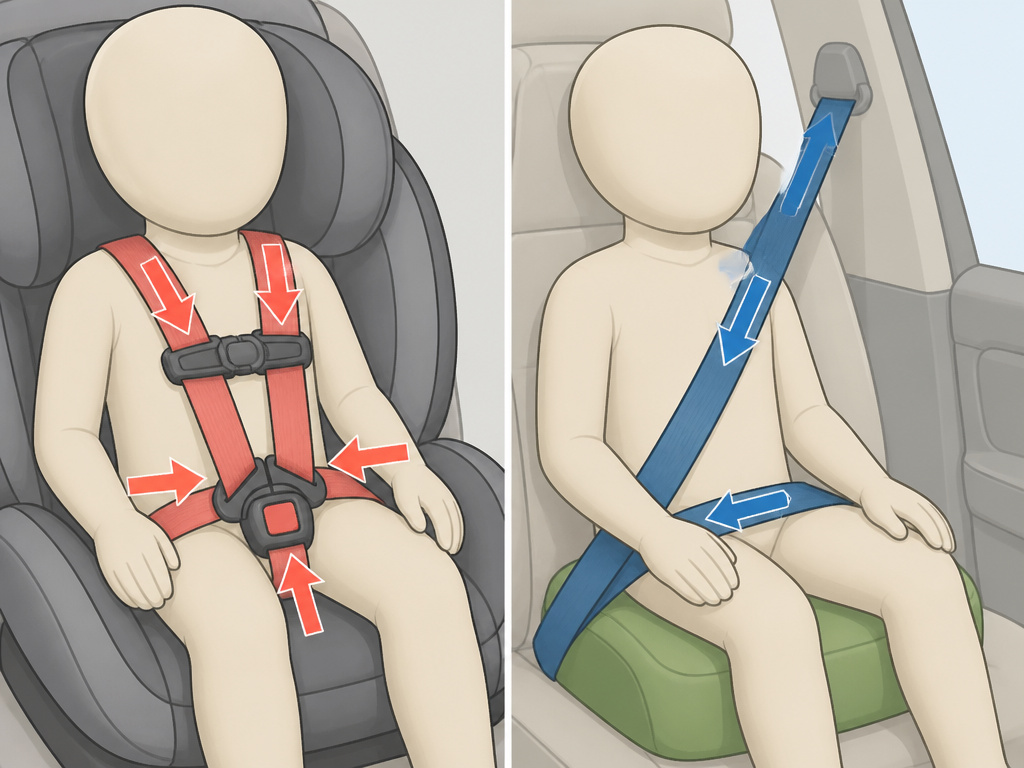
A 5-point harness spreads crash forces across five strong points: two shoulders, two hips, and the crotch. The vehicle’s seat belt, even when positioned correctly by a booster, is a 3-point system: one shoulder and one lap belt anchor. The physics are different.
The harness restrains the child’s body directly. In a frontal crash, it holds the torso back, limiting forward head excursion. The seat belt restrains the booster seat, which in turn restrains the child. This indirect path can allow more forward movement, which is why the transition timing is so critical.
This is also where improper use bites hardest. The NHTSA has issued guidance clarifying that the common label “Secure this child restraint with a vehicle belt” is not appropriate for belt-positioning boosters. The child’s weight secures the booster; the belt goes around the child. Getting that wrong, like trying to strap the empty booster to the car seat, defeats the entire system.
Choosing and Using a Booster Correctly
Your choice between a dedicated booster and a convertible car seat that turns into one is mostly about convenience. Dedicated boosters are often lighter and simpler. Convertible seats that convert a car seat into a booster mode offer a longer lifespan from a single purchase.
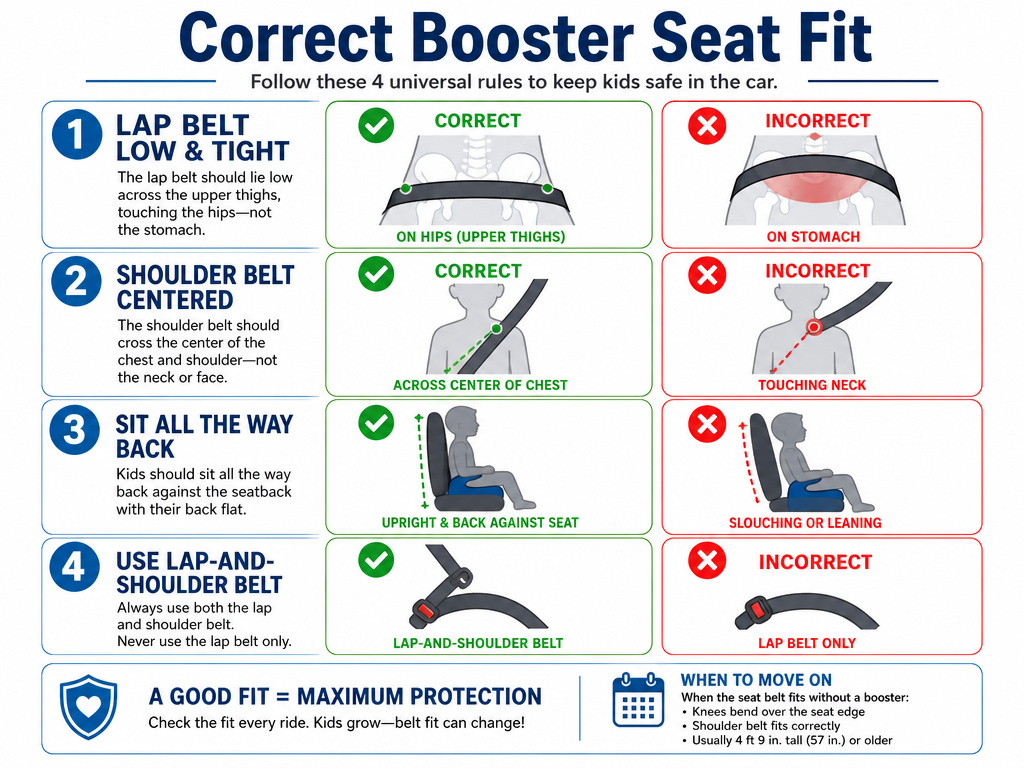
Once you have the seat, correct use is everything. Follow the official booster seat safety ratings from NHTSA for model-specific guidance. The universal rules are few but absolute.
- The lap belt must lie low across the hips/thighs, not ride up onto the soft abdomen.
- The shoulder belt must cross the middle of the chest and shoulder, not touch the neck or face.
- The child must sit all the way back against the vehicle seatback, without slouching.
- The booster must be used in a seating position with a lap and shoulder belt. Never with a lap-only belt.
The process to install a booster seat is straightforward: place it on the vehicle seat, have the child sit in it, and buckle the seat belt around them. The real work is in the fit check every single time you drive.
Where this goes sideways: Letting a child use the seat belt under their arm or behind their back because it’s uncomfortable. That turns the shoulder belt into a deadly abdominal restraint in a crash. If the belt touches the neck, use a high-back booster with belt guides or consider a harness-to-booster seat for a little longer.
Frequently Asked Questions
Does a high-back booster seat provide more safety than a backless one?
Yes, in most cases. A high-back booster provides head and neck support in side-impact crashes and has integrated belt guides to keep the shoulder belt positioned correctly. It’s the recommended first step after a harness seat. A backless booster is for older children who can reliably sit correctly without the side support.
What is the weight and height requirement for a booster seat?
Check your specific model’s manual, but general guidelines are a minimum of 40 pounds and 38 inches tall. More importantly, the child must have outgrown their forward-facing harness seat per the 5-step test above. Weight and height minimums are just the entry point.
Can I use a booster seat with just a lap belt?
No. Never. A booster seat must be used with a lap and shoulder belt combination. A lap-only belt cannot provide upper-body restraint, leading to severe head and spinal injuries in a crash. If your vehicle only has a lap belt in a certain position, that position is not safe for a booster.
How long should a child stay in a booster seat?
Until the vehicle’s seat belt fits them correctly without it. This is typically between 8 and 12 years old, when they are about 4’9″ tall. The 5-step belt fit test is the only measure that matters.
Are there any booster seats that are also car seats?
Yes. These are called combination seats or harness-to-booster seats. They start as a forward-facing harness seat and later convert to a belt-positioning booster. Models like the Graco Tranzitions or Britax Grow With You ClickTight are popular harness to booster car seats for this two-in-one function.
The Bottom Line
A booster seat is a vital tool, but it’s a step down in protection from a 5-point harness. The data shows it saves lives compared to no restraint, but introduces specific risks compared to seat belts alone. The 2018 CPSC rules make newer models safer against falls.
The rule is simple: max out the harness first. When your child passes the 5-step test, then a booster seat becomes their safest option. Use a high-back model first, ensure a perfect belt fit every trip, and never rush the transition. Your goal is to use the right restraint at the right time, for every mile.
