Is It Safe to Put a Car Seat in the Third Row? Key Rules
This post contains affiliate links. As an Amazon Associate, we earn from qualifying purchases.
It is safe to put a car seat in a third row if the vehicle seat is properly equipped, the combined weight of the child and seat does not exceed the lower anchor limit (often 65 pounds), you use the top tether for forward-facing seats, and the seat fits without dangerous overhang onto folded or movable seatbacks.
That “if” carries four conditions. Most parents check the first one. The other three are where third-row installs fail — silently, until a crash.
What follows is the checklist you won’t find in the vehicle manual: the 65-pound combined weight limit that switches you from LATCH to seat belt, the tether rule that stops a forward-facing seat from becoming a projectile, and the two physical fit issues that turn a safe seat into a dangerous one. By the last section, you’ll know whether your third row is a viable option or a hard no.
Key Takeaways
- The 65-pound combined weight limit is a hard stop for LATCH anchors. Once your child and seat together weigh more, you must switch to a seat belt install.
- Always use the top tether for a forward-facing car seat in any row. It cuts head excursion in a crash by up to 8 inches.
- Check for seat belt geometry before committing a booster seat to the third row. Belts mounted too far forward won’t retract properly, leaving a dangerous gap.
- A car seat must sit fully on the vehicle seat with less than an inch of overhang. More than that, and the seat can tip or rotate in a crash.
- Register your car seat with the manufacturer. It’s the only guaranteed way to get recall notices for defects that could make your third-row install unsafe.
The 65-Pound LATCH Limit
Every car seat manual and vehicle owner’s manual says the same thing, and almost everyone skips it: LATCH anchors have a weight limit. For most vehicles, including the Tesla Model 3, that limit is a combined 65 pounds for the child and the car seat.
Lower anchors have weight limits set by the vehicle and car seat manufacturers. You can determine the lower anchor weight limit by checking the warning label or installation diagrams located on the side of the car seat.
That’s the federal guideline. The Tesla Model 3 owner’s manual spells it out directly: for both rear-facing and forward-facing seats, if the combined weight exceeds 65 pounds, you must stop using the lower anchors and install with the vehicle seat belt instead.
The math is simple but easy to miss. A typical convertible car seat weighs 18 to 25 pounds. A 3-year-old can weigh 30 to 35 pounds. Add them up, and you’re already pushing 55 pounds. One growth spurt later, and you’ve blown past the limit without realizing it.
What most people get wrong: They think LATCH is always safer or easier than a seat belt. It’s not. Once you pass the weight limit, a seat belt install is the only safe method. The lower anchors are not tested beyond their rated capacity.
| Installation Method | When to Use | Risk If You Exceed Limits |
|---|---|---|
| LATCH (Lower Anchors) | Combined weight of child + seat ≤ 65 lbs | Anchor points can fail in a crash |
| Seat Belt | Combined weight of child + seat > 65 lbs | Secure, tested up to seat’s own limits |
| Seat Belt + Top Tether (Forward-Facing) | Always, if anchors available | Without it, head can whip forward 8+ inches |
The switch point is a structural limit. Find your car seat’s weight on its label, add your child’s weight, and do the math before you wrestle it into the back.
Third-Row Seat Belt Geometry
A seat belt is just a strap until it fits the person wearing it. In a third row, that fit is often broken by design.
The pillars at the back of the vehicle force seat belt mounting points forward and low. For an adult or a child in a booster, this creates a belt path that hovers in front of the shoulder instead of laying across the collarbone. The Car Seats For The Littles third-row analysis notes this is a common flaw in many SUVs and minivans. The belt can’t retract properly against the child’s body.
You’ll see it after you buckle your child in. The shoulder belt stays loose. If they lean forward and back, it never cinches tight again. That slack is a direct path to internal injury in a crash.
Common mistake: Assuming a third-row seat belt will fit a booster seat rider. Climb back there yourself and buckle in. If the belt doesn’t touch the middle of your collarbone, it won’t fit your child either.
High-back boosters with belt guides can sometimes correct this, but not all. The shape of the booster’s guide has to match the angle of the incoming belt. If it doesn’t, you get the same loose fit.
For a forward-facing harnessed seat, the belt geometry matters less because the harness holds the child. But you still need a solid, tight seat belt install for the seat itself. If the belt’s buckle stalk is too short or the latchplate gets stuck against the seat shell, you can’t get a proper installation. That’s a deal-breaker before you even consider the child’s fit.
The Tether Rule Nobody Follows (But Should)
 For a forward-facing car seat, the top tether is non-negotiable. It’s the strap that hooks to an anchor point behind the vehicle seat. NHTSA recommends using it every single time, whether you install with LATCH or a seat belt.
The tether’s job is to limit forward head movement in a crash. Without it, a child’s head can travel an extra 6 to 8 inches on impact. That’s the difference between a restrained whip and a concussion.
Where this goes sideways: Third rows often have fewer tether anchors than seat belts. You might have three seat belts but only one or two tether anchors. Some vehicles put all their anchors in the second row, leaving the third row with none. Before you plan a forward-facing seat back there, get on your hands and knees and look for the anchor symbol. If it’s not there, that seat position is off the table for a forward-facing install.
If you have an anchor, use it. Route the tether strap correctly — not over the headrest, not twisted — and pull it tight until there’s no slack. A loose tether is as good as no tether.
When “Fits” Isn’t Really a Fit
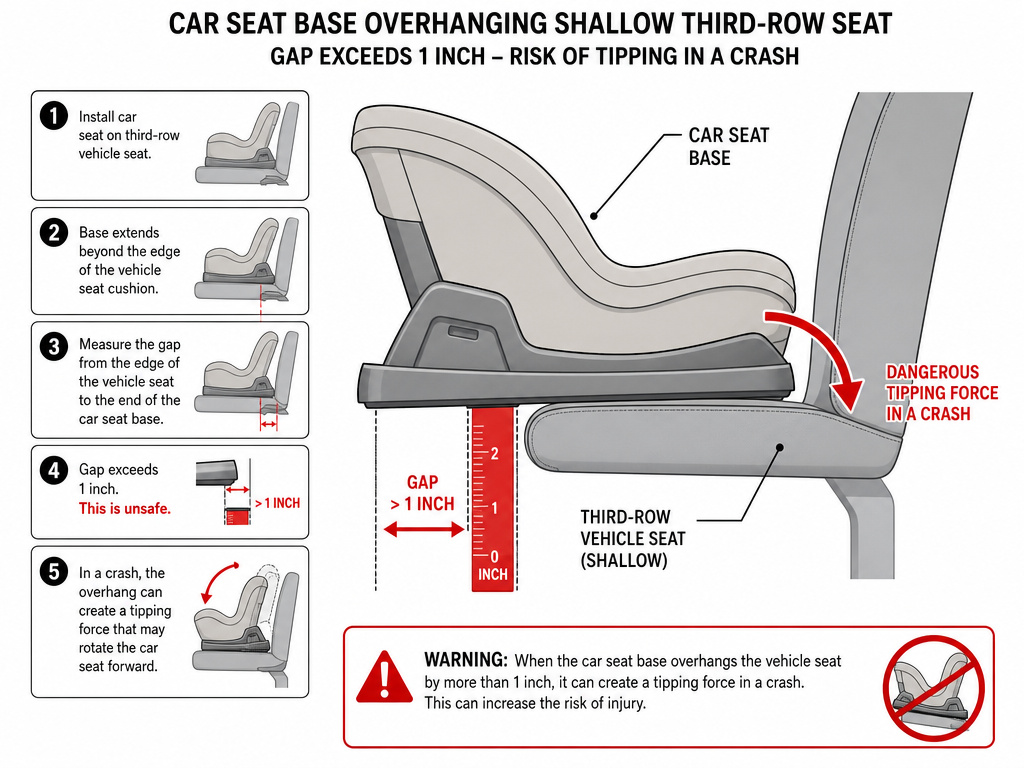 A car seat needs to sit fully on the vehicle seat cushion. The rule is less than one inch of overhang at the front edge. More than that, and the car seat is cantilevered. In a crash, that overhung section can tip, rotating the entire seat and putting enormous stress on the belt path or lower anchors.
Third-row seats are often shallower than second-row seats. A rear-facing infant seat with a long base can easily overhang. So can a bulky convertible seat.
The other fit killer is a folding seatback. In many SUVs, the third row folds forward to increase cargo space. If your car seat is installed on that seat, and someone else folds the seatback down even partway, the car seat’s recline angle changes instantly. It’s no longer at the correct angle, and the install is compromised. This is a specific, physical failure mode that doesn’t happen in a fixed second row.
Do you actually know what your soil pH is right now? Most people don’t, and that’s the whole problem. Same with overhang. You assume it fits because it sits there. Get a ruler. Measure the gap between the front edge of the car seat base and the edge of the vehicle seat cushion. If it’s over an inch, that position is unsafe.
The Hidden Dangers Beyond the Crash
 Safety involves the environment you’re putting your child in for the two-hour drive to Grandma’s.
Third rows are often closer to the rear window. In a rear-end collision, that’s the impact point. While modern cars are designed to crumple, the forces involved are still significant. A rear-facing seat is generally safer in this scenario, as it cocoons the child away from the point of impact.
Then there’s climate. The very back of a vehicle can be a temperature extreme zone. On a hot day, it gets hotter faster than the second row. A 2023 study in the journal Pediatrics highlighted that car interiors can reach lethal temperatures in minutes, and the third row is often the last place air circulation reaches. The published pediatric safety study on PMC raises questions about whether car seat manuals adequately warn about heat risks.
The Peg Perego manual explicitly says to “store the product, away from light, moisture, excessive heat or cold” when not in use. If heat can damage a stored seat, imagine what it does to a child sitting in it. This is a documented physical stressor that most parents don’t consider when choosing the third row.
How to Check Your Third Row (A 4-Step Field Test)
Don’t guess. Test.
- Locate the hardware. Before you lift the seat, get on the floor of the third row. Find the lower anchor points (the metal bars between the seat cushions). Find the tether anchor (usually on the back of the seat, on the shelf, or on the floor). No tether anchor? Forward-facing seats are out.
- Test the seat belt fit. Sit in the seat yourself. Buckle the seat belt. Does the shoulder portion cross the middle of your collarbone, or does it cut across your neck or fall off your shoulder? If it doesn’t fit you, it won’t fit a booster rider.
- Measure for overhang. Place the car seat in the position. Use a ruler or a piece of paper (standard printer paper is 11 inches long). If more than one inch of the car seat base hangs over the front edge of the vehicle seat, it fails.
- Perform the one-inch movement test. Once installed, grab the car seat at the belt path (where the seat belt or LATCH strap goes through). Try to move it side-to-side and front-to-back. It should not move more than one inch in any direction. More than that means the install is loose.
If your seat passes all four, the third row is a viable option. If it fails any, you need a different plan.
Frequently Asked Questions
Can you use LATCH in the third row?
Yes, if your vehicle has lower anchor points there. The critical rule is the combined 65-pound weight limit for the child and car seat. Exceed that, and you must switch to a seat belt installation. Always check your vehicle manual—some third rows have anchors, some don’t.
Is the third row safer than the second row?
Not necessarily. The second row is generally safer due to its longer distance from both front and rear impact points. The third row is closer to the rear crumple zone. The safest vehicle seat is still the rear middle seat of the second row, when available.
What if my third row doesn’t have a tether anchor?
You cannot safely install a forward-facing harnessed car seat there. The top tether is mandatory for forward-facing installations. Without it, you must use the seat in rear-facing mode (if it still fits your child) or choose a different seating position that has a tether anchor.
Can a booster seat go in the third row?
It can, but the seat belt geometry often makes it unsafe. If the vehicle’s shoulder belt doesn’t rest properly on the child’s collarbone and the lap belt sits low on the hips, the booster isn’t doing its job. A car seat safety check in that position is essential.
How do I know if my car seat is too big for the third row?
Perform the overhang test. Less than one inch of the car seat base can overhang the front edge of the vehicle seat. Also, ensure the car seat doesn’t interfere with the folded seatback mechanism if your third row folds, and that you can achieve a proper recline angle for a rear-facing seat.
Before You Go
The third row isn’t a forbidden zone, but it’s a conditional one. The 65-pound LATCH limit is the first gate. A proper tether anchor is the second. The physical fit of the seat and the seat belt is the third.
Skip the third row if any of those conditions fail. The inconvenience of rearranging passengers is nothing compared to the consequence of a compromised install. Your vehicle manual and car seat manual have the final say—not a blog, not a forum, and certainly not the assumption that because there’s a seat belt, it’s safe.
Register your seat with the manufacturer. That’s how you’ll hear about a recall that could affect your third row installation. And if you’re ever unsure, get a proper installation check from a certified Child Passenger Safety Technician. They’ve seen every weird third-row quirk there is.
