
Where to Go for a Professional Car Seat Installation Check
This post contains affiliate links. As an Amazon Associate, we earn from qualifying purchases.
Go to the National Highway Traffic Safety Administration (NHTSA) website and use their “Find a Car Seat Inspection Station” tool. This connects you with certified Child Passenger Safety Technicians (CPSTs) at locations like fire stations, hospitals, and health departments. You can also schedule a virtual check or contact local Safe Kids coalition chapters.
That tool is the only national directory vetted by the federal government. It filters by zip code and lists events where technicians will inspect your seat for free. The appointment takes about 30 minutes.
What most guides skip is the preparation. Walking into a check with the wrong paperwork or a dirty seat wastes everyone’s time. The technician needs your car seat manual, your vehicle manual, and the child present. They can’t certify a generic installation. They verify the specific seat, in your specific car, with your specific child buckled in.
This guide walks through the three verified sources for a check, what happens during the appointment, and the exact specs from major seat manuals that the technician uses as their benchmark. You’ll also learn when a virtual check is your best option and what to do if no local events are listed.
Key Takeaways
- The official NHTSA car seat finder tool is the primary source for locating certified, free inspection events. Never assume your local fire station offers the service without checking this directory first.
- A proper installation check requires three things: the car seat, the vehicle, and the child. Technicians cannot verify safety without seeing all three components together.
- Virtual car seat checks are a legitimate and growing option, especially in rural areas. They follow the same certification standards as in-person visits.
- The benchmark for a secure installation is movement of less than 1 inch (2.5 cm) at the belt path. This spec comes directly from manufacturer manuals like the Graco 4Ever and Chicco Fit360.
- If you cannot find a local event, your next steps are to contact a local Safe Kids coalition chapter or schedule a one-on-one consultation with a certified CPST, which may involve a fee.
The 3 Places to Get Your Car Seat Checked
You have three reliable paths to a verified car seat installation check. The first is the only one with a national guarantee, the second is a modern adaptation, and the third is your local safety network.
1. The NHTSA Finder & Local Inspection Events
The National Highway Traffic Safety Administration maintains the definitive database. You visit their “Right Seat” campaign page, click “Find a Car Seat Inspection Station,” and enter your zip code.
The results show scheduled inspection events, usually hosted at police stations, fire departments, hospitals, or community centers. These are staffed by volunteers who are nationally certified Child Passenger Safety Technicians (CPSTs). The service is almost always free.
Where this goes sideways: Showing up without an appointment. Most listed events require registration. The event details will specify “appointment only” or “first-come, first-served.” Missing that note means you drive across town for nothing.
2. Virtual Car Seat Checks
The pandemic made virtual checks standard practice. Many CPSTs now offer them via video call. This is a legitimate professional installation verification method for those in remote areas or with tight schedules.
The process is structured. You’ll need a smartphone or tablet with a stand, good lighting, and the ability to move the camera around the car seat. The technician will guide you to show specific angles: the belt path, the recline angle indicator, the harness height, and the buckle placement on your child.
A 2020 study protocol in the Journal of Medical Internet Research confirmed that remote guidance for correct installation could achieve error rates comparable to in-person instruction when following a structured checklist. The key is the technician’s ability to see detail.
3. Safe Kids Coalitions & Hospital Programs
Safe Kids Worldwide is a non-profit network with local chapters in all 50 states. Many chapters have CPSTs on staff or can refer you to hospital-based car seat programs. These are often tied to maternity wards.
Hospitals with Level III or IV neonatal intensive care units (NICUs) almost always have a CPST on staff. They get a car seat installed correctly before a medically fragile infant is discharged. For the general public, these resources are best accessed by calling the hospital’s community health or injury prevention department directly.
| Source | Best For | What to Prepare |
|---|---|---|
| NHTSA Event | Free, in-person verification with multiple technicians. | Car seat manual, vehicle manual, child (if possible), appointment confirmation. |
| Virtual Check | Rural residents, parents with newborns, or last-minute checks. | Smartphone/tablet with stand, good lighting, all manuals, child present. |
| Hospital/Safe Kids | Parents of newborns or children with special healthcare needs. | Discharge paperwork (if applicable), car seat, vehicle. Often requires a referral. |
What a Certified Technician Actually Checks
A CPST isn’t just looking to see if the seat is tight. They follow a formal checklist that cross-references your car seat manual, your vehicle manual, and the child’s proportions. The goal is to eliminate “serious misuse,” which research defines as at least one critical error or two minor errors.
Their assessment rests on a few physical benchmarks that don’t change from seat to seat.
The 1-Inch Movement Rule
This is the universal test. After the seat is installed, the technician grabs it at the belt path—where the seat belt or LATCH strap goes through the car seat shell. They pull side-to-side and front-to-back with moderate force.
If the seat moves less than 1 inch (2.5 cm) at the belt path, it passes. This specification is printed in nearly every car seat manual, including the Graco 4Ever and Slimfit guides.
A seat that shifts more than an inch has slack in the belt or LATCH strap. In a crash, that slack allows dangerous forward or lateral motion before the restraint system engages.
Harness Fit and Chest Clip Placement
The harness is the second half of the system. A tight seat with a loose harness is still a failure. The technician checks two things on your child:
- The Pinch Test. With the child secured, they try to pinch the harness strap vertically at the child’s shoulder. If they can pinch any excess webbing, the harness is too loose.
- Chest Clip Position. The clip must be at armpit level. Too high risks neck injury. Too low risks internal injury.
They also verify the harness straps are at or just below the child’s shoulders for rear-facing seats, and at or just above for forward-facing seats. This prevents submarining or ejection.
Recline Angle & Top Tether
For rear-facing seats, the correct angle is non-negotiable. An infant’s airway can close if the seat is too upright. A seat too reclined offers less protection. The technician uses the built-in level indicator on your seat’s base.
The part nobody mentions: The vehicle must be on level ground before checking the angle. A sloped driveway throws the indicator off. Many manuals, like the Chicco Fit360 guide, state this explicitly.
For forward-facing seats with a harness, the top tether strap is critical. It limits forward head movement in a crash by over 6 inches. The technician verifies it’s connected to the correct anchor point in your vehicle and is snug.
How to Prepare for Your Car Seat Check Appointment
Walking in prepared cuts the appointment time in half and lets the technician focus on education, not hunting for documents. Bring these four items, every time.
- The Car Seat. Obviously. But also make sure it’s clean and free of aftermarket accessories like head supports or strap covers that didn’t come with the seat. These can void the seat’s warranty and compromise safety.
- The Car Seat Manual. The technician will need the model name, number, and manufacture date. This is on a sticker on the seat shell. They use the manual to confirm weight limits, belt paths, and specific instructions.
- The Vehicle Owner’s Manual. This tells the technician where the lower LATCH anchors and top tether anchors are hidden in your specific car. It also states if there are any restrictions (e.g., “do not use the center seat LATCH anchors”).
- The Child. If possible, bring the child who will use the seat. The fit of the harness is part of the check. If the child can’t come, know their current weight and height.
TL;DR: Seat, manual, car manual, kid. Missing one turns a 30-minute check into a 60-minute puzzle.
What If There Are No Local Checks? Your Next Steps
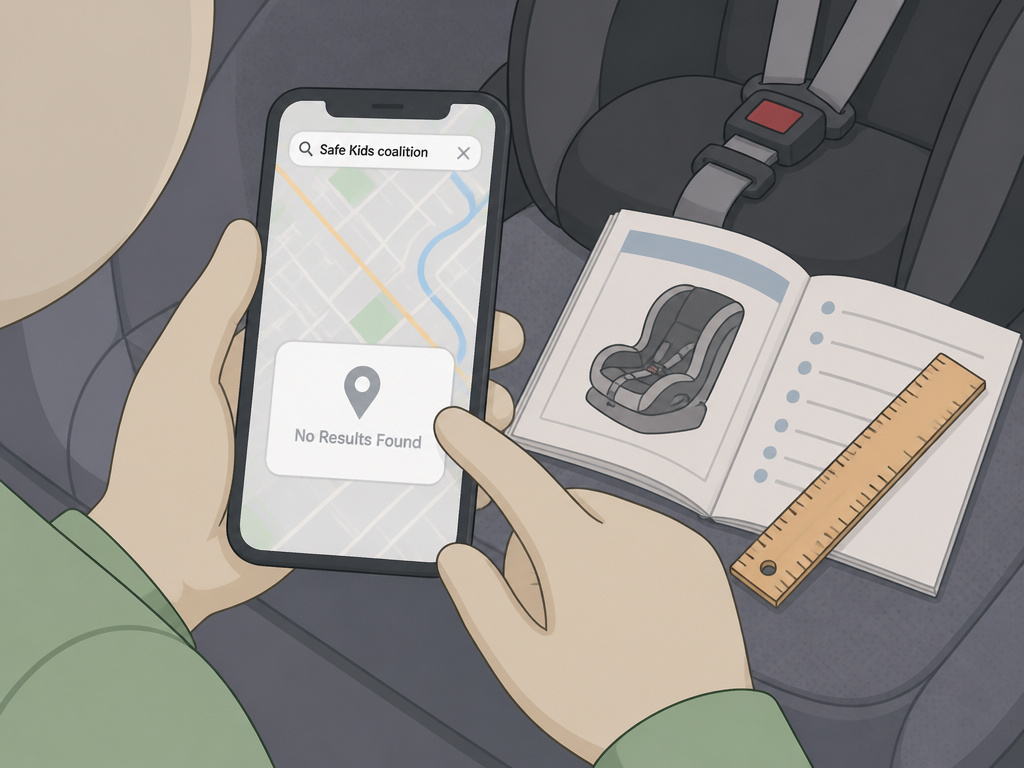
The NHTSA tool might show no events within 50 miles. Rural areas face this often. You aren’t out of options.
First, call your local fire department or police station directly. Even if they’re not on the NHTSA list, some have a certified technician on staff who can do a courtesy check by appointment. Don’t just drop in.
Second, search for “[Your County] Safe Kids coalition” online. Their coordinators often know every CPST in the region and can connect you with someone for a private consultation. This may involve a fee, typically between $25 and $75.
Finally, consider a thorough self-check using the manufacturer’s guide as your bible. Our detailed step-by-step installation check walks you through the same process a CPST uses, referencing the same 1-inch rule and harness fit standards.
Frequently Asked Questions
Does the fire station install car seats for free?
Many do, but it is not a universal service. You must verify using the NHTSA car seat finder tool or by calling ahead. The station must have a currently certified Child Passenger Safety Technician on duty. Never assume.
How long does a car seat check take?
Plan for 30 minutes. A straightforward installation check with a well-prepared parent can take 20. A complex situation involving a new seat, an unfamiliar vehicle, or multiple seats will take 45 minutes to an hour. The technician’s goal is education, not speed.
Can I install a car seat with both LATCH and a seat belt?
No. This is a critical and common error. You must use one system or the other unless the car seat manual explicitly states that dual installation is approved. Using both can create conflicting force paths and overstress the car seat shell in a crash. Always follow the manual for the safest installation method.
What’s the difference between LATCH and ISOFIX?
LATCH (Lower Anchors and Tethers for Children) is the U.S. Term. ISOFIX is the international term. They are functionally the same system: rigid lower anchors in the vehicle seat crease. A seat sold in the U.S. With lower connectors is a LATCH seat. The secure ISOFIX installation process is identical.
How often should I get my car seat installation checked?
You should get a professional check anytime you install a seat for the first time, switch the seat to a new mode (e.g., rear-facing to forward-facing), or move it to a different vehicle. It’s also wise to do a self-check using the 1-inch rule every month, as seats can loosen with normal vehicle vibration.
Before You Go
Your first stop is the NHTSA website. That tool is the single most reliable way to find a car seat installer who is certified and current. If an event is nearby, book it.
If the search comes up empty, your next move is a direct call to local safety organizations or a scheduled virtual check. These are valid paths to a verified installation.
The goal isn’t just a tight seat today. It’s understanding why it’s tight—the 1-inch rule, the harness fit, the angle. That knowledge lets you confidently reinstall the seat after it’s cleaned or moved. Use the technician’s time to learn, not just to watch. Your child’s safety depends on you being the final authority on their seat, every trip.
