
Find Who Can Check If Your Car Seat Is Installed Correctly
This post contains affiliate links. As an Amazon Associate, we earn from qualifying purchases.
A certified Child Passenger Safety Technician (CPST) is the only person formally qualified to check your car seat installation. You can find them for free through the NHTSA’s seat check locator, at many local fire departments and hospitals, or through private inspection services. The ISO 13215-2 standard defines the test where 85% of adults should correctly install a seat in 10 minutes, most parents don’t pass it alone.
That 85 percent figure is the whole point of the check. It’s not about you missing a step. It’s about a design or instruction failure that the seat’s own manufacturer didn’t catch, and that a trained eye spots in thirty seconds. A recent EU market surveillance campaign found seven out of nine seats failed crash tests, with six also failing static checks for markings and instructions. The gap between the manual and real-world use is where mistakes live.
What follows is the map to the right help: who is certified, where they work, what they actually look for, and the one question you must ask before you let anyone touch the harness.
Key Takeaways
- Only a Child Passenger Safety Technician (CPST) holds the national certification to properly evaluate an installation. Anyone else is just a helpful person with an opinion.
- Free checks are standard through the NHTSA’s locator, but appointments book weeks out. Some fire departments and hospitals offer them, but you must call ahead, many have stopped or require scheduling.
- Paid private inspectors exist and are worth the fee for immediate, thorough help, especially for complex seats like 360-degree rotators or for third-row vehicle installations.
- The car seat’s own manual and your vehicle’s owner’s manual are the final authority. A CPST cross-references both; a well-meaning friend will not.
- Seats made after September 2024 should meet the updated UN Regulation No. 129 (R129). The EU found widespread failures in seats that didn’t; a proper check verifies your model’s compliance.
The Three People Who Can Actually Check Your Car Seat
You have three paths to a verified installation: a free certified technician, a paid private expert, or a self-check against the manuals. The first is best. The second is fastest. The third is a last resort that still misses the professional calibration of harness tightness and seat belt lock-offs.
A Child Passenger Safety Technician (CPST) is a person who has completed a 32–40 hour national certification course administered by Safe Kids Worldwide. They are trained to assess installations across hundreds of seat and vehicle combinations, identify misuse, and educate caregivers on proper use. Their certification number is public and verifiable.
Your first stop should be the NHTSA’s seat check finder. It lists local events and permanent inspection stations. The California Highway Patrol also runs a statewide child safety seat program with certified officers. These services are free, but demand is high. Book an appointment the moment you know your due date or purchase date.
Some fire departments still offer checks, but the era of walk-in help is over. Most require appointments, and some have discontinued the service entirely due to liability and staffing. Always call your local fire department ahead of time, don’t just show up. The same rule applies to hospitals; many offer checks only for newborns before discharge.
For immediate, guaranteed help, hire a private CPST. These are often the same technicians who run the free clinics, offering one-on-one sessions for a fee. You get their undivided attention, often at your home, and they will spend an hour ensuring every element is correct. This is the solution when the free clinic waitlist is eight weeks long.
What a Professional Check Covers (And What It Doesn’t)
A proper inspection is a 20–40 minute process. It’s not a quick glance. The technician follows a strict protocol that mirrors the ISO 13215-2 panel test standard, checking for the serious misuse that studies link to reduced crash protection.
They start with the seat itself. Is it expired? Is it under recall? They’ll find the model number and manufacturing date sticker, on a Graco 4Ever, it’s on the back of the seat shell. They check for visible damage, cracks, or missing parts. Then they move to the vehicle.
The four non-negotiable checks are:
- Correct seat for child’s size: Weight and height must be within the seat’s limits. They’ll measure a toddler’s head position relative to the shell for rear-facing seats.
- Secure installation to vehicle: Using either the LATCH system or the seat belt, the seat should not move more than one inch side-to-side or front-to-back at the belt path.
- Proper harness fit: The chest clip must be at armpit level. The harness straps should be snug, you should not be able to pinch any slack at the child’s shoulder.
- Correct recline angle: For rear-facing seats, especially for infants, the angle must be correct to prevent head flopping. They’ll use the seat’s built-in indicator or a separate angle checker.
Common mistake: Installing a seat with both LATCH and the seat belt. This is prohibited unless the seat manufacturer explicitly allows it. The forces in a crash could overload one system, causing both to fail. A CPST will immediately disengage one.
What they won’t do is install it for you. Their job is to educate and verify. They will guide your hands, have you remove and reinstall the seat, and make you demonstrate the harness adjustment. The goal is for you to leave confident you can do it yourself next time.
| Checkpoint | Correct Outcome | Risk If Wrong |
|---|---|---|
| Seat Movement | ≤1 inch at the belt path | In a crash, the seat rotates excessively, increasing head excursion and injury risk. |
| Harness Tightness | No pinchable slack at shoulder | The child can be ejected from the seat or suffer severe internal injuries from submarining. |
| Chest Clip Position | Level with child’s armpits | In a crash, the clip can cause abdominal injuries if too low or neck injuries if too high. |
| LATCH or Belt Lock-Off | Audible ‘click’ and locked mechanism | The seatbelt unspools during crash forces, allowing the seat to fly forward. |
How to Vet a Technician or Service
Not all help is equal. A person in uniform is not automatically a CPST. Use these steps to verify you’re getting a true expert.
First, ask for their CPST certification number. You can verify it through Safe Kids Worldwide. Second, ask about their experience with your specific seat type. A technician familiar with the Chicco Fit360’s unique base system or the Joie Saffron’s load leg is better than one who isn’t.
Be wary of anyone who insists on one installation method over another without consulting your manuals. The vehicle manual dictates whether you can use LATCH in a center seat, for example. A good technician will pull out both booklets.
When using the NHTSA’s car seat check location tool, read the event details carefully. Some are “check and fix” events where they will help on the spot. Others are “education only” events where they teach but don’t touch your seat. Know which you’re walking into.
For a professional car seat check from a private service, read reviews. Look for mentions of thoroughness, patience, and whether they worked with your car seat brand. The cost should be transparent upfront.
The DIY Check: A Step-by-Step Verification Guide
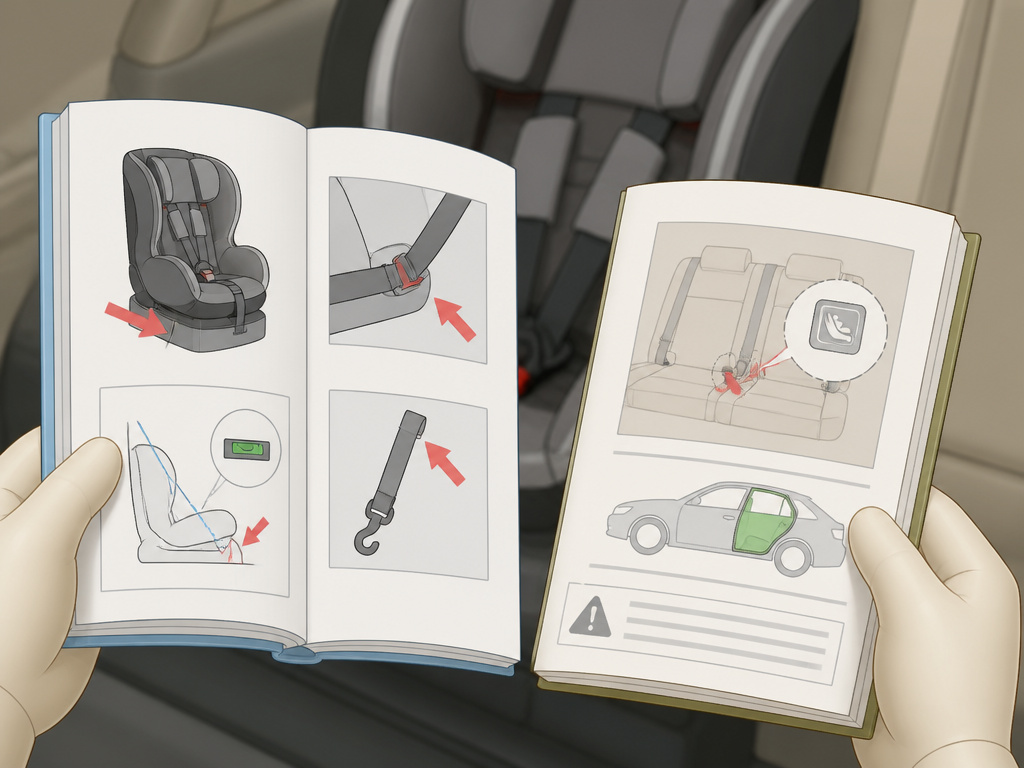
If you cannot get to a professional immediately, you can perform a rigorous self-check. This is a temporary measure, not a replacement. You will need your car seat manual and your vehicle owner’s manual.
Gather the manuals. This is the single most skipped step. The car seat manual has the weight limits, harness height rules, and installation diagrams. The vehicle manual has the rules for LATCH anchor locations, tether anchor use, and which seating positions are approved.
Check the installation tightness. Kneel in the seat and use your body weight to press it down into the vehicle cushion. Then, with one hand at the belt path (where the seat belt or LATCH strap goes through the seat), try to move the seat side-to-side and front-to-back. It should not move more than one inch. If it does, you need more tension.
Inspect the harness system.
- Remove the child and all bulky clothing like winter coats.
- Adjust the harness straps to be at or just above the shoulders for rear-facing, at or just below for forward-facing.
- Buckle the child in and tighten the harness. Perform the pinch test at the child’s shoulder. If you can pinch a vertical fold of harness webbing, it’s too loose.
- Position the chest clip at armpit level.
Verify the recline angle. For rear-facing infants, the seat must be at the correct angle to keep the airway open. Use the built-in angle indicator (usually a line or bubble level on the seat shell). Adjust using the base’s recline foot or a tightly rolled towel under the seat if the manual permits.
Where this goes sideways: Using aftermarket products not approved by the seat manufacturer. Head supports, strap covers, and seat protectors can interfere with the harness system or installation. If it didn’t come with the seat, assume it’s unsafe unless the manual says otherwise.
After your installation check, plan to get a professional verification as soon as possible. Your sense of “tight enough” is often not tight enough.
Why “Close Enough” Isn’t Good Enough: The Safety Data
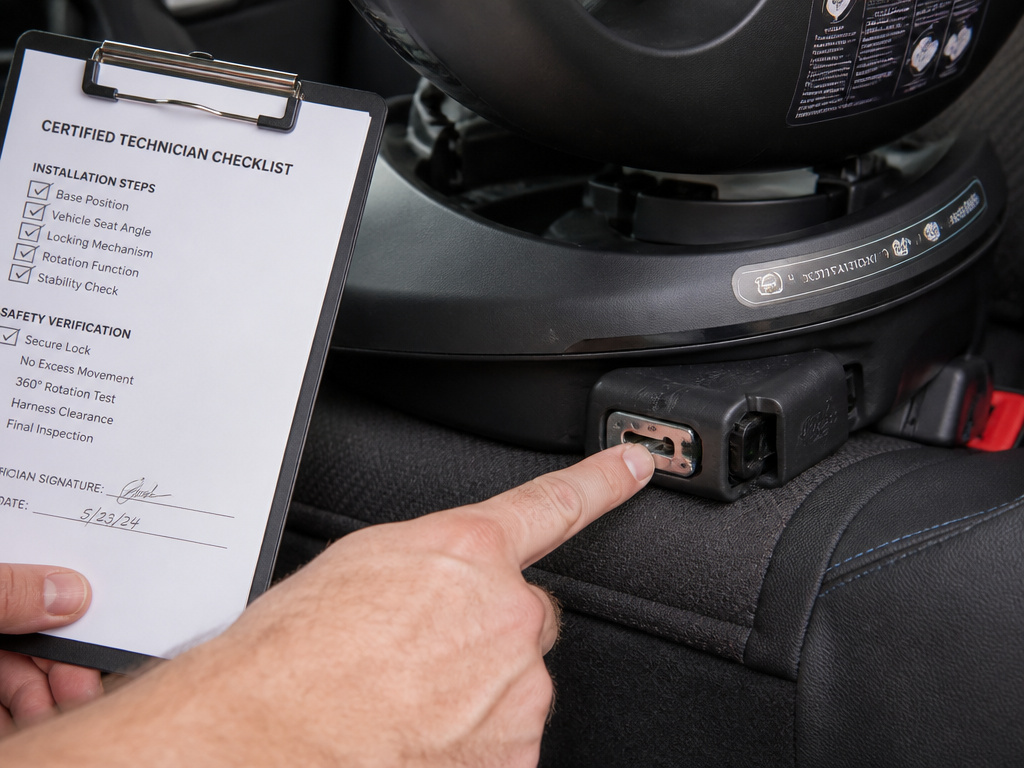
The stakes are not theoretical. Misuse is common and consequential. The ISO 13215-2 standard exists because “certain misuse configurations and interface problems can have serious consequences for child occupants in vehicle crashes.”
A 2026 EU market surveillance campaign tested nine child car seats against UN Regulation No. 129. Seven failed dynamic crash tests. Six failed static checks for things like missing warnings and incorrect height labels. Two were recalled. The authorities explicitly warned consumers to buy seats placed on the market after September 2024, as they must meet this stricter R129 standard, and to avoid older R44-standard seats.
This is why a professional check matters. They are looking for the mismatches and oversights that turn a safe seat into a compromised one. They know, for instance, that 360-degree rotating seats have mechanisms not specifically tested under current regulations. They will check that the rotation lock engages solidly every time.
Your goal isn’t just a snug seat. It’s a system, seat, child, vehicle, working together as engineers intended. A certified technician is your auditor for that system.
Frequently Asked Questions
Can the fire department install my car seat?
Many fire stations have CPSTs on staff who can check and help you install your car seat. They typically do not perform the installation for you. You must call your local fire department ahead to confirm if they offer the service, when, and if an appointment is needed. Do not assume walk-in service is available.
Is there a charge to have my car seat checked?
Most community events and permanent inspection stations listed through the NHTSA or CHP car seat inspection services are free. Private Child Passenger Safety Technicians who offer one-on-one appointments typically charge a fee for their time and expertise. Always ask about cost when scheduling.
How often should I get my car seat checked?
You should get a professional check after you first install any new seat. Get it checked again if you move the seat to a different vehicle, if your child transitions to a new mode (e.g., rear-facing to forward-facing), or if you adjust the harness height. An annual check is a good practice to catch any gradual loosening or changes in best practices.
What if I can’t find a CPST near me?
If you cannot locate a technician, your next best option is a virtual car seat check. Many certified CPSTs now offer video consultations where they guide you through a step-by-step installation verification. You will need a phone or tablet with a good camera and both your manuals.
Does a correct installation guarantee safety in a crash?
No car seat can guarantee absolute protection. Proper installation and use simply maximize the seat’s ability to do its job, to restrain the child and manage crash forces. As the Graco manual states, “proper use helps reduce the risk of serious injury or death.” It is the most critical factor within your control.
Before You Go
Find a CPST and book the appointment, even if the wait is long. While you wait, perform your own thorough check using the manuals as your guide. Remember the one-inch rule for movement and the pinch test for the harness. Avoid all aftermarket accessories. Your child’s seat is the most important piece of safety equipment you will ever use. Its effectiveness hinges entirely on being installed correctly. Don’t guess. Get it checked.
