
The Right Time to Get Rid of a Car Seat’s Newborn Insert
This post contains affiliate links. As an Amazon Associate, we earn from qualifying purchases.
Remove the newborn insert from your car seat when your child reaches the specific weight limit stated in your manual, often 11 pounds. OR when they pass a four-point fit test without it, whichever comes first. Never use an aftermarket insert, and always remove bulky clothing before checking the fit.
That 11-pound number is a starting point, not a finish line. The real answer lives in your car seat’s manual and in the physical space between your child’s shoulders and the harness straps.
This guide walks through the manufacturer specs that matter, the visual and tactile checks that override a scale, and the single mistake that voids a car seat’s warranty and safety certification. You’ll know the rule, the exceptions, and the reason each one exists.
Key Takeaways
- The 11-pound limit is common but not universal, always check your specific model’s manual (e.g., UPPAbaby MESA V2 starts at 4 lbs, Chicco Fit3x at 5 lbs).
- You can remove the insert before the weight limit if your child passes the fit test: harness at/below shoulders, chest clip at armpit level, no slouching, and the crotch buckle rests securely.
- Using a non-approved, aftermarket insert or adding extra padding is a direct safety violation, it compromises the harness system and the seat’s crash-test integrity.
- The insert must come out for airplane travel if the child exceeds the weight limit; the base is never used on a plane.
- Expiration dates and crash replacement rules apply to the entire seat, insert included, a seat involved in a moderate/severe crash is trash, regardless of the insert’s condition.
The Universal 11-Pound Rule (and When It’s Wrong)
Most car seat manuals point to 11 pounds as the trigger. The Chicco Fit3x, Nuna REVV, and Cybex ATON 2 all use it. But treating it as a strict deadline misses the nuance written into the instructions.
The UPPAbaby MESA V2 manual states its infant insert is for children weighing 4–11 lbs (1.8–5 kg). That “4–11” range is the first clue. If the insert is mandatory until exactly 11.0 pounds, the lower bound wouldn’t exist, it would just say “up to 11 lbs.” The range implies it’s a tool for achieving a proper fit within those bounds.
The newborn insert is only for infants who weigh between 5 and 11 lbs (2.3 and 5 kg). – Chicco Fit3x ClearTex Ultra-Slim All-in-One Car Seat Manual, Page 52.
The Cybex ATON 2 manual is even more explicit about fit over weight. It recommends the Infant Insert until 22 lbs, “or until child needs more room.” It adds a critical caveat: “If the Insert pushes baby’s head forward, or compromises the fitting of the child to the seat it may be removed.” The weight limit is a ceiling, but the fit check is the daily gatekeeper.
| Car Seat Model | Insert Weight Range | Key Manual Phrase |
|---|---|---|
| Chicco Fit3x | 5 – 11 lbs (2.3 – 5 kg) | “The newborn insert is only for infants who weigh between 5 and 11 lbs.” |
| UPPAbaby MESA V2 | 4 – 11 lbs (1.8 – 5 kg) | “The Infant Insert is designed for children who weigh: 4–11 lbs.” |
| Nuna REVV | 5 – 11 lbs (2.3 – 5 kg) | “The infant insert… Is for use with infants who weigh between 5–11 lb. DO NOT use the insert for a child who weighs more than 11 lb.” |
| Cybex ATON 2 | Up to 22 lbs (10 kg) or until more room needed | “If the Insert pushes baby’s head forward, or compromises the fitting of the child to the seat it may be removed.” |
The rule is a guardrail. The real work is the fit test you perform every time you buckle your child in.
The 4-Point Fit Test: Removing the Insert Early
You don’t need to wait for a precise weigh-in if your child is clearly too snug with the padding. Both UPPAbaby and Cybex endorse early removal based on fit. Here’s how to run the test.
First, take the child out. Remove the infant insert. Put them back in the seat wearing only thin, snug clothing, no puffy coats or snowsuits. Now, check these four points in order.
- Harness Height: The harness straps must be at or slightly below the child’s shoulders. If the straps are coming from above the shoulders, the insert is likely propping them too high. Remove it.
- Chest Clip Position: The chest clip must sit at armpit level. If the insert is so thick that the clip rests on the abdomen, the harness isn’t positioned to contain the torso correctly in a crash.
- Body Position: The child’s back and bottom should be flat against the seat back. Look for slouching or a curled “C” shape. If the insert is forcing their head forward or their pelvis to tilt, it’s compromising the seat’s geometry.
- Crotch Buckle: The buckle should rest securely against the child, between the legs, with no gap. The UPPAbaby MESA Max manual is specific: “When using insert, child should not sit on top of the buckle.” If they are, the insert is too thick.
Pass all four? The insert can go into storage. Fail any point? The insert stays for now, but re-check in a week. Babies grow fast.
Where this goes sideways: Leaving the insert in because the baby “looks cozy.” An insert that forces the head forward changes the impact path in a collision, directing force through the neck instead of the back. The manual’s fit criteria exist to prevent that.
Model-Specific Rules You Can’t Ignore
Car seat design isn’t monolithic. A rule for one model can be dangerously wrong for another. This is why “check your manual” isn’t just cautious advice, it’s the only way to know.
- Chicco Fit3x & Nuna REVV: These models are strict. The insert is for 5-11 lbs, period. The Nuna REVV manual is unambiguous: “DO NOT use the insert for a child who weighs more than 11 lb.” There’s no fit-based early removal clause.
- UPPAbaby MESA V2 & MESA Max: These allow the fit-based removal we just outlined. Their manuals state the insert can be removed “when you can achieve all fit criteria without it.”
- Cybex ATON 2: This seat has two pieces. The Newborn Inlay (an EPS foam pad under the cover) is for babies up to 11 lbs or about 3 months. The Infant Insert (the padded head and torso piece) can be used until 22 lbs, removed for fit, or even folded under the child to boost them for proper harness alignment. It’s the most flexible system.
Confusing the insert for the Chicco with the rules for the Cybex is how parents make a safety error with good intentions. When you take the infant insert out, you’re following a script written for that exact seat.
The Side Support Isn’t the Insert
On convertible seats like the Chicco Fit3x, don’t confuse the newborn insert with the side support bolsters. The manual is clear: “Always use the side support… With a child weighing 40 lbs (18 kg) or less.” The side support stays long after the newborn insert is gone. Removing it prematurely removes a key part of the seat’s side-impact protection.
What Happens If You Remove It Too Early (Or Too Late)
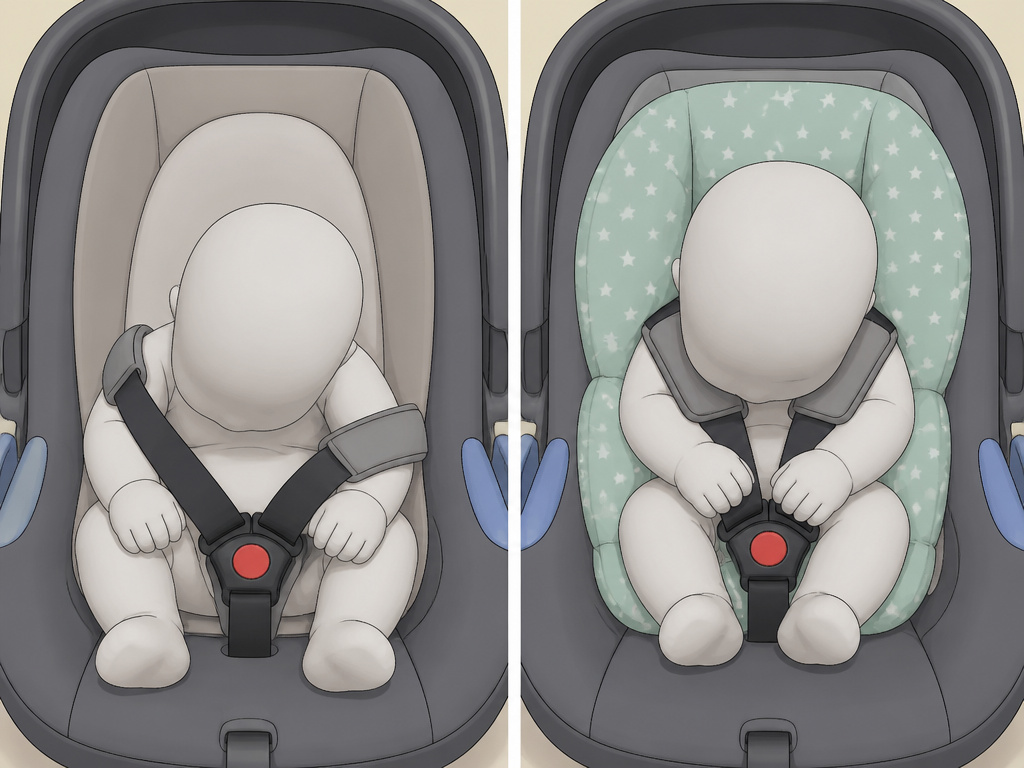
The consequences have timelines. Get them wrong, and the seat fails to do its one job.
Removing it too early means the harness won’t fit. On a 7-pound baby, the straps will be too far out to the sides, likely resting off the shoulders. The child will slouch, their airway can become restricted, and in a crash, they risk submarining, sliding down and out under the harness belt. This isn’t scare talk. It’s the predictable outcome of a harness that doesn’t contain the body.
Leaving it in too long is just as dangerous. Once a child needs more room, the compressed insert pushes their body forward, altering the seat’s engineered recline angle. The harness system is designed to manage crash forces across specific points on a body that’s positioned correctly. An overstuffed seat changes those load points. The chest clip sinks too low, and the harness straps can gap, leading to excessive forward movement on impact.
The purpose of the insert is to act as a temporary spacer. Its entire job is to become obsolete.
The Non-Negotiables: Aftermarket Inserts and Expiration
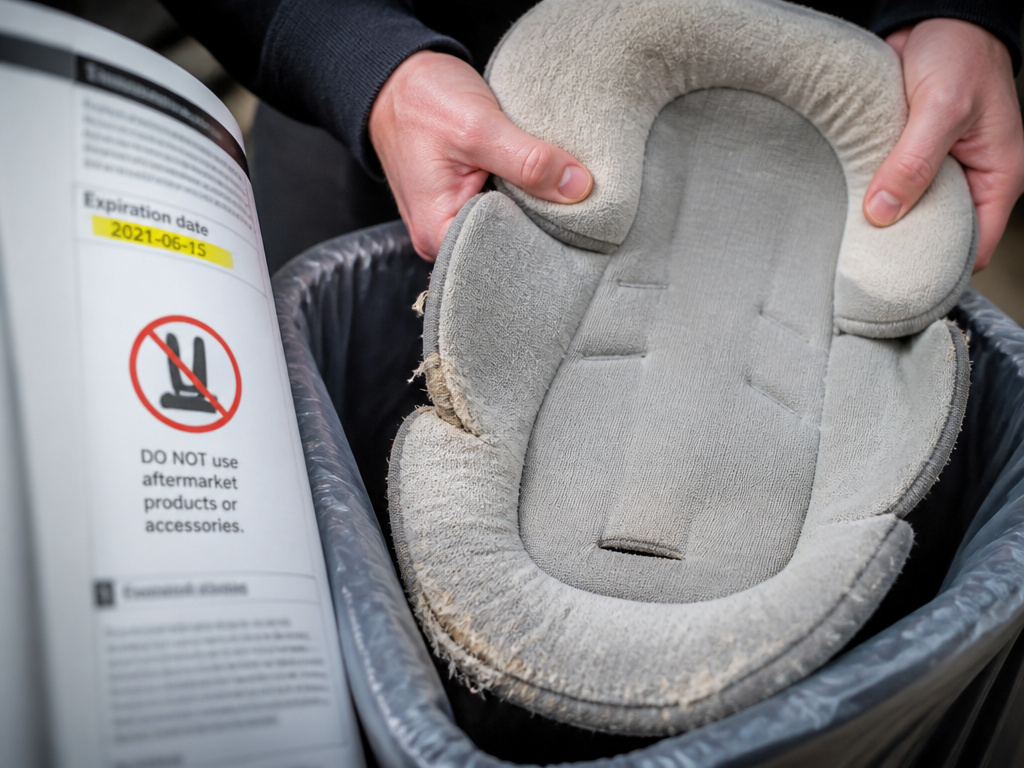
Some rules have no exceptions. They are the bright lines that separate safe use from a violation.
Never use an aftermarket insert. Not a cozy head supporter from Etsy, not a memory foam pad from Amazon, not a rolled-up receiving blanket. The safety risks of inserts that aren’t crash-tested with your specific seat are twofold. First, they add compressible material between the child and the harness, creating slack in a crash. Second, they can interfere with the buckle or harness path, preventing a proper lock. The manual for every seat cited here has a version of this warning. Using one voids any warranty and, more importantly, the seat’s safety certification.
Respect the expiration date. The UPPAbaby MESA V2 manual states: “Discontinue use of this child restraint after 7 years from the date of manufacture or after a crash.” The Chicco Fit3x manual points to the “Do Not Use After” date on the label. This includes the insert. The plastics and foams degrade with heat, cold, and time. A 10-year-old insert is a 10-year-old piece of safety equipment, it’s not reliable.
Replace the entire seat after a moderate or severe crash. The National Highway Traffic Safety Administration (NHTSA) criteria are in the Nuna REVV manual. If the crash doesn’t meet all the conditions for a “minor” crash, the seat is compromised. The insert didn’t bear the load, but the seat’s structure did. Bin it.
Special Cases: Premature Babies and Airplane Travel
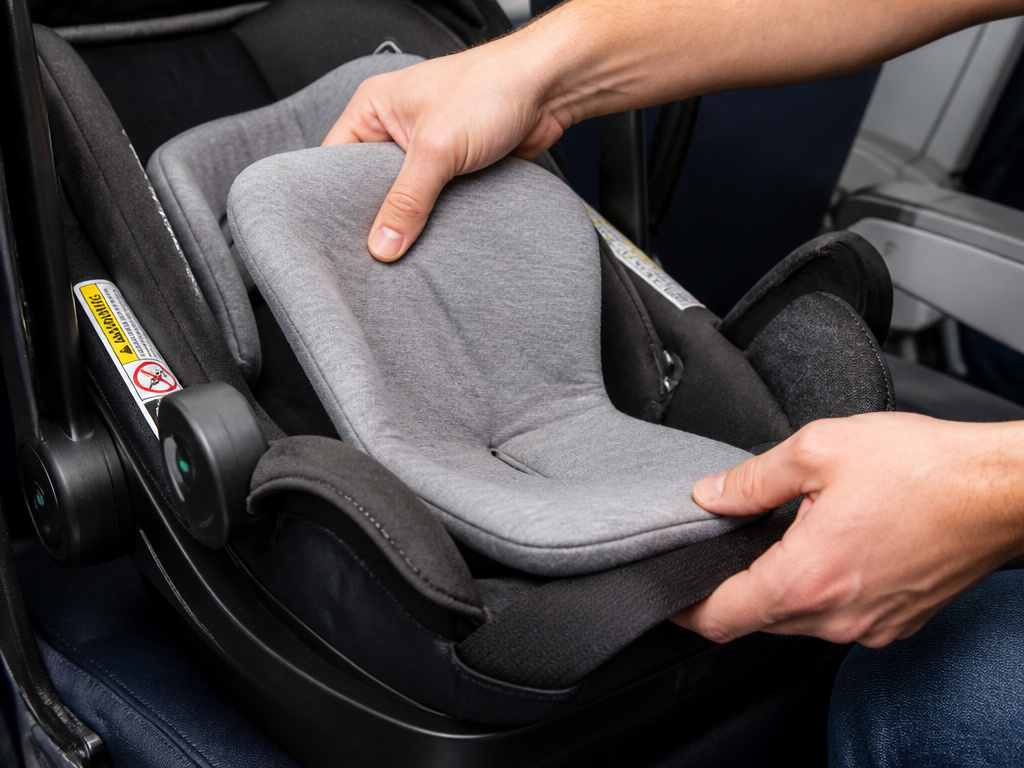
The standard guidelines assume a full-term infant. For preemies, the Chicco Fit3x manual provides the only rule you need: “For premature infants, you must consult the infant’s doctor before using this car seat.” Their muscle tone and airway development are different. The doctor may advise using the insert longer, or may recommend a car bed. This is not a DIY decision.
For airplane travel, the rule changes again. The UPPAbaby MESA Max manual is clear: “DO NOT use base with aircraft installation. Only the carrier is certified for aircraft use.” If your child has exceeded the insert’s weight limit, you must remove the newborn padding before you fly. You install the carrier directly onto the airplane seat using the aircraft lap belt. The goal is the same, a secure, proper fit without the base.
Frequently Asked Questions
Can I just leave the insert in for extra comfort?
No. Comfort is a secondary benefit. The insert is a safety device for achieving correct fit. Once it prevents correct fit, it becomes a hazard. Aftermarket comfort accessories are not approved and are dangerous.
My 10-pound baby seems fine without the insert. Can I take it out?
Maybe. Run the 4-point fit test. If the harness is at/below the shoulders, the chest clip is at armpits, the back is flat, and the crotch buckle is secure, you can remove it. For strict models like the Nuna REVV, you must wait until 11 lbs.
What do I do with the insert once it’s removed?
Store it with the manual. You might need it for a future child, or if you sell or give away the seat, all original parts should be included. Do not throw it away.
Is the “newborn insert” the same as the “infant insert”?
Usually, yes. Manufacturers use the terms interchangeably. However, as with the Cybex ATON 2, sometimes “newborn inlay” refers to a specific foam piece, and “infant insert” refers to the padded upper body support. Your manual clarifies.
Why do some seats have a higher weight limit for the insert?
Seat shell design. A seat with a deeper shell or different harness geometry can safely use padding with a larger child. This is why you cannot swap inserts between models. The best infant insert for your seat is the one that came with it.
Before You Go
The decision to remove the infant insert hinges on two documents: your car seat’s manual and your child’s growth. The 11-pound rule is a helpful marker, but the fit test is the final exam. Never add padding that didn’t come with your seat, and remember that expiration dates and crash replacement rules don’t care if the insert looks fine. When in doubt, the manual holds the answer written for your exact model. Use it.
