
Guide: When to Take Your Infant Car Seat Insert Out
This post contains affiliate links. As an Amazon Associate, we earn from qualifying purchases.
Remove the infant car seat insert when your child reaches the weight limit specified in your seat’s manual, which is most commonly 11 lb (5 kg). This is not a universal rule—some seats, like the Cybex Aton 2, allow the insert until 22 lb (10 kg), while convertible seats like the Graco 4Ever have different rules for its body support. Never use an infant insert in forward-facing mode.
That 11 lb figure is printed in manuals for seats like the Joie Saffron SI and Nuna REVV. It’s a hard stop, not a suggestion. But if you just search for a generic answer, you’ll miss the seats that break the pattern and the specific signs that matter more than the scale.
What follows is a breakdown of the numbers from five manufacturer manuals, the physical cues that trump the manual, and the one mistake that turns a safety aid into a hazard.
Key Takeaways
- The most common removal threshold is 11 lb (5 kg), as stated in manuals for the Joie Saffron SI, Nuna REVV, and Nuna EXEC.
- The Cybex Aton 2 manual allows its infant insert until 22 lb (10 kg), a major exception that proves you must check your own manual.
- Never use an infant insert when the car seat is forward-facing. The Joie Saffron SI manual explicitly forbids it.
- If your child’s shoulders are cramped against the insert or their head is pushed forward, it’s time to remove it—even if they’re under the weight limit.
- After removal, a slight head slump is normal; use rolled receiving blankets on the sides for support, not aftermarket head cushions.
The 11 lb Rule Isn’t Universal (Check Your Manual)
Look up your model. The number is in the manual, and it’s not a suggestion.
For the Joie Saffron SI, the manual states the infant insert “MUST be removed once the child reaches 11 lb. (5 kg).” The Nuna REVV and Nuna EXEC manuals set the same 5–11 lb (2.3–5 kg) range for insert use. The language is definitive: “DO NOT use the insert for a child who weighs more than 11 lb.”
Common mistake: Assuming all seats follow the 11 lb rule. The Cybex Aton 2 manual recommends using its infant insert “until 22 lb (10 kg) or until child needs more room.” That’s double the weight allowance of a Nuna seat.
This variance stems directly from different shell designs, harness geometries, and safety testing protocols. Using a Nuna insert past 11 lb or removing a Cybex insert at 11 lb when it’s rated for 22 lb are both deviations from the tested safety standard.
| Car Seat Model | Infant Insert Weight Limit | Manual Directive |
|---|---|---|
| Joie Saffron SI | 11 lb (5 kg) | “MUST be removed once the child reaches 11 lb.” |
| Nuna REVV | 11 lb (5 kg) | “DO NOT use the insert for a child who weighs more than 11 lb.” |
| Nuna EXEC | 11 lb (5 kg) | “The infant insert MUST be used for a child weighing between 5–11 lb and must NOT be used otherwise.” |
| Cybex Aton 2 | 22 lb (10 kg) | “We recommend using the Infant Insert until 22 lb (10 kg) or until child needs more room.” |
| Graco 4Ever 4-in-1 | 20 lb (9 kg) for head/body support | “The infant head support and infant body support can only be used for children weighing 20 lb (9 kg) or less.” |
The table makes the point visually: you cannot know without looking. If you’ve lost your manual, search for the PDF online using your seat’s exact model name and number. This is the first step in any responsible guidelines for removing the newborn insert.
Is It an Infant Insert or a Newborn Inlay? (Know the Difference)
Some seats have two pieces of added padding, and they serve different purposes. Confusing them means removing the wrong part too early or leaving the wrong part in too long.
The infant insert is typically a U-shaped pad that cradles the baby’s torso and head. Its job is to position a small infant correctly within the shell so the harness straps fit snugly over the shoulders. This is the piece with the weight limit discussed above.
The newborn inlay (or “infant body support” in some manuals) is a thinner, flat piece of foam that sits under the seat cover. It raises the baby’s bottom to improve the recline angle and prevent slouching. The Cybex Aton 2 manual calls this a “Newborn Inlay” and recommends its use “until your child is 11 lb (5 kg).”
Where this goes sideways: Pulling out the thick infant insert but leaving the flat newborn inlay in place, wondering why your baby still seems perched too high. Or, removing the inlay at 11 lb but leaving the insert in because the baby still fits. Check your manual for both.
The Graco 4Ever manual calls its version an “infant body support” and mandates it be used for all children 40 lb or less in rear-facing mode—a completely different function from a typical infant insert. This is why understanding the specific purpose of the insert in your seat is non-negotiable.
The Physical Signs That Say “Remove It Now”
The scale gives you a number. Your eyes give you the context. If the weight limit is a guardrail, the fit check is the road.
You need to remove the insert before the weight limit if you see any of these three signs:
- Shoulders are crammed. The baby’s shoulders press firmly against the side wings of the insert. You shouldn’t have to squeeze them in.
- Head is pushed forward. The insert is so thick that it positions the baby’s head in a “chin-to-chest” posture. This can compromise the airway.
- Harness fit is off. You cannot get the harness straps snug and flat over the shoulders because the insert is in the way.
The Reddit thread for the Evenflo Pivot system captures this perfectly. Parents reported their 13–14 lb babies looking “tight” with shoulders not fitting, but they feared removing it because “his head flops over more than seems safe.” That’s the dilemma. The manual was unclear, so they were stuck between a bad fit with the insert and perceived instability without it.
In that scenario, the cramped fit is the higher-priority warning. The head slump has a safer fix than the compression. This is a classic case where the developmental milestones for insert removal are about physical size, not just calendar age or weight.
How to Check Fit After You Remove the Insert

The head flop is what scares parents back into keeping the insert too long. It’s a normal adjustment period.
When you take the insert out, the shell will feel cavernous. Your baby will have more side-to-side room. A slight head tilt to the side is expected and is not a safety risk in a properly installed rear-facing seat. What you’re checking for is a severe chin-to-chest slump that could block breathing.
Here’s how to secure your child and assess the new fit:
- Place your child in the seat without the insert. Buckle the harness.
- Perform the pinch test on the harness straps at the collarbone. If you can pinch a vertical fold of webbing, it’s too loose. Tighten until the strap is smooth.
- Check that the chest clip is at armpit level. A low clip is useless in a crash.
- Look at the head position. If it’s lolling severely to one side, you can use small, tight rolls of receiving blankets placed on either side of the head for support. Do not place anything behind the head, under the baby, or between the baby and the harness straps.
This manual adjustment is the approved, safe method. It is the alternative to risky aftermarket products. For more on this, see our guide on techniques to keep the head up.
The One Forward-Facing Rule You Cannot Break
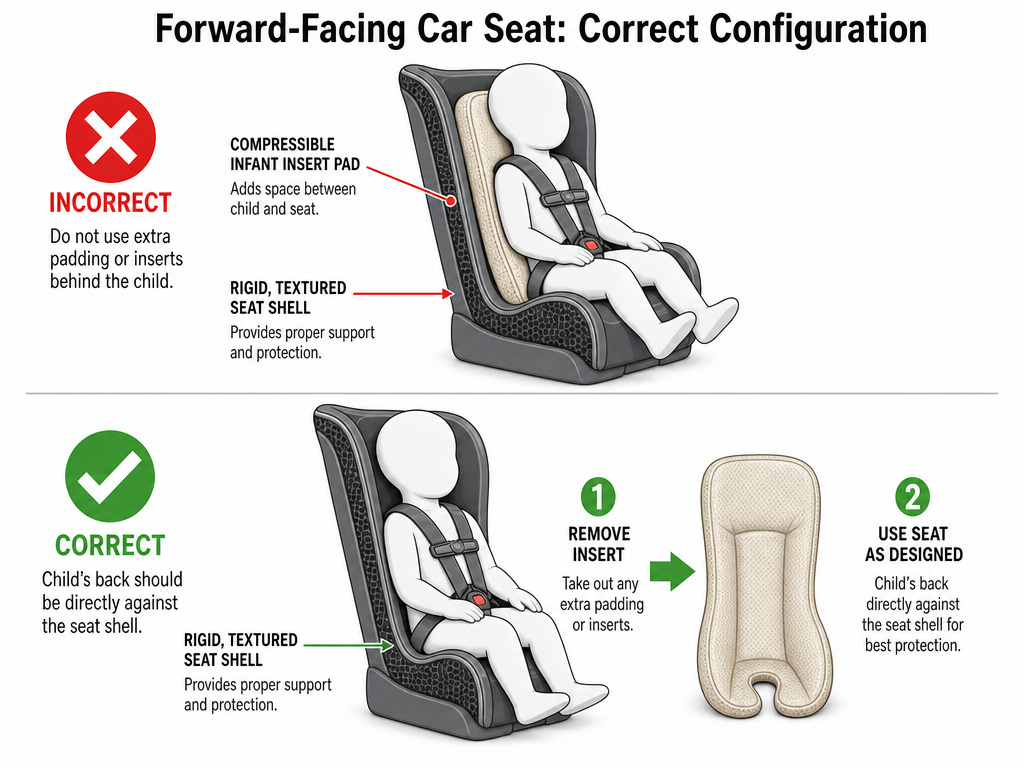
This distinction is a bright line.
Infant inserts are for rear-facing use only. The Joie Saffron SI manual explicitly states, “NEVER use the infant insert when forward-facing.” When you switch the seat to forward-facing mode, the insert comes out regardless of the child’s weight.
The physics are simple. In a frontal crash (the most common and severe type), a forward-facing child is thrown forward into the harness. An infant insert adds compressible padding between the child’s back and the seat shell. This creates extra space for the child to ramp up speed before the harness catches them, increasing the force on their neck and spine. The seat’s safety testing did not account for that extra space.
Never use an infant insert when forward-facing. The tested safety geometry of the seat assumes the child’s back is directly against the rigid shell.
If you’re using a convertible seat like the Graco 4Ever, note that its “seat insert” (a different part) has its own rules: it must be installed for rear-facing use and must be removed for booster mode. This again underscores the necessity of model-specific knowledge. Never assume the safety of inserts translates across all modes of use.
What If Your Manual Is Missing or Unclear?
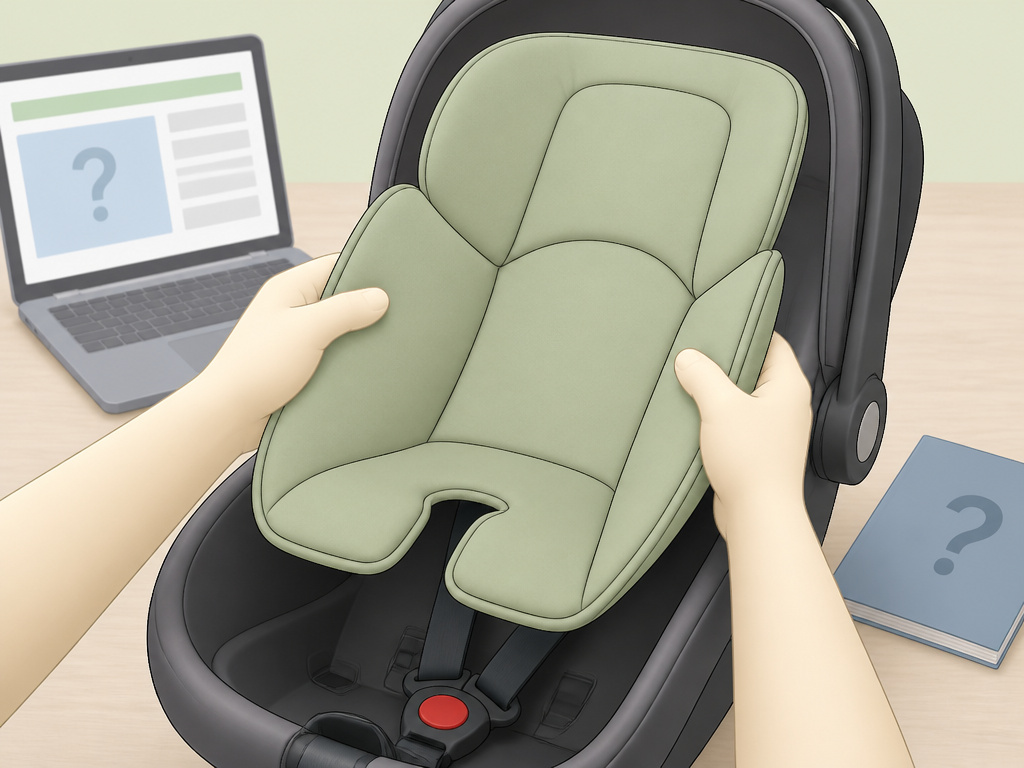
You emailed the manufacturer. You searched online. The PDF for your exact model doesn’t exist. Now what?
First, try to find the manual for the closest model. An Evenflo LiteMax DLX manual is better than nothing, but note any differences in parts. Second, use the universal signs of outgrowing the insert (cramped shoulders, forward head push) as your guide. When in doubt, remove it. A slightly roomier fit is safer than a definitely restrictive one.
Finally, get a professional opinion. Many fire stations, police departments, and hospitals offer free car seat safety checks by certified technicians. They can assess the fit with and without the insert and give you a definitive answer. This is the best step when you’re caught between unclear instructions and a baby who seems between sizes.
This proactive approach is always better than guessing, especially when it involves non-approved inserts or missing information.
Frequently Asked Questions
My baby is 10 lb but seems cramped. Should I remove the insert early?
Yes. The weight limit is a maximum, not a minimum. If the insert is compressing the shoulders or pushing the head forward, take it out. A proper harness fit on the child’s body is the primary safety system; the insert is just a positioning aid.
The insert says “for infants up to 12 lb” but my manual says 11 lb. Which do I follow?
Always follow the manual. The text on the insert itself is often a general guideline for a product line. The manual contains the specific, legally relevant instructions for your model that were validated during safety testing.
Can I use a aftermarket head support pillow after I remove the insert?
No. Aftermarket products that go behind the head, under the baby, or between the baby and the harness are not crash-tested with your seat. They can interfere with harness tightening and create compressible space in a crash. Use only manufacturer-approved padding, which for most seats means the insert itself and nothing else.
My convertible seat has a “body support.” Is that the same as an infant insert?
Not necessarily. As the Graco 4Ever manual shows, a “body support” or “seat insert” in a convertible seat often serves a structural role for rear-facing positioning and has a much higher weight limit (40 lb). It is not the same as the plush infant insert in a bucket seat. Check your manual for its specific definition and rules.
Before You Go
The answer is the specific number in your manual—be it 11 lb, 22 lb, or 20 lb—combined with the physical evidence of a bad fit. Ignore the weight limit, and you risk compressing your child in a crash.Ignore the fit cues, and you risk the same.
Pull your manual. Find the section on the infant insert or newborn support. Note the weight, note the mode restrictions, and then look at your child. If the shoulders are tight or the head is jutting forward, the decision is already made. When you take it out, secure the harness snugly, accept a slight head tilt, and never put that insert back in if you turn the seat forward-facing.
That’s the sequence. It turns a vague worry into a five-minute task with a known outcome.
