
Are Car Seat Ponchos Safe? | The NHTSA’s Two-Page Answer
This post contains affiliate links. As an Amazon Associate, we earn from qualifying purchases.
A car seat poncho is safe only if it is worn over a properly tightened harness, never underneath it, and if it is independently certified (like CPSC/CPSIA) and crash-tested. No federal safety standard directly regulates aftermarket covers, but adding any material between the child and the harness creates slack—Transport Canada linked this exact failure mode to infant fatalities in two separate collisions.
That “slack” is the mechanical heart of the problem. A car seat harness works by holding the child tightly against the seat’s structure during a crash. Any compressible material—a snowsuit, a thick blanket, or an improperly used poncho tucked under the straps—gets compressed on impact. That compression creates inches of slack in the harness system in milliseconds. The child can then be ejected or suffer severe head impact.
What follows is the regulatory framework that defines the risk: two key NHTSA interpretations, the manufacturer warnings you must heed, and the physical test that separates a safe wearable blanket from a dangerous accessory.
Key Takeaways
- No FMVSS directly regulates aftermarket car seat covers or ponchos. Federal Motor Vehicle Safety Standard (FMVSS) No. 213 applies to the child restraint itself, not accessories sold separately.
- Adding compressible material behind the child is a documented cause of injury and death. Transport Canada’s investigation of two fatal collisions found aftermarket products that created harness slack were a contributing factor.
- The legal onus shifts based on who installs the cover. If a consumer adds a cover, it doesn’t need to meet flammability standards. If a dealer or manufacturer installs it, it must.
- A truly safe poncho is a wearable blanket, not an accessory to the seat. It must be placed over the child after the harness is snugly tightened, with no material under the straps or behind the child’s back.
- Car seat manufacturers universally warn against aftermarket additions. Manuals from brands like Evenflo explicitly state: “DO NOT attach additional padding, toys or other devices not made by Evenflo.”
The Two Federal Interpretations That Frame the Risk
The legal landscape for car seat ponchos is defined by absence and warning. There is no Federal Motor Vehicle Safety Standard (FMVSS) that directly applies to an aftermarket car seat cover. This is the core finding of the NHTSA child seat cover interpretation from March 13, 2006. FMVSS No. 213 governs the child restraint system itself for children under 65 pounds, but it “does not apply to accessory items, such as a cover that is used with a child restraint system.”
The NHTSA’s 2006 interpretation states that while no FMVSS applies to an aftermarket cover, the product is still considered motor vehicle equipment. This makes the manufacturer subject to recall laws if a safety-related defect is found.
However, the agency immediately layers on crucial caveats. The cover must not obscure warning labels (like the airbag warning). It also should not degrade the child seat’s compliance with FMVSS No. 302 for flammability resistance. This last point gets a deeper ruling in a separate NHTSA slip-on seat cover interpretation.
That 2008 letter draws a critical legal line. If a consumer buys and installs an aftermarket cover themselves, the cover does not need to meet FMVSS 302 flammability standards. But if a manufacturer, dealer, distributor, or repair business installs that same cover, they are legally required to ensure it meets the standard. Installing a non-compliant cover in a commercial context “renders inoperative” the seat’s original compliance, a violation of federal law.
| Scenario | Must Meet FMVSS 302 Flammability Standard? | Who is Legally Responsible? |
|---|---|---|
| Cover purchased & installed by vehicle/seat owner | No | Consumer (but subject to product defect recall laws) |
| Cover installed by dealer, manufacturer, or repair shop | Yes | The commercial entity installing it |
The takeaway isn’t that flammability is the only risk. It’s that the federal framework treats these products as potential interferers. Their primary safety question is whether they undo the certified performance of the original seat.
Why Slack in the Harness is a Fatal Design Flaw
The warnings in car seat manuals aren’t theoretical. Transport Canada investigated two separate collisions where aftermarket products “may have contributed to the serious injury and/or death of the infants.” Their conclusion points to a single, physical failure mode: induced slack.
A car seat harness must be snug. The classic test is the “pinch test” – if you can pinch a vertical fold of the harness strap at the child’s collarbone, it’s too loose. Bulky winter coats, padded seat inserts, and ponchos tucked under the straps all add compressible material between the child’s body and the harness webbing.
In a crash, forces measure in the multiples of gravity. That fluffy padding compresses instantly.
Where this goes sideways: A one-inch thickness of compressible fleece or down can compress to a quarter-inch under crash forces. That creates over three inches of slack in the harness system. In a frontal collision, that slack allows the child’s body to travel farther forward before the restraint engages, dramatically increasing the risk of head injury or partial ejection.
This is why the Evenflo LiteMax manual states: “In cold weather, DO NOT dress the child in bulky clothing, like snowsuits, if the child is riding in a child restraint. This clothing makes it difficult to properly tighten the harness.” The same principle applies to any material under the straps.
What a Safe Poncho Actually Looks Like (and What to Buy)
A safe car seat poncho functions as a wearable blanket, not a seat modification. The child is buckled into the seat directly over their base layers (a thermal shirt and pants, for example). The harness is tightened to pass the pinch test against this thin clothing. Then the poncho is draped over the child’s head and the entire harness, lying on top like a cape.
The back of the poncho should be lifted up and over the top of the car seat shell, so no significant material is behind the child’s head or back. This ensures zero compressible material is in the restraint path.
The Birdy Boutique Car Seat Poncho is the most cited example of a product designed this way. It is marketed as CPSC/CPSIA certified and claims to have been independently crash-tested. The key is its design: it’s a blanket with a head hole, not an accessory that integrates with the seat.
| Safe Poncho Feature | Why It Matters | Red Flag If Missing |
|---|---|---|
| Worn over the tightened harness | No material under straps to compress | Instructions show child sitting on poncho or poncho under arms |
| Loose, blanket-like drape | Does not restrict harness straps or re-route them | Has sleeves, armholes, or a fitted back |
| Lightweight, compressible fabric (e.g., fleece) | Minimizes bulk and potential slack even if draped incorrectly | Uses thick, padded, or quilted materials |
| Independent safety certification (CPSC/CPSIA) | Third-party validation of flammability and general product safety | No mention of testing or certification |
You can find a safe car seat poncho that meets these criteria. The alternative is a dedicated car seat safe coat that opens fully down the front and sleeves, allowing the harness to pass directly against the child’s clothes.
The Manufacturer Warnings You Cannot Ignore
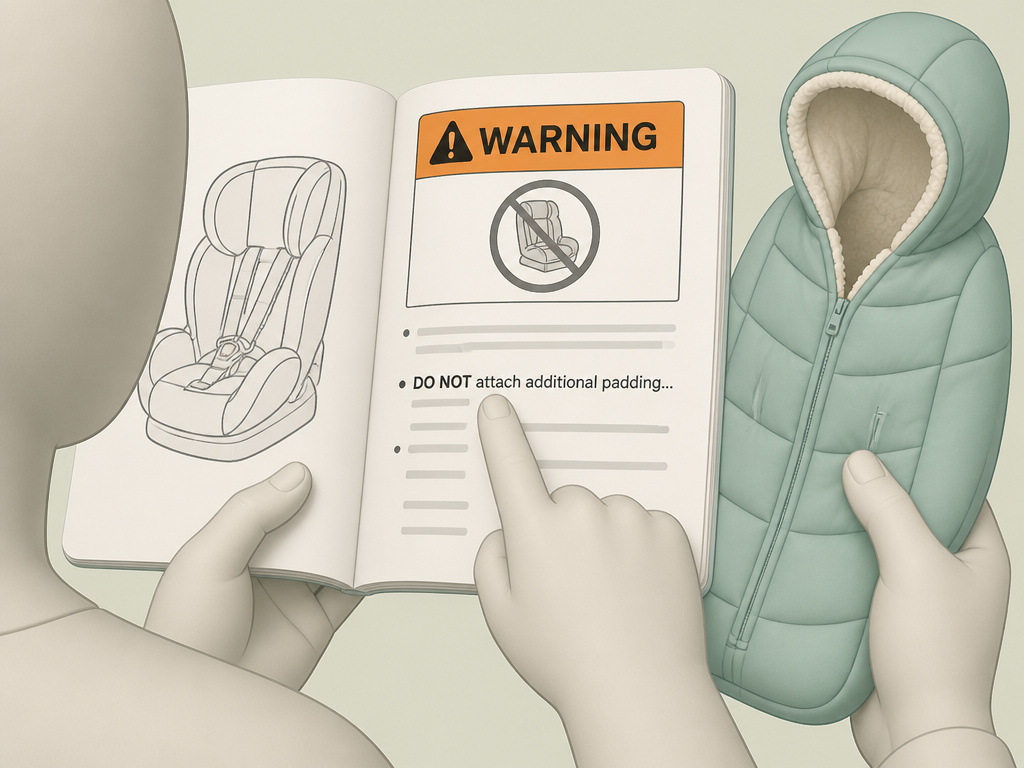
Car seat manufacturers are unequivocal. They design and crash-test their seats with the components they supply. Adding anything they didn’t include voids their testing and, often, their warranty.
The Evenflo manual is blunt: “DO NOT attach additional padding, toys or other devices not made by Evenflo, or described in these instructions, to the child restraint.” This warning covers head supports, body inserts, car seat blanket pads, and yes, ponchos that attach to or are used under the harness.
This stance is about liability and physics. A car seat insert or head support can alter the harness routing path over the child’s shoulders. Even a slight shift can create slack or cause the straps to sit off the collarbone. In a crash, the harness could load incorrectly, increasing the risk of injury.
The same logic applies to winter car seat cover products that bundle the entire seat. If they push the child forward or create padding behind the back, they introduce compressibility. Your first and last stop should always be the manual for your specific seat model.
How to Use a Poncho Safely: A 4-Step Checklist
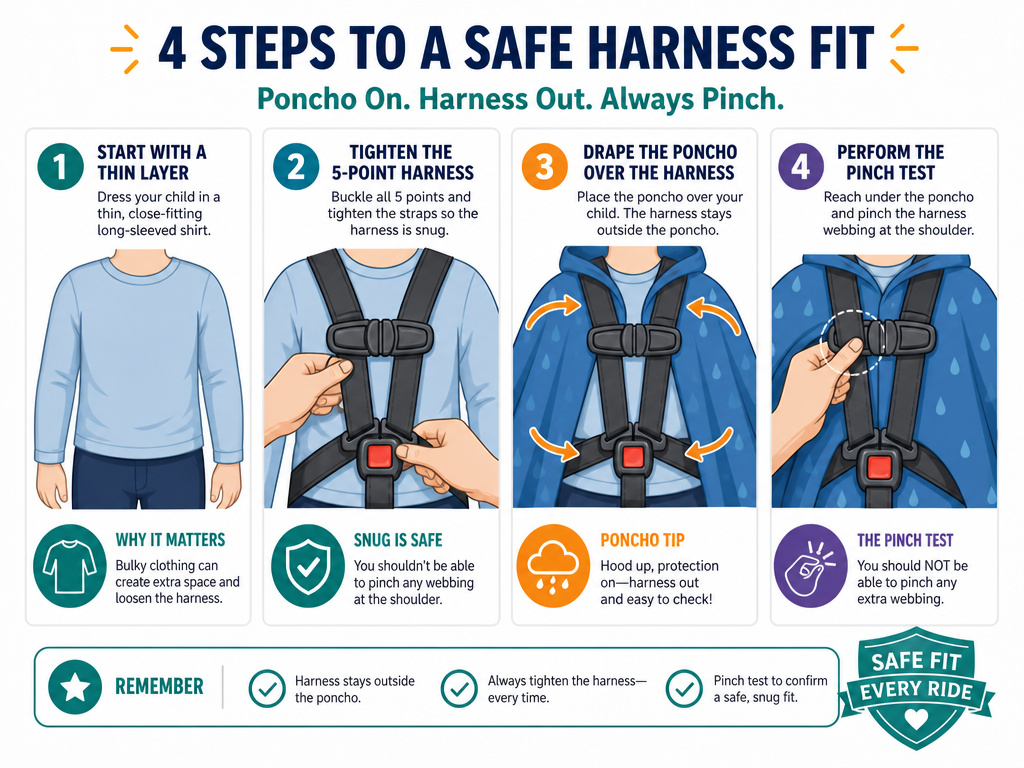
If you choose a certified poncho like the Birdy Boutique, correct use is non-negotiable. Follow this sequence every single time.
- Dress the child in thin, tight layers. Use thermal underwear, leggings, and a long-sleeve shirt. Avoid sweaters or hoodies with bulky fabric. This is the layer the harness will tighten against.
- Secure the child in the seat. Buckle the harness and tighten it until it passes the pinch test over the child’s thin layers. The chest clip should be at armpit level.
- Drape the poncho over the harness. Put the poncho on like a cape, over the child’s head. Ensure the entire harness (straps, buckle, and chest clip) is on the outside of the poncho. Lift the back of the poncho up and over the car seat shell.
- Perform a final harness check. Reach under the poncho at the child’s shoulders and chest. Verify you cannot pinch the harness straps. Re-tighten if necessary.
Never use the poncho as a substitute for a coat when outside the car. It is a car-specific garment. For outdoor warmth, use a separate winter car seat coat or layer the poncho over a light jacket that is removed before buckling.
Frequently Asked Questions
Do car seat ponchos work with infant carriers?
Yes, the principle is identical. Buckle the infant into the carrier wearing only thin layers. Tighten the harness snugly. Then drape the poncho over the baby and the harness, pulling the back up and over the carrier shell. Never place any material from the poncho between the infant’s back and the carrier insert.
Are car seat ponchos safer than winter coats?
Properly used, certified poncho is safer than a bulky winter coat worn under the harness. However, a thin, fleece jacket that passes the “coat test” (the harness is just as tight with or without the jacket) can be equally safe. The poncho’s advantage is convenience—you don’t have to remove it to achieve a safe harness fit.
What about snow pants in the car seat?
Snow pants pose the same risk as a bulky coat: compressible material under the harness straps, especially at the hips and thighs. If the pants are thin and flexible, they may be okay. Thick, padded snow bibs are a hazard. The safest practice is to remove them or use a poncho that covers the legs without going under the child.
Can I use a regular blanket instead?
Loose blanket placed over a properly secured child is generally safe, as it poses no compression risk. The problem is that blankets slip off, leaving a cold child. A poncho stays in place. The danger comes from tucking a blanket around the child under the harness straps or behind their back, which creates the compressible layer.
Have car seat ponchos been recalled?
There is no widespread federal recall of car seat ponchos as a category. Individual products could be recalled if a specific defect is found, such as a choking hazard from detachable parts or a flammability issue. This underscores the importance of choosing a product with stated CPSC/CPSIA certification, which indicates baseline safety testing.
Before You Go
The safety of a car seat poncho hinges entirely on its use. No accessory is worth compromising the harness fit that took engineers thousands of crash tests to perfect. The federal guidance is clear: these products exist in a regulatory gray area, with the burden of safe use falling on you.
Stick to the rule of nothing compressible under the harness. Choose a certified poncho designed as an over-the-harness cape. And always, always consult your car seat’s manual first—their warning against aftermarket additions is there for a reason documented in real-world tragedies. For everything from car seat cover risks to car seat protector guidelines, the principle is the same: the seat as certified is the safest seat.
