
Putting a Newborn in a Car Seat from the Hospital: A Guide
This post contains affiliate links. As an Amazon Associate, we earn from qualifying purchases.
To put a newborn in a car seat from the hospital, you must pass a state-mandated car seat challenge: a 90 to 120-minute observation where hospital staff monitors your baby’s breathing and heart rate while properly secured in your own rear-facing seat. The harness straps must be at or below the shoulders, the chest clip at armpit level, and the seat reclined to about 45 degrees. For babies under 5 lbs or born before 37 weeks, this test is not optional, it’s a required medical screening before discharge.
That 90-minute window is where the real screening happens. It’s not just a formality. Hospitals use a pulse oximeter to watch for oxygen drops below 90% or a heart rate under 80 beats per minute for more than 10 seconds. A fail here means your baby’s cardiorespiratory system can’t handle the semi-upright position of a standard car seat yet.
What follows is the breakdown of that mandatory test, the precise way to position your newborn to pass it, and what your actual options are if the monitor alarms. We’ll cover the hospital’s protocol, your step-by-step role, and the backup plans nobody talks about until the screen flashes red.
Key Takeaways
- The car seat challenge is a 90–120 minute monitored test, not just a car seat check. Its pass/fail criteria are specific: oxygen saturation staying above 90% and heart rate above 80 bpm.
- Harness fit is non-negotiable. Straps must be at or below the shoulders, the chest clip at armpit level, and you should not be able to pinch any slack at the collar.
- Preterm and low-birth-weight infants (under 37 weeks or 5 lbs) are at the highest risk of failing. The American Academy of Pediatrics mandates they be evaluated before any car trip.
- A failed challenge does not mean you’re stuck in the hospital. The next step is usually a car bed, a flat, crash-tested alternative for babies who need to lie down during travel.
- Never add aftermarket head supports or padding. These can introduce slack into the harness system and are not safety-tested with the seat.
What Is the Hospital Car Seat Challenge?
It’s a monitored stress test for your baby’s breathing, not a demonstration of how to install a car seat. Every U.S. State requires a properly used child restraint for discharge, but the challenge is the hospital’s method to fulfill the AAP’s recommendation for high-risk infants. Staff will observe your newborn, connected to a pulse oximeter, in your own car seat for the duration of your expected car ride home, or a minimum of 90 minutes.
The goal is to catch episodes of desaturation (oxygen drop) or bradycardia (slow heart rate) that can occur when a newborn, especially a preterm one, sits semi-upright. Their airway can become obstructed if their head slumps forward. This clinical assessment for car seat safety found preterm infants fail this testing 11% to 60% of the time.
The Brigham and Women’s car seat challenge protocol defines a failure as oxygen saturation falling below 90% for 10 seconds or more, or a heart rate dropping below 80 beats per minute for 10 seconds. The baby is immediately removed from the seat if this happens.
Where this goes sideways: Assuming the nurse is just checking your car seat installation. They are watching a monitor, not the latch connectors. Their primary focus is the number on the screen, not the tightness of the belt path.
Who Has to Take the Test? (It’s Not Everyone)
While all babies go home in a car seat, not every newborn nursery performs a formal challenge on every infant. The policy targets specific high-risk groups. You can expect a mandatory challenge if your baby fits any of these criteria:
- Gestational age under 37 weeks at birth.
- Birth weight under 5 pounds (2.3 kg).
- Diagnosed cardiorespiratory conditions (like chronic lung disease) or neurological concerns (like hypotonia).
- Hospital policy. Some institutions, following the most conservative interpretation of guidelines, test all NICU graduates or even all newborns.
The Canadian Paediatric Society explicitly does not recommend routine testing for all preterm infants, citing insufficient evidence. In the U.S., the AAP’s guidance drives most hospital policies, making the test standard for the preemie population. If your baby is full-term, healthy, and over 5 lbs, the staff will likely do a visual check of your properly installed infant car seat but may forgo the prolonged monitoring.
| Scenario | Likely to Need Formal Challenge? | Reason |
|---|---|---|
| Baby born at 35 weeks, 4.5 lbs | Yes | Meets both preterm and low-birth-weight criteria. |
| Baby born at 41 weeks, 7 lbs, with a heart murmur | Maybe | Depends on hospital policy and pediatrician’s assessment. |
| Baby born at 39 weeks, 8 lbs, no complications | No | Typically receives a visual safety check only. |
The 5-Point Pre-Charge Checklist
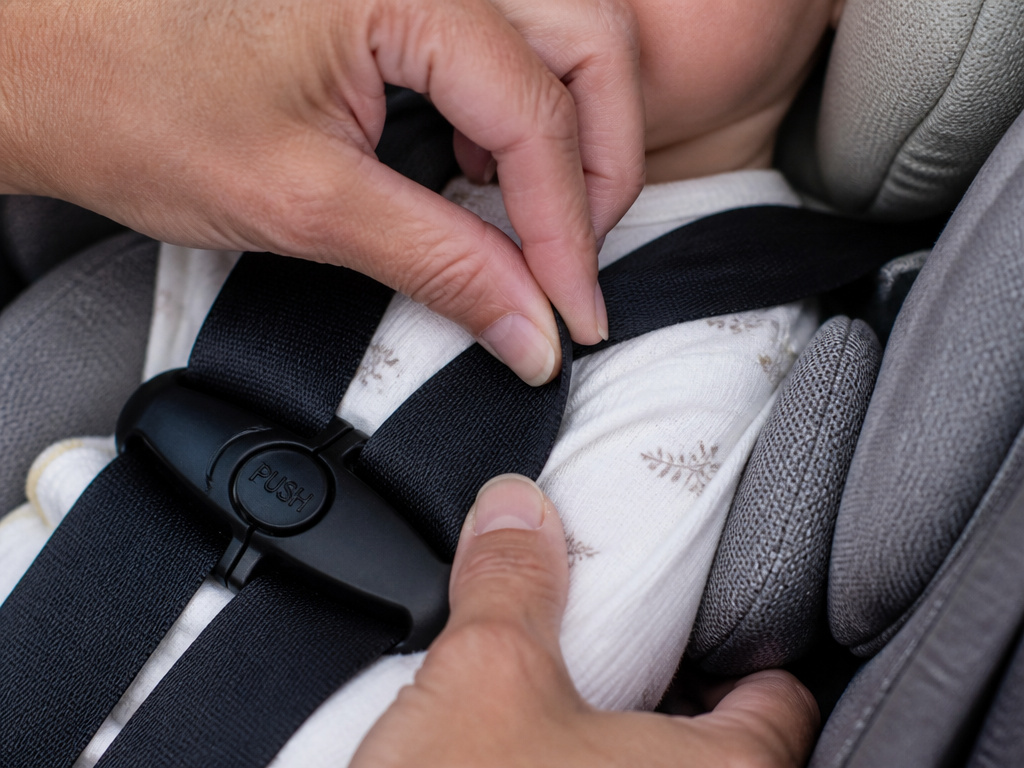
Before the clock starts on the 90-minute test, you and the nurse will run through this setup. Get any of these wrong and the test is compromised.
1. Use Your Actual Seat. The challenge must be done in the exact car seat, with the exact insert, that the baby will ride home in. Don’t borrow a hospital demo model.
2. Assemble It Yourself. You will be asked to put a newborn in a car seat as you would at the car. This proves you can do it. The nurse guides, but your hands do the work.
3. Achieve the 45-Degree Recline. This is the safe middle ground, upright enough for crash protection, reclined enough to keep a newborn’s airway open. Most seats have a level indicator; the nurse will help adjust it.
4. Position the Harness Correctly.
- Shoulder Straps: At or below the baby’s shoulders for rear-facing.
- Chest Clip: Level with the armpits, not on the belly or neck.
- Tightness: The pinch test is law. Try to pinch the strap vertically at the collarbone. If you can gather material, it’s too loose.
5. No Aftermarket Stuff. That includes head positioners, strap covers, or buntings not made by your car seat manufacturer. They alter the safety geometry.
Common mistake: Dressing the baby in a bulky snowsuit before harnessing. The puffiness creates deadly slack in a crash. Buckle the harness snugly over thin clothing, then lay a blanket over the secured child.
What Happens If Your Baby Fails?
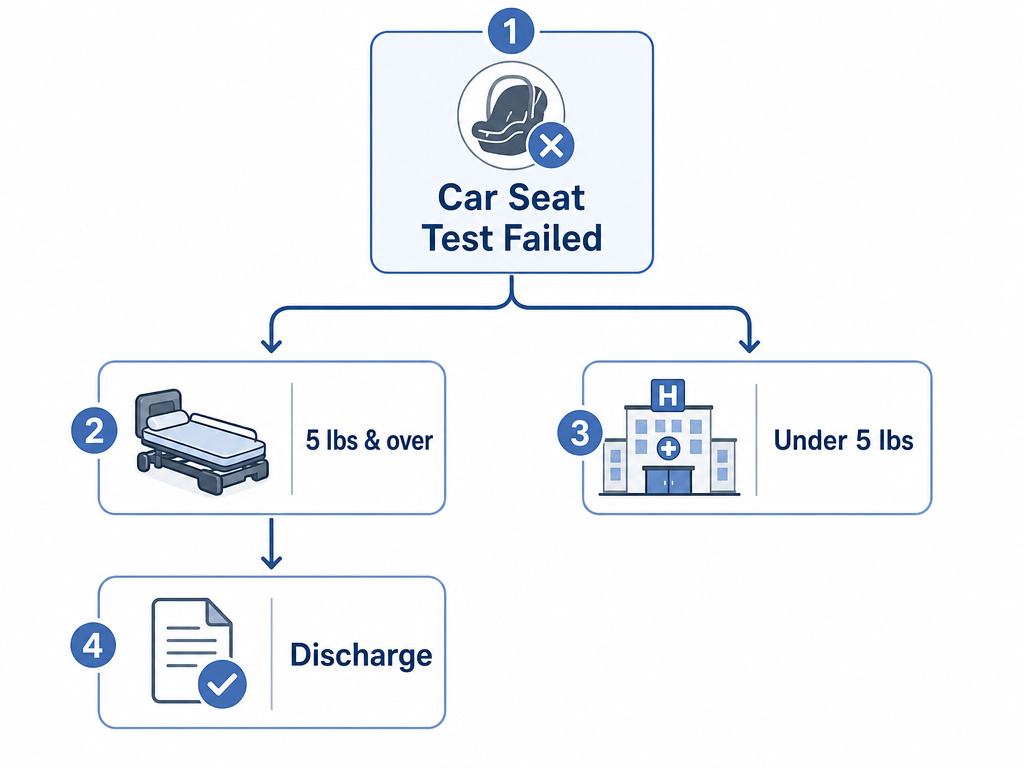
The monitor alarms. The nurse calmly disconnects the probes and lifts your baby out of the seat. This is not a catastrophe; it’s a data point. The protocol for what happens next is strict and depends on one thing: weight.
For babies 5 lbs and over: The immediate step is a car bed challenge. A car bed is a flat, crash-tested restraint where the baby lies supine. If the baby passes monitoring in the bed, they are discharged in it. You’ll get instructions on how to safely secure a newborn in this different device and when to transition to a traditional seat.
For babies under 5 lbs: The path narrows. The hospital will try to locate a car bed rated for under 5 lbs. If one isn’t available, the baby must remain hospitalized until they either gain enough weight or pass a re-challenge of the car seat in 48 hours.
The underlying physiology is clear. A study noted that 18 of 29 babies who failed saw their oxygen levels correct immediately when the seat’s recline was increased from 45 to 30 degrees. But that extreme recline isn’t safe for vehicle travel. The car bed is the engineered solution.
Step-by-Step: Securing Your Newborn for the Ride Home
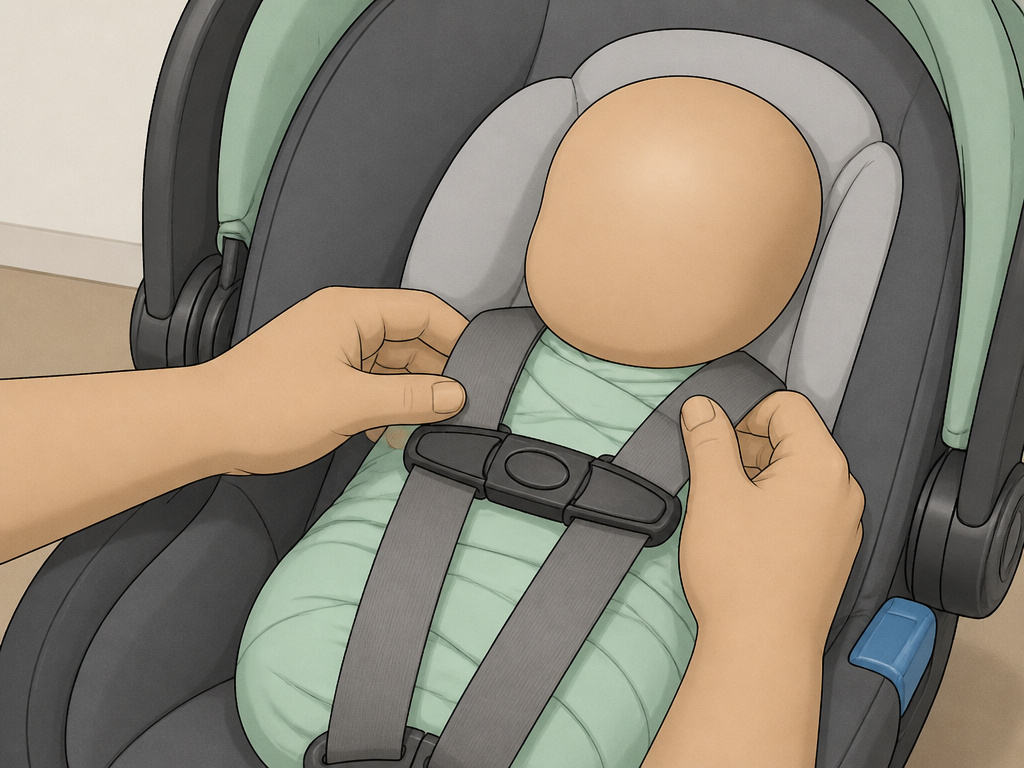
This is the hands-on procedure, once the challenge is passed. It’s how you properly buckle a newborn every single time.
- Place the Seat on a Flat, Stable Surface. The floor next to the car is ideal. Never balance the seat on the vehicle seat while you buckle.
- Unbuckle and Fully Loosen the Harness. Open the chest clip and spread the straps wide to the sides so you have a clear pocket for the baby.
- Position the Baby. Lower your newborn gently into the seat, centering their back and bottom. Ensure their back is flat against the seat back.
- Thread the Harness. Bring each shoulder strap over the corresponding shoulder. Check that the straps are not twisted. A single twist can concentrate force in a crash.
- Buckle and Tighten. Snap the buckle tongues into the crotch buckle. You’ll hear a click. Then pull the harness adjustment strap at the front of the seat until snug. Perform the pinch test.
- Position the Chest Clip. Slide it up until it’s level with the armpits. It should sit on the sternum.
- Check the Head. The baby’s head should not be slumped forward. If needed, use the seat’s built-in newborn insert for support, not a rolled blanket.
The Car Seat vs. Car Bed Decision
Most parents will never see a car bed. But if your baby needs one, understanding the difference is critical. This isn’t about preference; it’s about medical necessity.
| Aspect | Infant Car Seat | Car Bed |
|---|---|---|
| Position | Semi-upright (~45° recline) | Fully flat, supine (lying on back) |
| Best For | Infants with stable cardiorespiratory function. | Infants who fail the car seat challenge due to desaturation. |
| Installation | Rear-facing only, with base or seatbelt. | Usually installed sideways across the vehicle’s back seat, secured with seatbelt. |
| Duration of Use | Until baby outgrows height/weight limits (typically 9-12 months). | Until pediatrician approves transition to a car seat, often around 4-6 months old. |
| Key Limitation | Can cause airway obstruction in preterm/weak infants. | Cannot be used for upright sitting devices (swings, carriers) until transitioned. |
Transitioning from a bed to a seat requires a doctor’s okay. Some hospitals run a follow-up car seat challenge clinical guidelines in an outpatient clinic a few months later.
What If You Don’t Have a Car?
This is the edge case from the Reddit thread. A parent who walks, bikes, or uses public transit faces a bureaucratic wall. Hospital policy is built around motor vehicle law, which mandates a car seat. There is no legal protocol for discharging a baby into a sling or stroller, even if it’s safer for that specific journey.
Your practical path is to still provide a car seat for the “challenge” and discharge paperwork. You then transport the seat home empty, using your preferred infant-carrying method. Be prepared to advocate calmly with the discharge nurse and your pediatrician. The system assumes car ownership, but your necessity of a car seat for hospital discharge is a paperwork necessity, not a functional one in this scenario.
FAQs: The Hospital Car Seat Challenge
Can I use a convertible car seat from day one?
Maybe, but it complicates things. Most hospital policies for using a convertible car seat are wary of them because they are bulkier and harder to get a proper recline for a tiny newborn. If you use one, it must have a low enough weight rating (starting at 4 or 5 lbs) and you must demonstrate a perfect install and harness fit. An infant-only seat is usually smoother.
How do I prevent my newborn’s head from slumping?
Use the seat’s built-in infant padding and ensure the recline angle is correct. After buckling, place small rolled muslin cloths alongside the baby’s head and torso, not behind the neck or back. Never use aftermarket head cushions. Our guide on techniques to prevent a newborn’s head from slumping has specific, safe methods.
Is the semi-upright position safe for a newborn’s spine?
Yes, when the seat is reclined properly. A newborn’s natural spinal curve is a “C” shape. A correctly reclined car seat cradles this curve without putting harmful pressure on the spine. The real risk is airway position, not spinal development. We detail the research on safety of car seats for newborn spinal development in a dedicated article.
What’s the most important feature in a first car seat?
A weight rating that starts at 4 or 5 pounds, and clear, easy-to-use harness adjustment. You will be tightening and loosening those straps multiple times a day. Seats like the Chicco KeyFit 30 or Graco SnugRide SnugLock are popular because their harness systems are straightforward when you’re exhausted. Always apply the essential criteria for selecting a safe infant car seat.
Do I need to bring the base to the hospital?
Not for the challenge. The test can be performed with just the car seat carrier. However, you must know how to install the base in your car before discharge. Practice the LATCH system installation at home before your due date.
Before You Go
The car seat challenge is a medical screening, not a parenting test. Passing it means your baby’s physiology is ready for the unique posture of a car ride. Failing it means you need a different piece of federally approved equipment, a car bed. Your job is to provide the seat, master the harness, and understand the protocol. The hospital’s job is to monitor and interpret.
Remember the sequence: harness at or below shoulders, chest clip at armpits, recline about 45 degrees, and a snug pinch test. That’s the baseline. Everything else, the 90-minute watch, the pulse ox, the car bed pathway, exists because keeping a newborn safe in a car is a two-part problem. It’s crash physics plus infant physiology. The challenge addresses the second part that a perfect installation never could.
